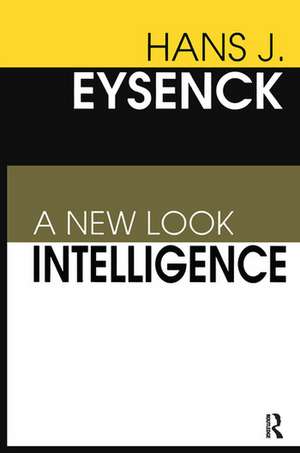
Intelligence: A New Look
Autor Hans Eysencken Limba Engleză Hardback – 15 mar 2018
Hans Eysenck believes these recent developments approximate a general paradigm which could form the
basis for future research. He explores the many special abilities verbal, numerical, visuo-spatial memory that contribute to our cognitive behavior. He examines pathbreaking work on "multiple" intelligence, and the notion of "social" or "practical" intelligence and considers whether these new ideas have any scientific meaning. Eysenck also includes a study of creativity and intuition as well as the production of works of art and science identifying special factors that interact with general intelligence to produce predictable effects in the actual world.
The work that Hans Eysenck has put together over the last fifty years in research into individual differences constitutes most of what anyone means by the structure and biological basis of personality and intelligence. A giant in the field of psychology, Eysenck almost single-handedly restructured and reordered his profession. Intelligence is Eysenck's final book and the third in a series of his works from Transaction.
Preț: 1253.77 lei
Preț vechi: 1528.98 lei
-18%
Puncte Express: 1881
Carte tipărită la comandă
Livrare economică 03-17 decembrie
Livrare prin curier în România Termenul estimat este afișat lângă disponibilitate.
Transport gratuit pentru acest produs Plată online sau ramburs, în funcție de opțiunile comenzii.
Retur gratuit în 14 zile Comandă securizată și suport în română.
Specificații
ISBN-13: 9781138526198
ISBN-10: 1138526193
Pagini: 227
Dimensiuni: 152 x 229 mm
Greutate: 0.59 kg
Ediția:1
Editura: Taylor & Francis
Colecția Routledge
Locul publicării:Oxford, United Kingdom
ISBN-10: 1138526193
Pagini: 227
Dimensiuni: 152 x 229 mm
Greutate: 0.59 kg
Ediția:1
Editura: Taylor & Francis
Colecția Routledge
Locul publicării:Oxford, United Kingdom
V-ar putea interesa
-
 Test Your IQHans J. EysenckPreț: 154.57 lei
 -
 Foundations of MetacognitionMichael J. Beran-31%Preț: 778.17 lei1126.21 lei
 -
 Genius UnmaskedRoberta Ness-9%Preț: 331.77 lei362.68 lei
 -
 What Is Intelligence?James R. FlynnPreț: 240.44 lei
 -
 Smoking, Health and PersonalityHans EysenckPreț: 438.27 lei
 -
 Preț: 468.91 lei
 -
 Genius 101Dean Keith SimontonPreț: 262.76 lei
 -
 Are We Getting Smarter?James R. FlynnPreț: 196.98 lei
 -
 Does Your Family Make You Smarter?James R. FlynnPreț: 193.35 lei
 -
 Maximizing IntelligenceDavid ArmorPreț: 462.35 lei
 -
 The Biological Basis of PersonalityHans Eysenck-15%Preț: 430.67 lei506.67 lei
 -
 The Structure and Measurement of IntelligenceHans EysenckPreț: 471.81 lei
 -
 Moral Dilemmas and Ethical ReasoningCarol HardingPreț: 475.58 lei
 -
 Social Intelligence, Leadership, and Problem SolvingM. Afzalur Rahim-18%Preț: 1111.68 lei1355.70 lei
 -
 Five Minds for the FutureHoward GardnerPreț: 148.46 lei
 -
 The Uses and Limits of IntelligenceWalter LaqueurPreț: 471.99 lei
 -
 Dimensions of PersonalityHans EysenckPreț: 481.46 lei
 -
 ChokeSian Beilock-26%Preț: 69.08 lei93.54 lei
 -
 Pocket PAL: Emotional IntelligenceSteve Bowkett-42%Preț: 43.37 lei75.18 lei
 -
 The Long Evolution of Brains and MindsGerhard Roth-18%Preț: 817.74 lei997.25 lei
Cuprins
1: The Paradox of Intelligence and Its Measurement; 2: Origin and Meaning of the IQ; 3: Nature and Nurture: The Great Partnership; 4: Intelligence, Reaction Time, and Inspection Time; 5: The Biological Basis of Intelligence; 6: What is the Use of IQ Tests?; 7: Can We Improve IQ?; 8: Many Intelligences?; 9: Creativity in History—What is Genius?; 10: Creativity and Intelligence; 11: Conditions for Excellence and Achievement; 12: Genius and Heredity; 13: Psychopathology and Creativity; 14: Cognition and Creativity; 15: Much Ado about IQ; Endnotes, References, and Comments
Descriere
Scientific Elite is about Nobel prize winners and the well-defined stratification system in twentieth-century science. It tracks the careers of all American laureates who won prizes from 1907 until 1972, examining the complex interplay of merit and privilege at each stage of their scientific lives and the creation of the ultra-elite in science.The study draws on biographical and bibliographical data on laureates who did their prize-winning research in the United States, and on detailed interviews with forty-one of the fifty-six laureates living in the United States at the time the study was done. Zuckerman finds laureates being successively advantaged as time passes. These advantages are producing growing disparities between the elite and other scientists both in performance and in rewards, which create and maintain a sharply graded stratification system.