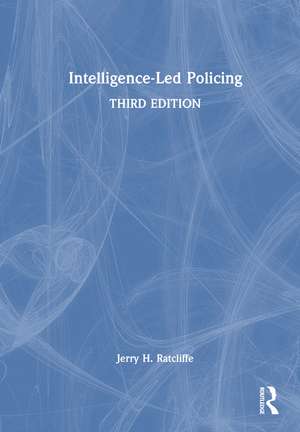
Intelligence-Led Policing
Autor Jerry H. Ratcliffeen Limba Engleză Hardback – 15 dec 2025
The revised and updated third edition of this foundational policing text includes new case studies and viewpoints, a revised crime funnel for serious crime, and a new chapter expanding on intelligence-led policing ethics and risk. A revised structure within the central chapters brings forward the definition of intelligence-led policing, increases discussion around confidential sources and informants, and highlights new thinking in police decision-making and risk management. Changes reflect the continuing evolution of ILP into a framework capable of encompassing more operational police activity than simply organised crime and recidivist offenders.
Topics covered in this book include:
• The origins and aims of intelligence-led policing
• A comparison of intelligence-led policing with other conceptual models of policing
• An exploration of analysis concepts and the role of analysis in target selection
• Evaluations of intelligence-led policing as a crime-control strategy
Written by an expert in the field, this third edition continues to offer a comprehensive and engaging introduction to intelligence-led policing for students, practitioners, and scholars of policing, criminal intelligence, and crime analysis. This book will be of particular interest to professionals within the law enforcement environment: senior officers, middle management, analysts, and operational staff.
Preț: 1155.47 lei
Preț vechi: 1409.10 lei
-18%
Puncte Express: 1733
Carte tipărită la comandă
Livrare economică 05-19 decembrie
Livrare prin curier în România Termenul estimat este afișat lângă disponibilitate.
Transport gratuit pentru acest produs Plată online sau ramburs, în funcție de opțiunile comenzii.
Retur gratuit în 14 zile Comandă securizată și suport în română.
Specificații
ISBN-13: 9781032796239
ISBN-10: 1032796235
Pagini: 230
Ilustrații: 76
Dimensiuni: 174 x 246 mm
Greutate: 0.59 kg
Ediția:3. Auflage
Editura: Taylor & Francis
Colecția Routledge
Locul publicării:Oxford, United Kingdom
ISBN-10: 1032796235
Pagini: 230
Ilustrații: 76
Dimensiuni: 174 x 246 mm
Greutate: 0.59 kg
Ediția:3. Auflage
Editura: Taylor & Francis
Colecția Routledge
Locul publicării:Oxford, United Kingdom
V-ar putea interesa
-
 Policing for a New South AfricaMike Brogden-18%Preț: 719.62 lei877.59 lei
 -
 Crime in EuropeMartin Farrell-15%Preț: 514.24 lei604.98 lei
 -
 Policing for a New South AfricaMike BrogdenPreț: 446.14 lei
 -
 Issues in Transnational PolicingJames Sheptycki-15%Preț: 457.51 lei538.25 lei
 -
 Preț: 445.02 lei
 -
 -15%Preț: 425.72 lei500.84 lei
 -
 Jammed UpRobert J. KanePreț: 343.09 lei
 -
 Place MattersDavid WeisburdPreț: 229.46 lei
 -
 Police OperationsKären Hess-23%Preț: 1312.24 lei1704.22 lei
 -
 -26%Preț: 394.19 lei531.00 lei
 -
 -27%Preț: 887.86 lei1209.90 lei
 -
 -27%Preț: 1054.44 lei1438.08 lei
 -
 -15%Preț: 476.19 lei560.22 lei
 -
 -15%Preț: 423.91 lei498.71 lei
 -
 Crime Prevention: Theory, Policy And PracticeDaniel GillingPreț: 331.81 lei
 -
 Policing Citizens: Police, Power and the StateP.A.J. Waddington-15%Preț: 425.39 lei500.45 lei
 -
 Foot Patrol: Rethinking the Cornerstone of PolicingJerry H. RatcliffePreț: 426.32 lei
Public țintă
Postgraduate, Undergraduate Advanced, and Undergraduate CoreCuprins
1. What is intelligence-led policing? 2. Origins of intelligence-led policing 3. Defining intelligence-led policing 4. The crime challenge 5. Intelligence models and information collection 6. Analysis and influence 7. Impacting crime 8. Technology and intelligence 9. Risks, proportionality and ethics 10. Evaluating intelligence-led policing 11. Challenges for the future
Recenzii
Intelligence Led Policing is, without doubt, essential reading for scholars and practitioners. Ratcliffe has carefully crafted a new edition that improves on earlier iterations by combining originality and insight from his vast experience and ongoing research. This results in an outstanding volume that bridges theory and practice and remains a major contribution to intelligence studies.
Dr Scott Keay, Edge Hill University, UK
Ratcliffe’s original work on intelligence-led policing influenced a generation of police practitioners. His latest book offers a wealth of new insights, positions ILP within the broader landscape of contemporary law enforcement approaches, and is a must read for students, policymakers and policing professionals alike.
R. Mark Evans OBE, University College London, UK
Professor Ratcliffe understands the realities of leading in today’s complex policing environment. This book offers a practical roadmap for making police decision-making smarter, more focused, and—most importantly—more impactful. It provides an actionable framework to disrupt cycles of harm, strengthen analysis capacity, and deliver measurable safety outcomes. I’ve seen these principles work, and this book shows why.
Chief Maris Herold (Ret., Boulder Police Department); Chief of Strategic Initiatives, Austin Police Department, Texas, USA; GMU Policing Hall of Fame 2022 Inductee
With updated examples and real-world insight, this third edition of Intelligence-Led Policing will resonate with those professionals navigating today's challenges, where understanding intelligence is critical to ethical and effective policing.
Dr Jacqueline Sebire, Assistant Professor, Rabdan Academy, UAE
With clarity, authority, and a deep understanding of operational realities, Intelligence-Led Policing lays out the principles and practice in a way that is both accessible and profoundly insightful. Ratcliffe not only explains the importance of using data and intelligence to guide strategic decision-making, but also addresses the cultural, ethical, and organisational challenges that often accompany this shift in policing philosophy. This book is an outstanding contribution to the evolving field of intelligence-led policing and is essential reading for police professionals, policy makers, and students of criminal justice.
David Cowan, Detective Superintendent, Victoria Police; President Australia and New Zealand Society of Evidence Based Policing
Dr Scott Keay, Edge Hill University, UK
Ratcliffe’s original work on intelligence-led policing influenced a generation of police practitioners. His latest book offers a wealth of new insights, positions ILP within the broader landscape of contemporary law enforcement approaches, and is a must read for students, policymakers and policing professionals alike.
R. Mark Evans OBE, University College London, UK
Professor Ratcliffe understands the realities of leading in today’s complex policing environment. This book offers a practical roadmap for making police decision-making smarter, more focused, and—most importantly—more impactful. It provides an actionable framework to disrupt cycles of harm, strengthen analysis capacity, and deliver measurable safety outcomes. I’ve seen these principles work, and this book shows why.
Chief Maris Herold (Ret., Boulder Police Department); Chief of Strategic Initiatives, Austin Police Department, Texas, USA; GMU Policing Hall of Fame 2022 Inductee
With updated examples and real-world insight, this third edition of Intelligence-Led Policing will resonate with those professionals navigating today's challenges, where understanding intelligence is critical to ethical and effective policing.
Dr Jacqueline Sebire, Assistant Professor, Rabdan Academy, UAE
With clarity, authority, and a deep understanding of operational realities, Intelligence-Led Policing lays out the principles and practice in a way that is both accessible and profoundly insightful. Ratcliffe not only explains the importance of using data and intelligence to guide strategic decision-making, but also addresses the cultural, ethical, and organisational challenges that often accompany this shift in policing philosophy. This book is an outstanding contribution to the evolving field of intelligence-led policing and is essential reading for police professionals, policy makers, and students of criminal justice.
David Cowan, Detective Superintendent, Victoria Police; President Australia and New Zealand Society of Evidence Based Policing
Notă biografică
Jerry H. Ratcliffe is the faculty director of the Master of Applied Criminology and Police Leadership program and a professor of practice in the Department of Criminology at the University of Pennsylvania. A former British police officer, he is also a scientific advisor to the International Association of Chiefs of Police.
Descriere
The revised and updated third edition of this foundational policing text includes new case studies and viewpoints, a revised crime funnel for serious crime, and a new chapter expanding on intelligence-led policing ethics and risk.