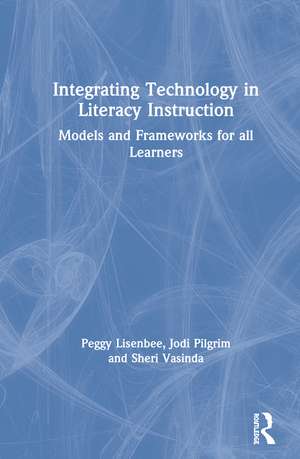
Integrating Technology in Literacy Instruction: Models and Frameworks for All Learners
Autor Peggy S. Lisenbee, Jodi Pilgrim, Sheri Vasindaen Limba Engleză Hardback – 8 iul 2020
Each chapter includes prompts for reflection and discussion to encourage readers to consider how literacy and technology can enable teachers to become agents of change, and the book also features Appendices with annotated resource lists of technology tools for students’ varied literacy needs in our digital age.
| Toate formatele și edițiile | Preț | Express |
|---|---|---|
| Paperback (2) | 374.24 lei 3-5 săpt. | |
| Taylor & Francis – 8 iul 2020 | 374.24 lei 3-5 săpt. | |
| Taylor & Francis – 21 mar 2025 | 384.35 lei 3-5 săpt. | +18.87 lei 7-13 zile |
| Hardback (2) | 1067.08 lei 6-8 săpt. | |
| Taylor & Francis – 20 mar 2025 | 1067.08 lei 6-8 săpt. | |
| Taylor & Francis – 8 iul 2020 | 1117.16 lei 3-5 săpt. |
Preț: 1117.16 lei
Preț vechi: 1362.39 lei
-18%
Puncte Express: 1676
Preț estimativ în valută:
197.53€ • 234.39$ • 171.74£
197.53€ • 234.39$ • 171.74£
Carte disponibilă
Livrare economică 11-25 martie
Specificații
ISBN-13: 9780367355432
ISBN-10: 0367355434
Pagini: 198
Dimensiuni: 152 x 229 x 15 mm
Greutate: 0.42 kg
Ediția:1Adnotată
Editura: Taylor & Francis
Colecția Routledge
Locul publicării:Oxford, United Kingdom
ISBN-10: 0367355434
Pagini: 198
Dimensiuni: 152 x 229 x 15 mm
Greutate: 0.42 kg
Ediția:1Adnotată
Editura: Taylor & Francis
Colecția Routledge
Locul publicării:Oxford, United Kingdom
Public țintă
PostgraduateCuprins
SECTION 1: FOUNDATIONS FOR THINKING ABOUT LITERACY Chapter 1: Literacy in a Changing World Chapter 2: Multiliteracies: Theory and Pedagogy that Reflect a Changing World Chapter 3: Universal Design for Learning within a Multiliteracies Perspective SECTION 2: FRAMEWORKS FOR THINKING ABOUT TECHNOLOGY INTEGRATION Chapter 4: TECHNOLOGY-Influenced Frameworks for Thinking about Literacy Instruction Chapter 5: Evaluation of Technology Integration: Technology-Influenced Taxonomies SECTION 3: APPLICATIONS IN CLASSROOM INSTRUCTION Chapter 6: The Use of the Internet in Literacy Instruction: Web 2.0 Tools Chapter 7: The Use of the Internet in Literacy Instruction: Online Reading and Research Chapter 8: Changing Learning Environments: Transformational Practices Chapter 9: Lesson Design: The Teacher as the Architect APPENDIX 9.1: List of Tools Arranged by the 4Cs APPENDIX 9.2: Using a Lesson Plan Template and the Integrating Technology into Literacy Instruction Textbook with the 4Cs APPENDIX 9.3: List of eBooks and Optical Reading Devices APPENDIX 9.1: List of Resources and Organizations Supporting All Learners
Notă biografică
Jodi Pilgrim is a professor and associate dean in the College of Education at the University of Mary Hardin-Baylor (UMHB).
Sheri Vasinda is a professor in the School of Teaching, Learning and Educational Sciences at Oklahoma State University.
Peggy S. Lisenbee is an associate professor in the Division of Early Childhood Education at Texas Woman’s University.
Sheri Vasinda is a professor in the School of Teaching, Learning and Educational Sciences at Oklahoma State University.
Peggy S. Lisenbee is an associate professor in the Division of Early Childhood Education at Texas Woman’s University.
Descriere
This text addresses the changing literacies surrounding students and the need to communicate effectively using technology tools. Both technologies and research in literacy are rapidly changing and evolving, this book presents lasting frameworks for teacher candidates to evaluate and implement digital tools to enhance literacy classrooms.
Recenzii
“Integrating Technology in Literacy Instruction: Models and Frameworks for All Learners is an excellent addition to the latest collection of books on effective technology integration in literacy instruction. The evidence-based models, frameworks, practices, and strategies introduced in the book provide strong guidance for classroom teachers interested in implementing technology-supported, technology-enhanced literacy instruction that is inclusive of all learners, including students with special needs and English language learners. The extensive list of digital tools, apps, and lesson plans makes the book a valuable resource for teachers of literacy at all grade levels. The book is also reader-friendly, making it an ideal choice for teacher education courses and professional development.” -- Dr. Jiening Ruan, professor of reading/literacy education at the University of Oklahoma
“This amazing book links best practices to ISTE Standards for educators and students.” -- Perla Luján, ISTE Certified Educator, Teacher and Academic Coach
“This updated edition of Integrating Technology in Literacy Instruction is an invaluable resource for educators seeking to embrace Universal Design for Learning (UDL) and foster a multiliteracies approach. By emphasizing diverse modes of representation and expression, it equips teachers to support all learners, particularly those with varying abilities and language backgrounds, through innovative strategies like audiovisual content and collaborative tools. Highly recommended for anyone aiming to enhance literacy instruction, this book not only promotes inclusivity but also empowers students to leverage their unique strengths in meaningful ways.” -- Dr. Robin Pizzitola, Associate Professor, Texas A&M University-Corpus Christi
“This amazing book links best practices to ISTE Standards for educators and students.” -- Perla Luján, ISTE Certified Educator, Teacher and Academic Coach
“This updated edition of Integrating Technology in Literacy Instruction is an invaluable resource for educators seeking to embrace Universal Design for Learning (UDL) and foster a multiliteracies approach. By emphasizing diverse modes of representation and expression, it equips teachers to support all learners, particularly those with varying abilities and language backgrounds, through innovative strategies like audiovisual content and collaborative tools. Highly recommended for anyone aiming to enhance literacy instruction, this book not only promotes inclusivity but also empowers students to leverage their unique strengths in meaningful ways.” -- Dr. Robin Pizzitola, Associate Professor, Texas A&M University-Corpus Christi