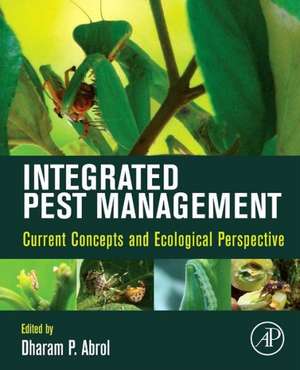
Integrated Pest Management: Current Concepts and Ecological Perspective
Editat de Dharam P. Abrolen Limba Engleză Hardback – 28 noi 2013
Integrated Pest Management covers these topics and more. It explores the current ecological approaches in alternative solutions, such as biological control agents, parasites and predators, pathogenic microorganisms, pheromones and natural products as well as ecological approaches for managing invasive pests, rats, suppression of weeds, safety of pollinators, role of taxonomy and remote sensing in IPM and future projections of IPM. This book is a useful resource to entomologists, agronomists, horticulturists, and environmental scientists.
- Fills a gap in the literature by providing critical analysis of different management strategies that have a bearing on agriculture, sustainability and environmental protection
- Synthesizes research and practice on integrated pest management
- Emphasizes an overview of management strategies, with critical evaluation of each in the larger context of ecologically based pest management
Preț: 624.91 lei
Preț vechi: 686.71 lei
-9%
Puncte Express: 937
Carte tipărită la comandă
Livrare economică 12-26 noiembrie
Livrare prin curier în România Termenul estimat este afișat lângă disponibilitate.
Transport gratuit pentru acest produs Plată online sau ramburs, în funcție de opțiunile comenzii.
Retur gratuit în 14 zile Comandă securizată și suport în română.
Specificații
ISBN-13: 9780123985293
ISBN-10: 0123985293
Pagini: 576
Ilustrații: black & white illustrations, black & white tables, figures, colour plates
Dimensiuni: 191 x 235 x 36 mm
Greutate: 1.34 kg
Editura: ELSEVIER SCIENCE
ISBN-10: 0123985293
Pagini: 576
Ilustrații: black & white illustrations, black & white tables, figures, colour plates
Dimensiuni: 191 x 235 x 36 mm
Greutate: 1.34 kg
Editura: ELSEVIER SCIENCE
V-ar putea interesa
-
 -31%Preț: 699.90 lei1010.89 lei
 -
 Plant-Animal CommunicationH. Martin Schaefer-22%Preț: 398.91 lei511.08 lei
 -
 Biological Diversity: Frontiers in Measurement and AssessmentAnne E. Magurran-21%Preț: 433.06 lei545.51 lei
 -
 Chemical Ecology in Aquatic SystemsChrister Brönmark-28%Preț: 404.67 lei560.17 lei
 -
 -22%Preț: 532.00 lei682.15 lei
 -
 Wytham Woods: Oxford's Ecological LaboratoryPeter Savill-22%Preț: 506.34 lei653.10 lei
 -
 Phase TransitionsRicard SoléPreț: 369.99 lei
 -
 Preț: 272.95 lei
 -
 -8%Preț: 538.81 lei585.66 lei
 -
 Rees, P: Introduction to Zoo Biology and ManagementPaul A. Rees-8%Preț: 579.61 lei630.01 lei
 -
 Artificial Reefs in Fisheries ManagementStephen A. Bortone-18%Preț: 1127.03 lei1374.42 lei
Public țintă
Entomologists; biological control researchers and practitioners; extension specialists; pest management, crop science, and agricultural economics researchers; agricultural engineers; plant pathologists, weed scientists, nematologists, and applied vertebrate zoologists; advanced and graduate-level students in these areasCuprins
SECTION 1: ECOLOGY OF PEST MANAGEMENT
1. Ecology of Pest Management
2. Host plant resistance in pest management
3. Impact of climate change on pests and pest management: Implications for crop production and food security
4. Application of remote sensing in integrated pest management
5. Weather-based pest forecasting for efficient crop protection
6. Forecasting of Colorado potato beetle development by means of computer aided system SIMLEP Decision Support System
SECTION 2: CHEMICAL CONTROL OF CROP PESTS
7. Role of semiochemicals in integrated pest management
8. Pesticides appled for the control of invasive species in the United States
9. Potential and utilization of natural products in pest control
SECTION 3: BIOLOGICAL CONTROL OF CROP PESTS
10. Biological control of insect pests in crops
11. Use of pheromones in insect pest management
12. Role of entomopathogenic fungi in IPM
13. Entomopathogenic nematodes for insect pest control
14. Entomopathogenic viruses and bacteria for insect pest control
15. Biological Control of Weeds by Plant Pathogens Using the Bioherbicide Approach
16. Biological control of invasive insect pests
17. Use of spiders as natural enemies to control insect pests
18. Cultural practices and physical methods for the management of insect pests
SECTION 4: BIOTECHNOLOGICAL APPROACH TO MANAGEMENT OF CROP PESTS
19. Biotechnological approaches for insect pest management
20. Biotechnological approaches for non-insect pest management
21. Genetically modified crops in IPM: agricultural, ecological, and evolutionary implications
22. Breeding of crops for resistance against insect pests and diseases
SECTION 5: MISCELLANEOUS ISSUES RELATED TO CROP PEST MANAGEMENT
23. Integrated management of rodent pests
24. Ecofriendly management of phytophagous mites
25. Risk to biodiversity by exotic species introduced for biological control
26. The critical role of taxonomy in IPM—Challenges and opportunities
27. IPM Extension: A Global Overview
28. Future of integrated pest management in the 21st century, whither or wither—A critical analysis
1. Ecology of Pest Management
2. Host plant resistance in pest management
3. Impact of climate change on pests and pest management: Implications for crop production and food security
4. Application of remote sensing in integrated pest management
5. Weather-based pest forecasting for efficient crop protection
6. Forecasting of Colorado potato beetle development by means of computer aided system SIMLEP Decision Support System
SECTION 2: CHEMICAL CONTROL OF CROP PESTS
7. Role of semiochemicals in integrated pest management
8. Pesticides appled for the control of invasive species in the United States
9. Potential and utilization of natural products in pest control
SECTION 3: BIOLOGICAL CONTROL OF CROP PESTS
10. Biological control of insect pests in crops
11. Use of pheromones in insect pest management
12. Role of entomopathogenic fungi in IPM
13. Entomopathogenic nematodes for insect pest control
14. Entomopathogenic viruses and bacteria for insect pest control
15. Biological Control of Weeds by Plant Pathogens Using the Bioherbicide Approach
16. Biological control of invasive insect pests
17. Use of spiders as natural enemies to control insect pests
18. Cultural practices and physical methods for the management of insect pests
SECTION 4: BIOTECHNOLOGICAL APPROACH TO MANAGEMENT OF CROP PESTS
19. Biotechnological approaches for insect pest management
20. Biotechnological approaches for non-insect pest management
21. Genetically modified crops in IPM: agricultural, ecological, and evolutionary implications
22. Breeding of crops for resistance against insect pests and diseases
SECTION 5: MISCELLANEOUS ISSUES RELATED TO CROP PEST MANAGEMENT
23. Integrated management of rodent pests
24. Ecofriendly management of phytophagous mites
25. Risk to biodiversity by exotic species introduced for biological control
26. The critical role of taxonomy in IPM—Challenges and opportunities
27. IPM Extension: A Global Overview
28. Future of integrated pest management in the 21st century, whither or wither—A critical analysis