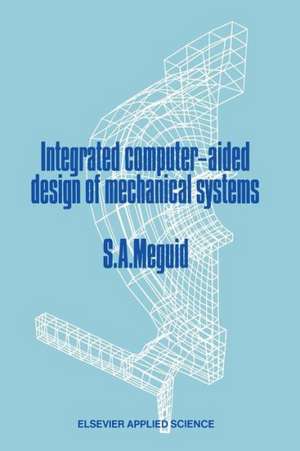
Integrated Computer-Aided Design of Mechanical Systems
Autor Shaker A. Meguiden Limba Engleză Paperback – 30 sep 2011
Preț: 329.80 lei
Preț vechi: 412.25 lei
-20%
Puncte Express: 495
Carte tipărită la comandă
Livrare economică 01-15 decembrie
Livrare prin curier în România Termenul estimat este afișat lângă disponibilitate.
Transport gratuit de la 400.00 lei Plată online sau ramburs, în funcție de opțiunile comenzii.
Retur gratuit în 14 zile Comandă securizată și suport în română.
Specificații
ISBN-13: 9789401080248
ISBN-10: 9401080240
Pagini: 212
Ilustrații: 196 p.
Dimensiuni: 152 x 229 x 12 mm
Greutate: 0.32 kg
Ediția:Softcover reprint of the original 1st ed. 1987
Editura: Springer
Locul publicării:Dordrecht, Netherlands
ISBN-10: 9401080240
Pagini: 212
Ilustrații: 196 p.
Dimensiuni: 152 x 229 x 12 mm
Greutate: 0.32 kg
Ediția:Softcover reprint of the original 1st ed. 1987
Editura: Springer
Locul publicării:Dordrecht, Netherlands
V-ar putea interesa
-
 -20%Preț: 410.94 lei513.69 lei
 -
 -31%Preț: 526.00 lei759.22 lei
 -
 Computational Intelligence in Design and ManufacturingAndrew Kusiak-14%Preț: 930.45 lei1081.92 lei
 -
 Concepts and Applications of Finite Element AnalysisRobert D. Cook-18%Preț: 1345.31 lei1640.62 lei
 -
 Pro/Engineer Wildfire 4.0 EssentialsInc Kogent-20%Preț: 580.51 lei725.63 lei
 -
 -4%Preț: 372.69 lei388.22 lei
 -
 MechatronicsW. Bolton-11%Preț: 667.57 lei750.07 lei
 -
 Computer Aided Engineering DesignBirendra Sahay-18%Preț: 1603.10 lei1954.99 lei
 -
 -23%Preț: 412.01 lei535.90 lei
 -
 -20%Preț: 585.88 lei732.36 lei
 -
 -20%Preț: 538.48 lei673.10 lei
 -
 -20%Preț: 513.73 lei642.17 lei
 -
 Drawing for Product DesignersKevin Henry-30%Preț: 160.26 lei229.64 lei
 -
 -18%Preț: 1213.86 lei1480.32 lei
 -
 Advances in Design Engineering IVCristina Manchado Del Val-18%Preț: 1446.06 lei1763.49 lei
 -
 Springer Handbook of Mechanical EngineeringKarl-Heinrich Grote-18%Preț: 2092.64 lei2552.00 lei
 -
 -18%Preț: 906.79 lei1105.84 lei
 -
 Recent Advances in Machine DesignC. V. Chandrashekara-18%Preț: 1231.51 lei1501.84 lei
Public țintă
ResearchCuprins
1 Introduction.- 1.1 The Developing Design Process.- 1.2 Design Methodology.- 1.3 Interactive Computer Graphics (ICG).- 1.4 Computer-Aided Engineering (CAE).- 1.4.1 Computer-Aided Design (CAD).- 1.4.2 Computer-Aided Analysis (CAA).- 1.4.3 Computer-Aided Draughting (CAD).- 1.4.4 Computer-Integrated Manufacturing (CIM).- 1.5 Initial Graphics Exchange Specification (IGES).- References.- 2 Three-Dimensional Automated Modelling.- 2.1 Automated Computer Graphics.- 2.2 Different Types of Modelling.- 2.2.1 Wire-Frame Modelling.- 2.2.2 Surface Modelling.- 2.2.3 Solid Modelling.- 2.3 Merits of Solid Modelling.- 2.4 Limitations of Solid Modelling.- References.- 3 Computer-Aided Design.- 3.1 Introduction.- First Case Study: Computer-Aided Design of Centrifugal Shot-Peening Equipment.- 3.2 The Shot-Peening Process.- 3.3 Historical Background.- 3.4 Design Constraints and Requirements.- 3.5 Conceptual Designs.- Second Case Study: Computer-Aided Design of a Fluid Coupling.- 3.6 Principle of Operation.- 3.7 Design Constraints and Requirements.- 3.8 Flow Models and Analysis.- 3.9 Conceptual Design.- 3.10 Evaluation of Coupling Design.- 3.11 Modified Design.- 3.12 The Need for Engineering Analysis.- References.- 4 Fundamentals of the Finite Element Method.- 4.1 Introduction.- 4.2 Fundamental Concept of the Finite Element Method.- 4.3 Fundamentals of Linear Elasticity.- 4.4 Principles of Finite Elements.- 4.5 Interpolation Polynomial Functions.- 4.6 Isoparametric Finite Element Representation.- 4.7 Derivation of a General Expression for Element Stiffness Matrix.- 4.8 Computer Implementation of Finite Element.- 4.8.3 Element Stiffness Matrix Generation and Assembly.- 4.9 Conclusions.- References.- 5 Computer-Aided Analysis.- 5.1 Introduction.- 5.2 General Purpose Finite Element Software.- 5.3 Computer-Aided System for Data Processing.- 5.4 Interactive Mesh Generation.- 5.5 Non-Linear Structural Analysis.- First Case Study: Computer-Aided Analysis of Wheel- Assembly.- 5.6 Structural Stress Analysis.- 5.7 Dynamic Response Studies.- Second Case Study: Computer-Aided Analysis of Fluid Coupling.- 5.8 Structural Stress Analysis and Dynamic Response Studies.- 5.9 Conclusions.- References.- 6 Computer-Integrated Manufacturing.- 6.1 Computer-Controlled Machine Tools.- 6.2 Types of Control Systems for NC Machines.- 6.3 NC Part-Programming Languages.- 6.4 NC Programming with Interactive Graphics.- 6.5 Tool Path Generation.- First Case Study: Computer-Integrated Manufacturing of Critical Components of Wheel-Assembly.- 6.6 Choice of Materials.- 6.7 Manufacture of Wheel-Assembly.- 6.8 Development of NC Machining Programs.- Second Case Study: Computer-Integrated Manufacturing of Fluid Coupling.- 6.9 Choice of Materials and NC Machining Programs.- 6.10 Concluding Remarks.- References.