
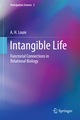
Intangible Life: Anticipation Science, cartea 2
Autor A. H. Louieen Limba Engleză Paperback – 31 aug 2018
Remarcăm faptul că în literatura academică actuală persistă o lacună între biologia moleculară reducționistă și înțelegerea sistemelor vii ca entități organizate funcțional. Intangible Life, publicată în seria Anticipation Science la Springer, vine să completeze acest gol printr-o abordare riguroasă a biologiei relaționale. Dacă lucrările anterioare ale autorului, More Than Life Itself și The Reflection of Life, s-au concentrat pe epistemologia și ontogenia vieții, acest volum de 288 de pagini mută accentul pe natura intangibilă a sistemelor vii, susținând că funcția dictează structura. Textul este structurat în trei părți fundamentale ce ghidează cititorul de la abstract la aplicat. Prima parte stabilește fundamentul set-teoretic prin studiul functorului „power set”, în timp ce a doua parte introduce o nouă formulare matematică a Legii Naturale, unde rețelele de Metabolism-Reparare devin modele generice pentru toate sistemele naturale. Ultima parte explorează conceptele de echivalență și adjuncție, esențiale pentru înțelegerea decodificării biologice. Credem că această ediție este distinctă prin modul în care transformă matematica în metalimbaj pentru biologie. Intangible Life acoperă aceeași arie tematică precum Theoretical Principles of Relational Biology, dar cu o abordare mult mai formalizată matematic, bazată pe teoria categoriilor. În comparație cu Understanding Living Systems, care propune o modelare pe mai multe niveluri de n-categorii, lucrarea lui A. H. Louie rămâne ancorată în tradiția începută de Robert Rosen, oferind un cadru algebric mai accesibil cercetătorilor care doresc să treacă de la mecanism la organizare relațională.




Preț: 721.30 lei
Preț vechi: 949.08 lei
-24%
Carte tipărită la comandă
Livrare economică 30 noiembrie-07 decembrie
Specificații
ISBN-10: 3319880217
Pagini: 288
Ilustrații: XXIII, 264 p. 4 illus.
Dimensiuni: 155 x 235 x 16 mm
Greutate: 0.44 kg
Ediția:Softcover reprint of the original 1st ed. 2017
Editura: Springer
Colecția Anticipation Science
Seria Anticipation Science
Locul publicării:Cham, Switzerland
V-ar putea interesa
-
 -23%Preț: 1470.04 lei1909.14 lei
 -
 Killer Cell DynamicsDominik Wodarz-18%Preț: 929.65 lei1133.72 lei
 -
 Dynamic Meteorology: Data Assimilation MethodsL. Bengtsson-15%Preț: 617.89 lei726.93 lei
 -
 Computational Modeling in Biological Fluid DynamicsLisa J. Fauci-18%Preț: 977.93 lei1192.61 lei
 -
 -18%Preț: 959.93 lei1170.64 lei
 -
 Mathematical Modelling of Immune Response in Infectious DiseasesGuri I. Marchuk-15%Preț: 669.91 lei788.12 lei
 -
 Applied Parameter Estimation for Chemical EngineersPeter Englezos-18%Preț: 2196.73 lei2678.94 lei
 -
 Modern Formal Methods and ApplicationsHossam A. Gabbar-15%Preț: 696.15 lei819.00 lei
 -
 Handbook of Thin Plate Buckling and PostbucklingFrederick Bloom-15%Preț: 690.82 lei812.73 lei
 -
 Numerical Methods for EngineersD. Vaughan Griffiths-20%Preț: 1490.52 lei1863.15 lei
 -
 Preț: 444.69 lei
 -
 Tutorials in Mathematical Biosciences IIIAvner FriedmanPreț: 388.77 lei
 -
 Tutorials in Mathematical Biosciences IVAvner FriedmanPreț: 386.26 lei
 -
 High Performance Computing on Vector Systems 2007Michael Resch-20%Preț: 674.25 lei842.81 lei
 -
 Mathematics - Key Technology for the FutureWilli Jäger-15%Preț: 673.99 lei792.93 lei
 -
 Modeling, Simulation and Optimization of Complex ProcessesHans Georg Bock-20%Preț: 1011.68 lei1264.59 lei
 -
 High Performance Computing on Vector Systems 2008Sabine Roller-20%Preț: 672.94 lei841.17 lei
 -
 Multiscale Modeling and Simulation in ScienceBjörn EngquistPreț: 393.74 lei
 -
 Mathematical Modeling in Biomedical Imaging IHabib AmmariPreț: 388.24 lei
 -
 Computational Fluid Dynamics for Sport SimulationMartin PetersPreț: 398.57 lei
De ce să citești această carte
Această carte se adresează cercetătorilor și studenților la nivel masteral sau doctoral din matematică, biologie teoretică și filosofia științei. Cititorul câștigă o perspectivă nouă asupra vieții, privită nu ca materie, ci ca o rețea de conexiuni funcționale. Este un instrument esențial pentru cei care doresc să înțeleagă biologia dincolo de reducționismul fizic, utilizând un aparat matematic modern și precis pentru a modela fenomene precum metabolismul și replicarea.
Despre autor
A. H. Louie este un cercetător proeminent în domeniul biologiei relaționale, fiind considerat unul dintre principalii continuatori ai școlii de gândire fondate de Robert Rosen și Nicolas Rashevsky. Opera sa este dedicată depășirii limitelor mecanicismului în științele vieții prin utilizarea teoriei categoriilor și a modelării matematice complexe. Prin trilogia sa începută cu More Than Life Itself, A. H. Louie a definit un nou cadru teoretic pentru studiul organizării biologice, punând accent pe relațiile de cauzalitate și pe natura sistemică a organismelor vii.