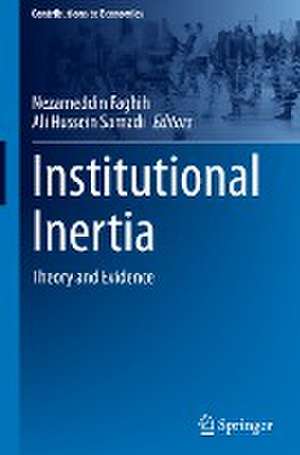
Institutional Inertia: Contributions to Economics
Editat de Nezameddin Faghih, Ali Hussein Samadien Limba Engleză Hardback – 9 feb 2024
Din seria Contributions to Economics
- 18%
 Preț: 1176.93 lei
 - 18%
 Preț: 1011.29 lei
 - 18%
 Preț: 1152.19 lei
 - 18%
 Preț: 1217.13 lei
 - 15%
 Preț: 548.80 lei
 - 18%
 Preț: 1150.77 lei
 - 15%
 Preț: 669.66 lei
 - 15%
 Preț: 645.13 lei
 - 15%
 Preț: 616.67 lei
 - 15%
 Preț: 628.52 lei
 - 15%
 Preț: 666.97 lei
 - 15%
 Preț: 644.90 lei
 - 15%
 Preț: 619.51 lei
 - 15%
 Preț: 620.55 lei
 - 15%
 Preț: 620.35 lei
 - 15%
 Preț: 640.73 lei
 -
 Preț: 368.79 lei
 - 18%
 Preț: 923.26 lei
 - 15%
 Preț: 624.49 lei
 - 15%
 Preț: 636.90 lei
 -
 Preț: 363.99 lei
 -
 Preț: 367.68 lei
 -
 Preț: 391.49 lei
 - 15%
 Preț: 624.36 lei
 - 15%
 Preț: 625.75 lei
 -
 Preț: 388.51 lei
 -
 Preț: 397.45 lei
 -
 Preț: 373.40 lei
 - 15%
 Preț: 641.11 lei
 - 20%
 Preț: 624.51 lei
 - 18%
 Preț: 726.06 lei
 -
 Preț: 374.14 lei
 - 15%
 Preț: 609.53 lei
 -
 Preț: 373.16 lei
 -
 Preț: 381.75 lei
 -
 Preț: 371.03 lei
 - 15%
 Preț: 639.42 lei
 -
 Preț: 383.27 lei
 - 15%
 Preț: 638.58 lei
 -
 Preț: 372.67 lei
 - 15%
 Preț: 626.40 lei
 -
 Preț: 371.73 lei
 - 15%
 Preț: 619.20 lei
 -
 Preț: 372.70 lei
 -
 Preț: 368.62 lei
 - 15%
 Preț: 623.96 lei
 -
 Preț: 384.50 lei
 -
 Preț: 370.30 lei
 -
 Preț: 383.79 lei
 -
 Preț: 368.05 lei
Preț: 1157.89 lei
Preț vechi: 1412.05 lei
-18%
Puncte Express: 1737
Carte tipărită la comandă
Livrare economică 04-18 decembrie
Livrare prin curier în România Termenul estimat este afișat lângă disponibilitate.
Transport gratuit pentru acest produs Plată online sau ramburs, în funcție de opțiunile comenzii.
Retur gratuit în 14 zile Comandă securizată și suport în română.
Specificații
ISBN-13: 9783031511745
ISBN-10: 3031511743
Pagini: 364
Ilustrații: XII, 352 p. 30 illus., 12 illus. in color.
Dimensiuni: 160 x 241 x 26 mm
Greutate: 0.66 kg
Ediția:1st ed. 2024
Editura: Springer
Colecția Contributions to Economics
Seria Contributions to Economics
Locul publicării:Cham, Switzerland
ISBN-10: 3031511743
Pagini: 364
Ilustrații: XII, 352 p. 30 illus., 12 illus. in color.
Dimensiuni: 160 x 241 x 26 mm
Greutate: 0.66 kg
Ediția:1st ed. 2024
Editura: Springer
Colecția Contributions to Economics
Seria Contributions to Economics
Locul publicării:Cham, Switzerland
Cuprins
I. Concepts, Types, Causes, and Effects.- Inertia: resistance and endurance.- An Introduction to Institutional Inertia: Concept, Types and Causes.- The Origin of Development, Critical Juncture, and Institutional Inertia.- Context, Institutional Inertia and Development.- Inertia in Informal Institutions: Concepts, and Effects.- II. Cognitive Inertia.- The Roots of Cognitive Inertia: An Introduction to Institutional Changes.- Cognitive Inertia as a Fundamental Cause of Institutional Inertia.- III. Organizational Inertia.- Overview of Institutional–Organization Inertia Nexus.- Internal Empowerment Dynamics of Organizational Inertia Management.- IV. Trade, Energy and Environments.- Trade and Institutional Inertia.- The Transition to Sustainable.- Energy and Institutional Inertia.- Legitimacy, Institutional Inertia, and Climate Change.- V. Innovation and Entrepreneurship.- Early Entrepreneurship Entry and Institutional Rigidities in Emerging Market Economies: Evidence from the Global Entrepreneurship Monitor.- Inertia, Innovation Failures, And Learning from Innovation Failures: Some Insights from MSEs in an Emerging Market Economy
Notă biografică
Nezameddin Faghih is an UNESCO Chair Professor Emeritus, and the Founding Editor-in-Chief of the Journal of Global Entrepreneurship Research (Springer). He has published more than 50 books and 100 fully refereed research articles, and presented more than 120 invited talks in academia, industry, and professional meetings.
Ali Hussein Samadi is a Professor at the University of Shiraz, Iran. He has a Ph.D. in public sector economics. He specializes in institutional economics and econometrics. His research focuses on institutional economics, law and economics, property rights, system dynamics modeling, econophysics, and complex networks. He is the Editor-in-Chief of the Iranian Journal of Economic Studies (IJES).
Ali Hussein Samadi is a Professor at the University of Shiraz, Iran. He has a Ph.D. in public sector economics. He specializes in institutional economics and econometrics. His research focuses on institutional economics, law and economics, property rights, system dynamics modeling, econophysics, and complex networks. He is the Editor-in-Chief of the Iranian Journal of Economic Studies (IJES).
Textul de pe ultima copertă
This edited volume explores the concept of institutional inertia and its relationship to economic growth and development. Including insights from experts across disciplines, chapters identify the types, causes and effects—both positive and negative—of institutional inertia. By questioning the types of institutional inertia that improve economic performance and impact the effectiveness of the state, as well as studying their role in the dynamics of institutional change, the volume attempts to trace and understand the different evolutionary paths of societies. Bridging important research gaps, this volume will be of use to students, researchers, and practitioners of institutional and evolutionary economics, development economics, management, and organizational theory.
Caracteristici
Explores the concepts, types, causes, and effects of institutional inertia Discusses the impact of institutional inertia on energy transition, climate change, innovation, entrepreneurship Traces the different evolutionary paths of societies
Descriere
Descriere de la o altă ediție sau format:
This edited volume explores the concept of institutional inertia and its relationship to economic growth and development.
This edited volume explores the concept of institutional inertia and its relationship to economic growth and development.