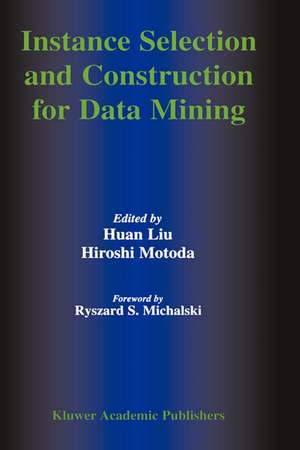
Instance Selection and Construction for Data Mining: The Springer International Series in Engineering and Computer Science, cartea 608
Editat de Huan Liu, Hiroshi Motodaen Limba Engleză Hardback – 28 feb 2001
One of the major means of instance selection is sampling whereby a sample is selected for testing and analysis, and randomness is a key element in the process. Instance selection also covers methods that require search. Examples can be found in density estimation (finding the representative instances - data points - for a cluster); boundary hunting (finding the critical instances to form boundaries to differentiate data points of different classes); and data squashing (producing weighted new data with equivalent sufficient statistics). Other important issues related to instance selection extend to unwanted precision, focusing, concept drifts, noise/outlier removal, data smoothing, etc.
Instance Selection and Construction for Data Mining brings researchers and practitioners together to report new developments and applications, to share hard-learned experiences in order to avoid similar pitfalls, and to shed light on the future development of instance selection. This volume serves as a comprehensive reference for graduate students, practitioners and researchers in KDD.
Din seria The Springer International Series in Engineering and Computer Science
- 18%
 Preț: 1263.85 lei
 - 18%
 Preț: 921.36 lei
 - 20%
 Preț: 633.65 lei
 - 20%
 Preț: 665.64 lei
 - 20%
 Preț: 662.69 lei
 - 24%
 Preț: 876.97 lei
 - 20%
 Preț: 663.58 lei
 - 20%
 Preț: 950.07 lei
 - 20%
 Preț: 665.12 lei
 - 18%
 Preț: 903.90 lei
 - 20%
 Preț: 950.72 lei
 - 18%
 Preț: 985.84 lei
 - 15%
 Preț: 621.23 lei
 - 18%
 Preț: 979.41 lei
 - 18%
 Preț: 907.54 lei
 - 18%
 Preț: 1173.85 lei
 - 15%
 Preț: 663.24 lei
 - 18%
 Preț: 976.26 lei
 - 18%
 Preț: 904.83 lei
 - 18%
 Preț: 904.83 lei
 - 20%
 Preț: 1325.05 lei
 - 20%
 Preț: 1725.82 lei
 - 20%
 Preț: 1326.15 lei
 - 20%
 Preț: 989.14 lei
 -
 Preț: 381.30 lei
 - 20%
 Preț: 635.71 lei
 - 18%
 Preț: 1193.58 lei
 - 20%
 Preț: 622.65 lei
 - 20%
 Preț: 1319.14 lei
 - 18%
 Preț: 974.15 lei
 - 20%
 Preț: 670.15 lei
 - 15%
 Preț: 664.58 lei
 - 18%
 Preț: 1179.97 lei
 - 15%
 Preț: 670.25 lei
 - 15%
 Preț: 663.36 lei
 - 20%
 Preț: 620.83 lei
 - 18%
 Preț: 990.04 lei
 - 15%
 Preț: 660.75 lei
 - 18%
 Preț: 1266.48 lei
Preț: 1032.47 lei
Preț vechi: 1290.59 lei
-20%
Puncte Express: 1549
Carte tipărită la comandă
Livrare economică 03-17 decembrie
Livrare prin curier în România Termenul estimat este afișat lângă disponibilitate.
Transport gratuit pentru acest produs Plată online sau ramburs, în funcție de opțiunile comenzii.
Retur gratuit în 14 zile Comandă securizată și suport în română.
Specificații
ISBN-13: 9780792372097
ISBN-10: 0792372093
Pagini: 452
Ilustrații: XXV, 416 p.
Dimensiuni: 160 x 241 x 29 mm
Greutate: 0.79 kg
Ediția:2001
Editura: Springer
Colecția The Springer International Series in Engineering and Computer Science
Seria The Springer International Series in Engineering and Computer Science
Locul publicării:New York, NY, United States
ISBN-10: 0792372093
Pagini: 452
Ilustrații: XXV, 416 p.
Dimensiuni: 160 x 241 x 29 mm
Greutate: 0.79 kg
Ediția:2001
Editura: Springer
Colecția The Springer International Series in Engineering and Computer Science
Seria The Springer International Series in Engineering and Computer Science
Locul publicării:New York, NY, United States
V-ar putea interesa
-
 Data Mining: Concepts and TechniquesJiawei Han-40%Preț: 434.30 lei721.87 lei
 -
 Just Enough Data Science and Machine LearningMark LevenePreț: 352.28 lei
 -
 The Elements of Statistical LearningTrevor Hastie-20%Preț: 547.10 lei683.87 lei
 -
 Handbook of Statistical Analysis: AI and ML ApplicationsRobert Nisbet-32%Preț: 582.99 lei859.83 lei
 -
 -39%Preț: 394.79 lei646.62 lei
 -
 Data Science and Big Data AnalyticsEmc Education Services-20%Preț: 405.57 lei506.97 lei
 -
 -20%Preț: 192.78 lei240.98 lei
 -
 -9%Preț: 581.31 lei638.79 lei
 -
 Data & AI ImperativeLillian Pierson-20%Preț: 172.87 lei216.09 lei
 -
 Data Science Essentials for DummiesLillian Pierson-20%Preț: 76.56 lei95.69 lei
 -
 The Data Hero PlaybookMalcolm HawkerPreț: 202.67 lei
 -
 Data Clustering: Algorithms and ApplicationsCharu C. Aggarwal-9%Preț: 1158.13 lei1272.67 lei
 -
 Algorithms and Data Structures in ActionMarcello La Rocca-20%Preț: 396.11 lei495.14 lei
 -
 Materials Data ScienceStefan Sandfeld-15%Preț: 601.09 lei707.16 lei
 -
 Statistics for ScientistsUmberto Michelucci-20%Preț: 279.62 lei349.53 lei
 -
 -20%Preț: 657.90 lei822.37 lei
 -
 Advances in Intelligent Data Analysis and ApplicationsShu-Chuan Chu-18%Preț: 1446.49 lei1764.01 lei
 -
 Data Engineering and ApplicationsJitendra Agrawal-20%Preț: 1347.50 lei1684.37 lei
 -
 Business Analytics with R and PythonDavid L. Olson-20%Preț: 433.90 lei542.38 lei
 -
 Preț: 139.76 lei
Public țintă
ResearchCuprins
1 Data Reduction via Instance Selection.- 2 Sampling: Knowing Whole from Its Part.- 3 A Unifying View on Instance Selection.- 4 Competence Guided Instance Selection for Case-Based Reasoning.- 5 Identifying Competence-Critical Instances for Instance-Based Learners.- 6 Genetic-Algorithm-Based Instance and Feature Selection.- 7 The Landmark Model: An Instance Selection Method for Time Series Data.- 8 Adaptive Sampling Methods for Scaling Up Knowledge Discovery Algorithms.- 9 Progressive Sampling.- 10 Sampling Strategy for Building Decision Trees from Very Large Databases Comprising Many Continuous Attributes.- 11 Incremental Classification Using Tree-Based Sampling for Large Data.- 12 Instance Construction via Likelihood-Based Data Squashing.- 13 Learning via Prototype Generation and Filtering.- 14 Instance Selection Based on Hypertuples.- 15 KBIS: Using Domain Knowledge to Guide Instance Selection.- 16 Instance Sampling for Boosted and Standalone Nearest Neighbor Classifiers.- 17 Prototype Selection Using Boosted Nearest-Neighbors.- 18 DAGGER: Instance Selection for Combining Multiple Models Learnt from Disjoint Subsets.- 19 Using Genetic Algorithms for Training Data Selection in RBF Networks.- 20 An Active Learning Formulation for Instance Selection with Applications to Object Detection.- 21 Filtering Noisy Instances and Outliers.- 22 Instance Selection Based on Support Vector Machine.- Appendix: Meningoencepalitis Data Set.