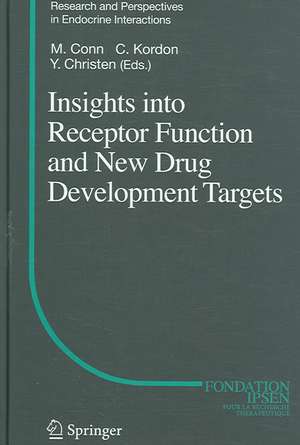
Insights into Receptor Function and New Drug Development Targets
Editat de P. Michael Conn, Claude Kordonen Limba Engleză Hardback – 25 iul 2006
The state of our art also benefits by the availability of superior tools that allow measurement of interactions and afford unprecedented insight into the biomolecular interactions that present novel approaches to drug design.
Preț: 691.32 lei
Preț vechi: 727.70 lei
-5%
Puncte Express: 1037
Carte tipărită la comandă
Livrare economică 09-23 iunie
Specificații
ISBN-13: 9783540344469
ISBN-10: 3540344462
Pagini: 220
Ilustrații: XV, 202 p.
Dimensiuni: 160 x 241 x 18 mm
Greutate: 0.5 kg
Ediția:2006
Editura: Springer
Locul publicării:Berlin, Heidelberg, Germany
ISBN-10: 3540344462
Pagini: 220
Ilustrații: XV, 202 p.
Dimensiuni: 160 x 241 x 18 mm
Greutate: 0.5 kg
Ediția:2006
Editura: Springer
Locul publicării:Berlin, Heidelberg, Germany
V-ar putea interesa
-
 Endosome Signaling Part AP. Michael Conn-35%Preț: 830.30 lei1279.75 lei
 -
 Cellular Endocrinology in Health and DiseaseAlfredo Ulloa-Aguirre-28%Preț: 668.36 lei928.93 lei
 -
 Receptor-Receptor InteractionsP. Michael Conn-28%Preț: 705.04 lei973.70 lei
 -
 Conn's Translational NeuroscienceP. Michael Conn-27%Preț: 748.11 lei1025.25 lei
 -
 Drugs in PsychiatryBasant K. Puri-18%Preț: 391.11 lei479.22 lei
 -
 Pharmaceutical ChemistryDavid G. Watson-29%Preț: 299.90 lei421.09 lei
 -
 Neuroendocrinology in Physiology and MedicineP Michael Conn-5%Preț: 1424.13 lei1499.09 lei
 -
 -5%Preț: 753.21 lei792.85 lei
 -
 Principles of Pharmacology: The Pathophysiologic Basis of Drug TherapyDavid E. Golan MD, PhD-5%Preț: 625.93 lei658.87 lei
 -
 Handbook of Proteomic MethodsP. Michael Conn-18%Preț: 1204.63 lei1469.06 lei
 -
 -5%Preț: 635.90 lei669.36 lei
Public țintă
ResearchCuprins
Molecular and functional diversity of the TRPC family of ion channels. TRPC channels and their role in ROCE/SOCE.- Functional Rescue of Misfolded Receptor Mutants.- Obesity-related mutations of leptin and melanocortin receptors.- cAMP- and cGMP-dependent control of lipolysis and lipid mobilization in humans: putative targets for fat cell management.- Central Neuropeptide Receptors Involved in Water Balance: Application to Apelin.- Targeting regulators of G protein signaling (RGS proteins) to enhance agonist specificity.- Dimeric GPCRs: what did we learn from the metabotropic glutamate receptors?.- Guiding principles applied in the design of GPCR-selective hypothalamic hormone agonists and antagonists.- Mutations in G proteins and G protein-coupled receptors in human endocrine diseases.- A molecular dissection of the glycoprotein hormone receptors.- Receptor Tyrosine Kinases as Targets for Cancer Therapy Development.- Targets for pituitary tumor therapy.- The endogenous cannabinoid system in the control of food intake and energy balance.
Textul de pe ultima copertă
G-Protein Coupled receptors (GPCRs) and other receptors are significant targets for drug discovery, due to their roles in fundamental physiological processes. Among these roles are: regulation of growth, food intake, reproduction, water balance, sensory perception, blood pressure and heart rate. GPCR-directed drugs account for approximately $40 billion in sales and, of drugs at market, approximately 70% target GPCR function.
The availability of combinatorial chemistry coupled with high throughput screening techniques have facilitated discovery of peptidic and non-peptidic ligands of membrane receptors. Mutant receptor models have revealed their role in health and disease and provided insight to new therapeutic approaches, based on control of protein trafficking. Understanding receptor-receptor interactions has provided one mechanism for receptor cross-talk and revealed unexpected interactions.
The completion of the human genome has identified a new source of therapeutic targets: "orphan receptors" with unknown functions and yet-to-be discovered ligands. Some orphans have now been identified as ghrelin, nociceptin, apelin, and urocortin. This finding, along with important technologies to develop ligands with desirable characteristics, including peptidomimetics is likely to further accelerate interest in this area.
The availability of combinatorial chemistry coupled with high throughput screening techniques have facilitated discovery of peptidic and non-peptidic ligands of membrane receptors. Mutant receptor models have revealed their role in health and disease and provided insight to new therapeutic approaches, based on control of protein trafficking. Understanding receptor-receptor interactions has provided one mechanism for receptor cross-talk and revealed unexpected interactions.
The completion of the human genome has identified a new source of therapeutic targets: "orphan receptors" with unknown functions and yet-to-be discovered ligands. Some orphans have now been identified as ghrelin, nociceptin, apelin, and urocortin. This finding, along with important technologies to develop ligands with desirable characteristics, including peptidomimetics is likely to further accelerate interest in this area.