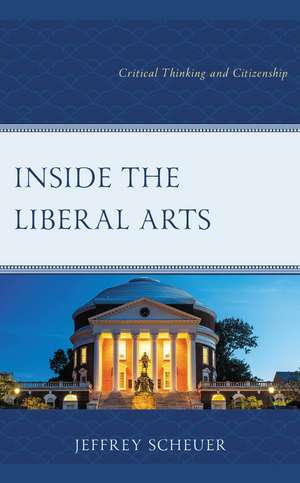
Inside the Liberal Arts: Critical Thinking and Citizenship
Autor Jeffrey Scheueren Limba Engleză Hardback – 8 mar 2023
Preț: 465.43 lei
Preț vechi: 643.31 lei
-28%
Puncte Express: 698
Carte tipărită la comandă
Livrare economică 07-21 decembrie
Livrare prin curier în România Termenul estimat este afișat lângă disponibilitate.
Transport gratuit pentru acest produs Plată online sau ramburs, în funcție de opțiunile comenzii.
Retur gratuit în 14 zile Comandă securizată și suport în română.
Specificații
ISBN-13: 9781475869873
ISBN-10: 1475869878
Pagini: 208
Dimensiuni: 152 x 232 x 18 mm
Greutate: 0.48 kg
Editura: Bloomsbury Publishing
Colecția Rowman & Littlefield
Locul publicării:New York, United States
ISBN-10: 1475869878
Pagini: 208
Dimensiuni: 152 x 232 x 18 mm
Greutate: 0.48 kg
Editura: Bloomsbury Publishing
Colecția Rowman & Littlefield
Locul publicării:New York, United States
V-ar putea interesa
-
 The Big Picture: Why Democracies Need Journalistic ExcellenceJeffrey ScheuerPreț: 237.87 lei
 -
 How to Get Tenure: Strategies for Successfully Navigating the ProcessMichael S. Harris-18%Preț: 1056.30 lei1288.17 lei
 -
 The Peeragogy Handbook, v. 3Joseph CorneliPreț: 117.59 lei
 -
 -18%Preț: 1112.48 lei1356.68 lei
 -
 -19%Preț: 644.21 lei795.33 lei
 -
 -23%Preț: 766.61 lei995.59 lei
 -
 Postwar CornellBrad EdmondsonPreț: 157.60 lei
 -
 Preț: 72.29 lei
 -
 Preț: 80.64 lei
 -
 Preț: 274.08 lei
 -
 Preț: 80.28 lei
 -
 Preț: 145.33 lei
 -
 Gespräche auf AugenhöheIrene M. BeierPreț: 173.80 lei
 -
 Preț: 345.12 lei
Cuprins
Preface
Chapter 1: THE LIBERAL ARTS IDEA
Chapter 2: THE LIBERAL ARTS AND TRIANGULAR CITIZENSHIP
Chapter 3: THE LIBERAL ARTS AS CRITICAL INQUIRY
Chapter 4: LANGUAGE LESSONS
Chapter 5: THE RANGE OF RATIONALITY
Chapter 6: DEFINING CRITICAL THINKING
Chapter 7: THE SPECTRUM OF CRITICAL THINKING
Chapter 8: ANALYSIS 101
Chapter 9: ANALYSIS AND AMBIGUITY
Chapter 10: THE USES OF COMPLEXITY
Chapter 11: TRUTH AND CONSEQUENCES
Chapter 12: THE RIDDLE OF CAUSALITY
Chapter 13: MORALITY AND THE LIBERAL ARTS
Chapter 14: DEMOCRACY AND THE LIBERAL ARTS
Chapter 1: THE LIBERAL ARTS IDEA
Chapter 2: THE LIBERAL ARTS AND TRIANGULAR CITIZENSHIP
Chapter 3: THE LIBERAL ARTS AS CRITICAL INQUIRY
Chapter 4: LANGUAGE LESSONS
Chapter 5: THE RANGE OF RATIONALITY
Chapter 6: DEFINING CRITICAL THINKING
Chapter 7: THE SPECTRUM OF CRITICAL THINKING
Chapter 8: ANALYSIS 101
Chapter 9: ANALYSIS AND AMBIGUITY
Chapter 10: THE USES OF COMPLEXITY
Chapter 11: TRUTH AND CONSEQUENCES
Chapter 12: THE RIDDLE OF CAUSALITY
Chapter 13: MORALITY AND THE LIBERAL ARTS
Chapter 14: DEMOCRACY AND THE LIBERAL ARTS
Recenzii
Remarking on the movement of populations within, and out of, urban America in the 1970s, Richard Sennett notes how it reflected our common urge to be with others "just like ourselves." That, fifty years on, this is precisely how observers characterize our media preferences, social and otherwise, suggests how deeply rooted our determination is to, as Sennett puts it, "remain inviolable." When civic life is reduced to a contest among competing solitudes, the possibility of broad consensus dims dramatically, leaving us with little more than rule by discord. To overcome this condition, we require, perhaps above all, the generously open and strenuously critical habits of mind encouraged by the liberal arts, which welcome opposition on the grounds that truth is most convincingly revealed, and falsehood most comprehensively exposed, through the give-and-take of spirited debate. "Iron," Aquinas reminds us, "is sharpened by iron." In his valuable and timely new book, Inside the Liberal Arts, Jeffrey Schueur brings to these pressing issues the concision of thought and expression we have come to expect from his earlier examinations of democracy and the media.
Jeffrey Scheuer's book on a familiar topic about which much ink has been spilled with pitifully little residue - the liberal arts - is welcome and remarkable on account of its wide-ranging and unusual effort to ground the ideas and practices of the liberal arts in the context of philosophy. The book is free of the familiar rhetoric surrounding educational polemics and makes provocative forays into the philosophy of science, the philosophy of language, epistemology, and moral theory. The point of this endeavor is to remind us that language is the essential instrument of inquiry. Therefore, the liberal arts are essential to democracy; they enable citizens to understand that the life of the mind and a free society go hand in hand.
Jeffrey Scheuer's book on a familiar topic about which much ink has been spilled with pitifully little residue - the liberal arts - is welcome and remarkable on account of its wide-ranging and unusual effort to ground the ideas and practices of the liberal arts in the context of philosophy. The book is free of the familiar rhetoric surrounding educational polemics and makes provocative forays into the philosophy of science, the philosophy of language, epistemology, and moral theory. The point of this endeavor is to remind us that language is the essential instrument of inquiry. Therefore, the liberal arts are essential to democracy; they enable citizens to understand that the life of the mind and a free society go hand in hand.