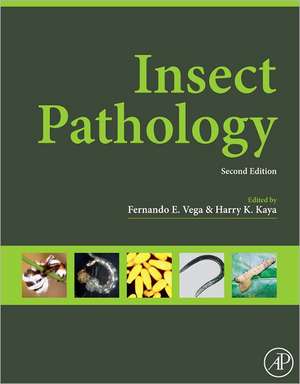
Insect Pathology
Editat de Fernando E. Vega, Harry K. Kayaen Limba Engleză Hardback – 13 feb 2012
Domeniul patologiei insectelor a cunoscut o evoluție accelerată în ultimele două decenii, trecând de la descrieri morfologice clasice la o înțelegere profundă, bazată pe biologia moleculară și genomică. Notăm cu interes că această a doua ediție a lucrării Insect Pathology, editată de Fernando E. Vega și Harry K. Kaya, vine să umple un gol informațional major, recalibrând standardul academic stabilit de prima ediție Tanada-Kaya. Putem afirma că volumul reușește să integreze progresele recente în filogenetică și ecologie, oferind o resursă indispensabilă pentru entomologi și practicienii controlului biologic.
Structura cărții este riguros organizată în 13 capitole, debutând cu principiile de bază și istoria disciplinei, pentru a trece apoi la analiza detaliată a fiecărui grup de patogeni. Un element distinctiv este includerea unor teme moderne, precum infecțiile cu Wolbachia și bolile insectelor benefice, aspecte esențiale pentru agricultura durabilă. Această abordare completează perspectiva oferită de Principles of Insect Pathology de Drion G. Boucias, adăugând date recente despre mecanismele de rezistență ale gazdei și tehnici avansate de diagnostic care nu erau disponibile la data publicării lucrării menționate. Totodată, spre deosebire de Manual of Techniques in Invertebrate Pathology, care se concentrează pe metodologii de laborator, acest volum pune accent pe procesul infecțios și patogeneză.
Poziționarea lucrării în contextul operei lui Fernando E. Vega este firească, acesta continuând cercetările asupra simbiozelor și parazitismului explorate în Insect-Fungal Associations și The Ecology of Fungal Entomopathogens. Insect Pathology reprezintă însă o sinteză mult mai vastă, extinzându-se dincolo de micologie către virologie și bacteriologie, fiind un pilon central pentru curriculumul universitar avansat în zoologie și protecția plantelor.
Preț: 867.92 lei
Preț vechi: 953.76 lei
-9%
Carte tipărită la comandă
Livrare economică 30 noiembrie-14 decembrie
Specificații
ISBN-10: 0123849845
Pagini: 508
Ilustrații: Illustrations
Dimensiuni: 216 x 276 x 28 mm
Greutate: 1.77 kg
Ediția:Revised
Editura: ELSEVIER SCIENCE
V-ar putea interesa
-
 Topics in Ecological and Environmental MicrobiologyThomas M. Schmidt-23%Preț: 542.99 lei701.09 lei
 -
 Mechanisms of MorphogenesisJamie A. Davies-25%Preț: 556.94 lei743.50 lei
 -
 Dynamic Systems Biology Modeling and SimulationJoseph DiStefano III-8%Preț: 569.21 lei618.70 lei
 -
 -22%Preț: 329.36 lei421.38 lei
 -
 Welt der Bakterien, Archaeen und VirenGerhard Gottschalk-5%Preț: 265.79 lei279.78 lei
Public țintă
Entomologists, microbiologists, mycologists, nematologists, protistologists, ecologists, and practitioners of biological control of insect pests; academic faculty and graduate/upper undergraduate students studying in these areas; research directors and laboratory scientists in basic and applied sciencesDe ce să citești această carte
Această ediție este esențială pentru cercetătorii și studenții care au nevoie de o bază teoretică actualizată despre bolile insectelor. Cititorul câștigă acces la expertiza colectivă a liderilor în domeniu, beneficiind de capitole noi despre biologia moleculară a patogenilor și strategii de control microbian. Este resursa definitivă pentru înțelegerea modului în care bolile pot fi utilizate ca alternativă ecologică la pesticidele chimice.
Descriere scurtă
Many of these advances involve new insights on ecology as well as phylogenetics and molecular biology of viruses, bacteria, fungi, microsporidia, nematodes, and protists. All these aspects, as well as basic biology, diagnosis, infectious process and pathogenesis, host response, transmission and more, are covered by renowned experts in their respective fields. The second edition of Insect Pathology includes chapters on the history of this discipline, principles of microbial control and epizootiology, diseases of beneficial insects, host resistance, and Wolbachia. This thoroughly illustrated and up-to-date revision will provide insect pathologists, entomologists, microbiologists, mycologists, nematologists, protistologists, ecologists, and practitioners of biological control of insect pests with a solid and much-needed reference.
- Covers all major groups of insect pathogens
- Includes chapters on the history of insect pathology, principles of microbial control and epizootiology, host resistance, Wolbachia and diseases of beneficial insects
- Includes contributions from the leading researchers and emerging leaders in their fields
Cuprins
Recenzii
"This edited book is an excellent new work spanning the breadth of the field of insect pathology…Excellent and useful illustrations (some in color) and tables are provided throughout the volume. References at the end of each chapter can be extensive, making this a great book for advanced students and professionals." --The Quarterly Review of Biology, June 2013
"[N]ominally a second edition of the 1993 text, ‘Insect Pathology’ by Tanada and Kaya (1993), but differs significantly from this earlier book in scope, organization, content and authorship…. The current book is organized into 13 chapters, each authored by very well-chosen experts in their respective fields…. To address the enormity and complexity of their subject area, Vega and Kaya, although authoring some chapters on their own, have taken advantage of expertise from an impressive roster of researchers to deal with the broad spectrum of information presented…. The book is targeted towards advanced undergraduates and graduate level students, and would provide an excellent basis for insect pathology courses, but would also be an indispensable addition to the library of any researcher interested in insect pathology, entomology, biological control, mycology, virology, bacteriology, protozoology, or nematology." --Society for Invertebrate Pathology Newsletter
"19 years after the publication of the 1st edition, the 2nd edition of this text reflects the strides made in the field, and usefully condenses new research and applications into a concise and authoritative text that will benefit a wide range of specialists, including biological control researchers and graduate students. The chapters include discussion of the various pathogens of each insect, their formulation, delivery systems, and resistance, when applicable, with attention to the specific applications on pest insects. Major chapter topics include the history of the field, principles of epizootiology and microbial control, baculoviruses, RNA viruses that infect pest insects, fungal and bacterial entomophathogens, and nematode parasites and entomopathogens. A separate chapter is devoted to diseases of silkworms and bees." --Reference and Research Book News, August 2012
"With contributions from several experts, the new version is very well written and reads more smoothly when compared to the previous one. Further, the number of chapters was reduced, but they are better arranged and illustrated. Every chapter is accompanied by a comprehensive list of references. It seems that this treatise will become a strong, indispensable tool for those interested in the field for years to come." --CHOICE, October 2012, Vol. 50, No. 02