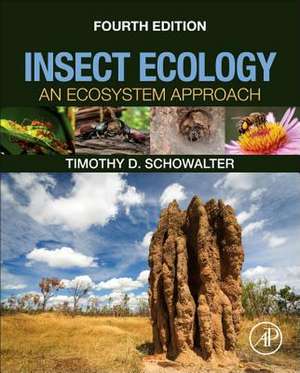
Insect Ecology: An Ecosystem Approach
Autor Timothy D. Schowalteren Limba Engleză Hardback – 15 aug 2016
Cea de-a cincea ediție a volumului Insect Ecology reprezintă o actualizare substanțială a celui mai cuprinzător text dedicat răspunsului insectelor la schimbările de mediu. Față de edițiile anterioare, Timothy D. Schowalter introduce capitole și date noi referitoare la tendințele pe termen lung ale abundenței speciilor, abordând direct fenomenul alarmant al „apocalipsei insectelor”. Subliniem faptul că aceasta rămâne singura resursă academică ce prioritizează efectele insectelor asupra proprietăților ecosistemice, dincolo de simpla lor clasificare biologică.
Structura volumului facilitează o progresie logică, de la ecologia individului (adaptări abiotice și alocarea resurselor) la dinamica populațiilor și biogeografie, culminând cu secțiuni extinse despre interacțiunile la nivel de comunitate și ecosistem. Considerăm esențial modul în care autorul tratează teme precum polenizarea, descompunerea și pedogeneza, demonstrând cum insectele acționează ca regulatori ai proceselor naturale. Această ediție extinde cadrul propus de Insects and Sustainability of Ecosystem Services prin integrarea unor date recente despre mecanismele de reglare a funcțiilor ecosistemice, oferind o perspectivă mult mai aplicată în managementul sustenabil.
În contextul operei sale, Insect Ecology rafinează temele explorate în Insects and Society, mutând accentul de la impactul social și economic către o analiză științifică riguroasă a serviciilor ecosistemice. Volumul reușește să sintetizeze principii ecologice complexe, fiind susținut vizual de peste 200 de ilustrații. Comparativ cu Insect Diversity and Ecosystem Services, care se concentrează pe aplicații industriale și medicale, lucrarea de față oferă o viziune sistemică, integrând morfologia și fiziologia în contextul adaptării la schimbările climatice globale.
Preț: 478.80 lei
Preț vechi: 630.82 lei
-24%
Carte tipărită la comandă
Livrare economică 01-15 decembrie
Specificații
ISBN-10: 012803033X
Pagini: 774
Dimensiuni: 191 x 235 x 43 mm
Greutate: 1.75 kg
Ediția:4 Rev ed.
Editura: ELSEVIER SCIENCE
V-ar putea interesa
-
 Biology of Ticks Volume 2Daniel E. Sonenshine-33%Preț: 1483.50 lei2212.26 lei
 -
 Spider MitesBozzano G Luisa-14%Preț: 2540.98 lei2954.63 lei
 -
 Insect MigrationV. Alistair Drake-8%Preț: 424.49 lei461.39 lei
 -
 An Introduction to Arthropod Pest ControlJ. R. M. Thacker-19%Preț: 501.69 lei619.37 lei
 -
 EntomologyCedric Gillott-18%Preț: 1281.68 lei1563.02 lei
 -
 Insects and Sustainability of Ecosystem ServicesTimothy D. Schowalter-18%Preț: 1121.20 lei1367.32 lei
 -
 Miniature LivesMichelle GleesonPreț: 382.84 lei
 -
 -18%Preț: 1534.21 lei1870.98 lei
 -
 -14%Preț: 843.49 lei980.81 lei
 -
 -14%Preț: 852.96 lei991.81 lei
 -
 -23%Preț: 861.47 lei1118.79 lei
 -
 The Buprestidae (Coleoptera) of Fennoscandia and DenmarkSvatopluk Bílý-14%Preț: 845.20 lei982.79 lei
 -
 -14%Preț: 849.51 lei987.80 lei
 -
 -23%Preț: 1049.51 lei1362.99 lei
 -
 The Psylloidea (Homoptera) of Fennoscandia and DenmarkF. Ossiannilsson-23%Preț: 1052.32 lei1366.65 lei
 -
 -23%Preț: 825.17 lei1071.65 lei
 -
 The Brentidae (Coleoptera) of Northern EuropeHans Gonget-23%Preț: 1110.18 lei1441.79 lei
Public țintă
Primarily professional entomologists, ecologists and others with interest in how insects engineer our global ecosystem, as well as how they respond to environmental changes. This book can be, and has been, used in graduate Insect Ecology courses. Reviewers of previous editions also have recommended it for undergraduate Insect Ecology studentsDe ce să citești această carte
Această resursă este fundamentală pentru entomologi și ecologi care doresc să înțeleagă rolul insectelor în menținerea echilibrului planetar. Cititorul câștigă o perspectivă modernă asupra declinului global al insectelor și instrumente practice pentru managementul sustenabil al dăunătorilor. Este un curs complet, ideal pentru studenții avansați, care transformă entomologia dintr-o știință descriptivă într-una strategică pentru conservarea mediului.
Descriere scurtă
Chapters build on fundamental information to show how insect populations respond to changing environmental conditions, including spatial and temporal distribution of food and habitat. The next section integrates populations of interacting species within communities and how these interactions determine structure of communities over time and space.
Other works in insect ecology stop there, essentially limiting presentation of insect ecology to evolutionary responses of insects to their environment, including the activities of other species. The unique aspect of this book is its four chapters on ecosystem structure and function, and how herbivores, pollinators, seed predators, and detritivores drive ecosystem dynamics and contribute to ecosystem stability.
- Provides the most advanced synthesis of insect ecology, with updated material throughout and new chapters
- Presents the roles of insects in delivery of ecosystem services and applications to pest management and conservation
- Features full coverage of ecosystem structure and function balanced with essential background on evolutionary aspects
- Includes case studies highlighting practical and theoretical applications for topics covered in each chapter
Cuprins
Section I: Ecology of individual insects2. Responses to Abiotic Conditions3. Resource Acquisition4. Resource Allocation
Section II: Population ecology5. Population Systems6. Population Dynamics7. Biogeography
Section III: Community ecology8. Species Interactions9. Community Structure10. Community Dynamics
Section IV: Ecosystem level11. Ecosystem Structure and Function12. Herbivory13. Pollination, Seed Predation, and Seed Dispersal14. Decomposition and Pedogenesis15. Insects as Regulators of Ecosystem Processes
Section V: Applications and synthesis16. Application to Sustainability of Ecosystem Services17. Management of Insect Populations18. Summary and Synthesis