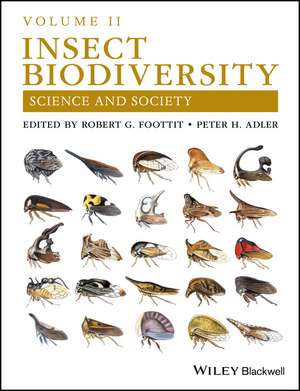
Insect Biodiversity: Insect Biodiversity, cartea 2
Editat de Robert G Foottit, Peter H Adleren Limba Engleză Hardback – 13 iun 2018
Evoluția entomologiei contemporane reflectă o trecere necesară de la simpla catalogare taxonomică la o înțelegere profundă a rolului insectelor în stabilitatea ecosistemelor globale. Putem afirma că Insect Biodiversity, Volumul 2, editat de Robert G Foottit și Peter H Adler, reprezintă un efort de sinteză masiv, adaptat provocărilor climatice actuale. Notăm cu interes extinderea ariei de studiu către regiuni mai puțin explorate în literatura de specialitate, precum zona Arctică și Asia, dar și includerea unor medii de nișă ca peșterile și insulele, unde biodiversitatea este extrem de vulnerabilă. Structura acestui volum de 1024 de pagini se distinge prin abordarea multidisciplinară: nu sunt analizate doar speciile și relațiile lor evolutive, ci și intersecția acestora cu cultura, arta și sistemele agricole. Ne-a atras atenția modul în care autorii integrează studiile de caz pentru a demonstra consecințele pierderii speciilor asupra securității alimentare a populației umane. Această ediție completează perspectiva oferită de Insect Biodiversity Science and Society, Volume 1, care se concentra pe bazele taxonomice și ecologice, adăugând acum dimensiunea societală, tehnică și impactul speciilor invazive. Față de Insect Diversity and Ecosystem Services, care pune accent pe aplicațiile medico-legale și industriale, lucrarea de față oferă o viziune mai vastă, incluzând date din registrul fosil și analize detaliate ale impactului schimbărilor climatice la nivel global.
Preț: 885.90 lei
Preț vechi: 1150.53 lei
-23%
Carte disponibilă
Livrare economică 30 octombrie-13 noiembrie
Specificații
ISBN-10: 1118945573
Pagini: 1056
Dimensiuni: 202 x 256 x 50 mm
Greutate: 2.15 kg
Ediția:Volume 2
Editura: Wiley
Seria Insect Biodiversity
Locul publicării:Chichester, United Kingdom
V-ar putea interesa
-
 Effects of Climate Change on Insects: Physiological, Evolutionary, and Ecological ResponsesDaniel González-Tokman-32%Preț: 699.67 lei1027.95 lei
 -
 Insects: A Very Short IntroductionSimon Leather-20%Preț: 57.11 lei71.20 lei
 -
 -21%Preț: 155.56 lei197.77 lei
 -
 -13%Preț: 131.16 lei151.45 lei
 -
 -16%Preț: 124.66 lei147.55 lei
 -
 Biodiversity and Insect PestsGeoff M Gurr-23%Preț: 734.10 lei953.37 lei
 -
 The Little Book of BeetlesArthur V. EvansPreț: 90.19 lei
 -
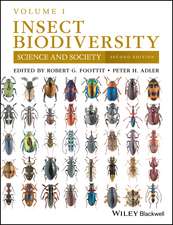 Insect Biodiversity Science and Society, Volume 1Robert G Foottit-23%Preț: 738.61 lei959.23 lei
 -
 -30%Preț: 118.78 lei170.16 lei
 -
 The Royal Entomological Society Book of British InsectsPeter C. Barnard-19%Preț: 422.17 lei521.19 lei
 -
 -29%Preț: 179.55 lei251.55 lei
 -
 Advances in Environmental Research: Volume 18Justin A Daniels-26%Preț: 730.58 lei992.26 lei
 -
 -23%Preț: 179.79 lei234.31 lei
 -
 Bug Life: How Insects, Spiders, Bees, and Worms Run the WorldKaryn Light-Gibson-21%Preț: 77.02 lei97.52 lei
 -
 -18%Preț: 1161.28 lei1416.19 lei
 -
 Insect ConservationMichael J Samways-19%Preț: 469.13 lei579.18 lei
 -
 -26%Preț: 205.13 lei276.91 lei
 -
 The Insect CrisisOliver Milman-32%Preț: 63.43 lei92.61 lei
 -
 An Insect A DayDominic Couzens-7%Preț: 154.29 lei166.40 lei
 -
 Insect Decline and Conservation in the NeotropicsJorge L. León-Cortés-18%Preț: 1073.76 lei1309.46 lei
De ce să citești această carte
Această lucrare este esențială pentru cercetători și studenți la biologie sau științele mediului, oferind un fundament teoretic și practic pentru gestionarea durabilă a ecosistemelor. Cititorul câștigă acces la cele mai noi date despre conservarea insectelor și înțelege mecanismele prin care degradarea habitatelor ne afectează direct existența. Este resursa definitivă pentru oricine studiază entomologia în contextul crizei climatice actuale.
Despre autor
Robert G Foottit și Peter H Adler sunt experți recunoscuți în domeniul entomologiei și biodiversității. Robert G. Foottit are o carieră îndelungată în cercetarea taxonomică și managementul datelor despre biodiversitate, fiind implicat în numeroase proiecte internaționale de catalogare a faunei de insecte. Peter H. Adler este profesor de entomologie, specializat în ecologia și sistematica dipterelor, cu o vastă experiență în studiul relațiilor dintre insecte și mediul lor. Împreună, au coordonat echipe globale de specialiști pentru a realiza această serie de referință publicată de Wiley.
Descriere
Volume Two of the new guide to the study of biodiversity in insects
Volume Two of Insect Biodiversity: Science and Society presents an entirely new, companion volume of a comprehensive resource for the most current research on the influence insects have on humankind and on our endangered environment. With contributions from leading researchers and scholars on the topic, the text explores relevant topics including biodiversity in different habitats and regions, taxonomic groups, and perspectives.
Volume Two offers coverage of insect biodiversity in regional settings, such as the Arctic and Asia, and in particular habitats including crops, caves, and islands. The authors also include information on historical, cultural, technical, and climatic perspectives of insect biodiversity.
This book explores the wide variety of insect species and their evolutionary relationships. Case studies offer assessments on how insect biodiversity can help meet the needs of a rapidly expanding human population, and examine the consequences that an increased loss of insect species will have on the world. This important text:
- Offers the most up-to-date information on the important topic of insect biodiversity
- Explores vital topics such as the impact on insect biodiversity through habitat loss and degradation and climate change
- With its companion Volume I, presents current information on the biodiversity of all insect orders
- Contains reviews of insect biodiversity in culture and art, in the fossil record, and in agricultural systems
- Includes scientific approaches and methods for the study of insect biodiversity
The book offers scientists, academics, professionals, and students a guide for a better understanding of the biology and ecology of insects, highlighting the need to sustainably manage ecosystems in an ever-changing global environment.
Notă biografică
Cuprins
Foreword xxix
Preface, Volume II xxxiii
Acknowledgments xxxv
1 Introduction - A Brief History of Revolutions in the Study of Insect Biodiversity 1
Peter H. Adler and Robert G. Foottit
1.1 Discovery 1
1.2 Conceptual Development 5
1.3 Information Management 6
1.4 Conclusions 7
Part I Habitats and Regions 13
2 Insect Biodiversity in the Arctic 15
Ian D. Hodkinson
2.1 Documenting Biodiversity - Traditional Taxonomy Versus DNA Barcoding 17
2.2 Insect Species Diversity in the Arctic 18
2.3 Historical Insect Biodiversity in the Arctic - the Time Perspective 29
2.4 Biodiversity on the Landscape Scale 32
2.5 Important Characteristics of Arctic Insect Biodiversity 35
2.6 Cold Tolerance - a Diversity of Adaptations 38
2.7 Dispersal, Immigration, and Biodiversity 39
2.8 Pollinator Networks and Pollinator Biodiversity 40
2.9 A Biodiversity Paradise for Parasites? 41
2.10 Biodiversity and the Changing Arctic Climate 42
3 Insect Biodiversity in Indochina: A Window into the Riches of the Oriental Region 59
Seunghwan Lee and Ram Keshari Duwal
3.1 Physical Geography and Climate 62
3.2 Features of Insect Biodiversity in the Lower Mekong Subregion 62
3.3 Insect Biodiversity and Society in Indochina 74
3.4 Conclusions 77
4 Biodiversity of Arthropods on Islands 81
Rosemary G. Gillespie and Kipling Will
4.1 What is an Island? 81
4.2 Ecological Attributes of Islands 85
4.3 Evolution on Islands 87
4.4 Evolution in Other Insular Environments 89
4.5 Characteristics of Island Biodiversity 90
4.6 Conservation 92
4.7 Conclusion 94
5 Beneficial Insects in Agriculture: Enhancement of Biodiversity and Ecosystem Services 105
Matthew S. Jones and William E. Snyder
5.1 Components of Biodiversity: Species Richness, Species Evenness, and Species Identity 106
5.2 Why Does Insect Biodiversity Matter to Agriculture? 106
5.3 Degradation of Biodiversity Through Agricultural Intensification, and Its Reversal 112
5.4 Restoring Biodiversity to Agroecosystems 112
5.5 Conclusions and Recommendations 115
5.6 Summary 116
6 Insects in Caves 123
David C. Culver and Tanja Pipan
6.1 The Story of Leptodirus hochenwartii 123
6.2 The Variety of Subterranean Spaces 124
6.3 Ecological Roles of Insects in Caves 133
6.4 Morphological and Life?]History Adaptations of Insects to Subterranean Life 134
6.5 Probable Modes of Successful Colonization of Subterranean Space 138
6.6 Taxonomic and Geographic Patterns of Subterranean Insect Biodiversity 142
6.7 Human Utility and Protection of Cave Insects 147
Part II Taxa 153
7 Biodiversity of the Thysanurans (Microcoryphia and Zygentoma) 155
Luis F. Mendes
7.1 Paleontological Data 159
7.2 Parasitism 167
7.3 Predation 168
7.4 Order Microcoryphia (= Archaeognatha) 168
7.5 Order Zygentoma (= Thysanura Sensu Stricto) 175
7.6 Genetic Studies of Thysanurans 183
7.7 Thysanurans and Humans 184
7.8 Geographic Distribution of the Thysanurans 185
8 Biodiversity of Zoraptera and Their Little?]Known Biology 199
Jae C. Choe
8.1 Morphology 201
8.2 Life History and Ecology 204
8.3 Reproduction 208
8.4 Phylogenetic Position - "The Zoraptera Problem" 210
8.5 Conclusion 211
9 Biodiversity of Embiodea 219
Janice S. Edgerly
9.1 Diversity in Habitat and Silk 223
9.2 The Promise of Silk?]Like Biomaterials and Emerging Lessons from Webspinners 228
9.3 Social Behavior 229
9.4 Families of Embiodea 231
9.5 Webspinners of the Fossil Record 239
9.6 Conclusion 239
10 Biodiversity of Orthoptera 245
Hojun Song
10.1 Taxonomic Classification and Phylogeny 245
10.2 Diversity and Distribution 246
10.3 Morphological and Biological Diversity 250
10.4 Societal Importance 253
10.5 Overview of Taxa 254
11 Biodiversity of Phasmatodea 281
Sven Bradler and Thomas R. Buckley
11.1 Phasmatodean Phylogeny 286
11.2 Overview of Taxa 288
11.3 The Phasmatodean Fossil Record 300
11.4 Phasmatodea as Research Tools 302
11.5 Importance to Human Society 304
12 Biodiversity of Dermaptera 315
Fabian Haas
12.1 Epizoic Dermaptera 315
12.2 Structure and Function 318
12.3 Locomotion 319
12.4 Distribution 319
12.5 Development and Reproduction 323
12.6 Behavior 323
12.7 Parasitism and Symbiosis 324
12.8 Fossils and Research History 324
12.9 Overview of Taxa 325
12.10 Societal and Scientific Importance 326
13 Biodiversity of Grylloblattodea and Mantophasmatodea 335
Monika J. B. Eberhard, Sean D. Schoville and Klaus?]Dieter Klass
13.1 Grylloblattodea 336
13.2 Mantophasmatodea 343
13.3 Fossil Record 351
13.4 Conclusions 352
14 Biodiversity of Blattodea - the Cockroaches and Termites 359
Marie Djernæs
14.1 Overview of Taxa 362
14.2 Societal Importance 373
15 Biodiversity of Mantodea 389
Frank Wieland and Gavin J. Svenson
15.1 Morphological and Biological Diversity 391
15.2 Phylogeny and Classification 396
15.3 Morphological Convergence and Ecomorphs 406
15.4 Conclusions 407
16 Biodiversity of Psocoptera 417
Edward L. Mockford
16.1 Classification 418
16.2 Overview of the Psocoptera 422
16.3 Summary of Diversity of the Psocoptera and Predictions 447
16.4 The Importance to Humans of Psocopteran Biodiversity 448
17 Biodiversity of Ectoparasites: Lice (Phthiraptera) and Fleas (Siphonaptera) 457
Terry D. Galloway
17.1 Phthiraptera - The Parasitic Lice 458
17.2 Siphonaptera - The Fleas 465
17.3 Medical and Veterinary Importance 474
17.4 Community Diversity of Lice and Fleas 477
17.5 Conservation of Lice and Fleas 478
18 Biodiversity of Thysanoptera 483
Laurence A. Mound
18.1 What Are Thrips? 484
18.2 Family Diversity 484
18.3 The Lives of Thrips 486
18.4 Thrips Around the World 487
18.5 Thrips as Research Targets 488
18.6 Structural Diversity of Thrips 491
18.7 Thrips as Pests 493
18.8 Thrips and Human Life 494
18.9 Thrips Information Sources 495
19 The Diversity of the True Hoppers (Hemiptera: Auchenorrhyncha) 501
Charles R. Bartlett, Lewis L. Deitz, Dmitry A. Dmitriev, Allen F. Sanborn, Adeline Soulier?]Perkin and Matthew S. Wallace
19.1 Overview of the Auchenorrhyncha 511
19.1.2 Fulgoromorpha 530
20 The Biodiversity of Sternorrhyncha: Scale Insects, Aphids, Psyllids, and Whiteflies 591
Nate B. Hardy
20.1 Sternorrhyncha and Society 591
20.2 Taxonomic Diversity of Sternorrhyncha 593
20.3 Functional Diversity of Sternorrhyncha 596
20.4 Conclusions 615
21 Biodiversity of the Neuropterida (Insecta: Neuroptera, Megaloptera, and Raphidioptera) 627
John D. Oswald and Renato J. P. Machado
21.1 Phylogeny 628
21.2 Geological Age 628
21.3 Metamorphosis and Life Stages 629
21.4 Biology 634
21.5 Distribution 636
21.6 Overview of Orders and Families 637
21.7 Societal Importance 658
21.8 Scientific Importance 659
22 Biodiversity of Strepsiptera 673
Jeyaraney Kathirithamby
22.1 Family Bahiaxenidae 678
22.2 Suborder Mengenillidia 678
22.3 Suborder Stylopidia 681
22.4 Infraorder Stylopiformia 685
22.5 Conclusions 694
23 Biodiversity of Mecoptera 705
Wesley J. Bicha
23.1 Suborder Nannomecoptera 706
23.2 Suborder Pistillifera 707
23.3 Societal Value of Mecoptera 715
23.4 Scientific Value of Mecoptera 716
23.5 Conclusion 716
Part III Perspectives 721
24 The Fossil History of Insect Diversity 723
Conrad C. Labandeira
24.1 Importance of the Insect Fossil Record 724
24.2 Types of Insect Diversity Past and Present 725
24.3 Biodiversity Changes Through Time 765
24.4 Current Societal Aspects of Fossil Insect Biodiversity 773
24.5 Conclusions 776
25 Phenotypes in Insect Biodiversity Research 789
István Mikó and Andrew R. Deans
25.1 Phenotype Data: Past and Present 789
25.2 Phenotype Data: Present and Future 791
25.3 Challenges and Future Directions 795
26 Global Change and Insect Biodiversity in Agroecosystems 801
David R. Gillespie, Matthew J. W. Cock, Thibaud Decaëns, Philippa J. Gerard, Sandra D. Gillespie, Juan J. Jiménez and Owen O. Olfert
26.1 Global Change 801
26.2 Insect Biodiversity in Agriculture 803
26.3 Effects of Global Change on Biodiversity - What Do We Know? 805
26.4 Island Versus Continent Contrasts 815
26.5 Tropical Versus Temperate Issues 818
26.6 Some Concluding Viewpoints 822
27 Digital Photography and the Democratization of Biodiversity Information 839
Stephen A. Marshall
27.1 The Digital Insect Collection 840
27.2 Digital Images in Interactive Keys 844
27.3 Digital Photography and Taxonomic Revisions 845
27.4 Organization of Digital Insect Collections 848
27.5 Conclusions 849
28 Bee (Hymenoptera: Apoidea: Anthophila) Diversity Through Time 851
Sophie Cardinal
28.1 Morphological Diversity 851
28.2 Behavioral Diversity: Social, Nesting, and Floral Hosts 852
28.3 Geographical Diversity 852
28.4 Evolutionary History and Diversification 853
28.5 Conclusions 863
29 Insect Biodiversity in Culture and Art 869
Gene Kritsky and Jessee J. Smith
29.1 Prehistory 870
29.2 Insects in the Ancient World 871
29.3 The Cult of Artemis: A Case Study 874
29.4 Roman Insect Art 875
29.5 Ancient China 876
29.6 Religions of India 877
29.7 Post?]Classical Era 877
29.8 The Americas 880
29.9 Modern History 882
29.10 Japanese Art 884
29.11 Language and Literature 886
29.12 Insects in Music 889
29.13 Insects in Cinema 891
29.14 Akihabara Culture: Toys, Video Games, and Anime from Modern Japan 892
29.15 Present and Future Trends in Cultural Entomology 894
29.16 The Internet Age 895
References 896
Index of Arthropod Taxa Arranged by Order and Family 899
Index of Arthropod Taxa Arranged Alphabetically 943
Index of non?]Arthropod Taxa Arranged Alphabetically 975
Subject Index 979