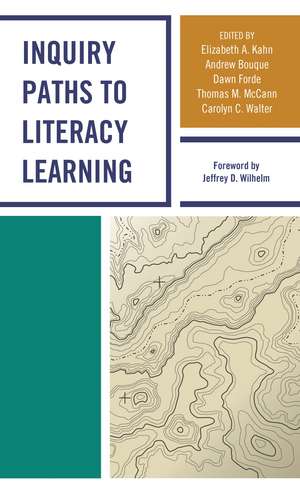
Inquiry Paths to Literacy Learning: A Guide for Elementary and Secondary School Educators
Editat de Elizabeth A. Kahn, Andrew Bouque, Dawn Forde, Thomas M. McCann, Carolyn C. Walteren Limba Engleză Paperback – 25 oct 2019
Preț: 281.45 lei
Preț vechi: 370.96 lei
-24%
Puncte Express: 422
Carte tipărită la comandă
Livrare economică 13-27 noiembrie
Livrare prin curier în România Termenul estimat este afișat lângă disponibilitate.
Transport gratuit de la 400.00 lei Plată online sau ramburs, în funcție de opțiunile comenzii.
Retur gratuit în 14 zile Comandă securizată și suport în română.
Specificații
ISBN-13: 9781475850352
ISBN-10: 1475850352
Pagini: 176
Ilustrații: 4 b/w illustrations; 4 tables; 13 textboxes
Dimensiuni: 150 x 228 x 14 mm
Greutate: 0.3 kg
Editura: Bloomsbury Publishing
Colecția Rowman & Littlefield
Locul publicării:New York, United States
ISBN-10: 1475850352
Pagini: 176
Ilustrații: 4 b/w illustrations; 4 tables; 13 textboxes
Dimensiuni: 150 x 228 x 14 mm
Greutate: 0.3 kg
Editura: Bloomsbury Publishing
Colecția Rowman & Littlefield
Locul publicării:New York, United States
Cuprins
Foreword
Jeffrey D. Wilhelm, Boise State University
Acknowledgments
Editors' IntroductionElizabeth A. Kahn, Andrew Bouque, Dawn Forde, Thomas M. McCann, and Carolyn C. WalterPart I: An Invitation to Inquiry
Chapter 1- Inquiring into Inquiry in English Language Arts
Hugh Kesson, Michael W. Smith, and Jon-Philip Imbrenda
Chapter 2- Inquiry-Based Processes for Writing
Thomas M. McCann
Chapter 3- Inquiry and Literature: Beginning with Why?
Carolyn Calhoun Walter
Chapter 4- Inquiring in First-Year Composition
Shayne Dwyer and Faye ScottPart II: The Practice of Inquiry
Chapter 5- Planning Inquiry-Based Learning
Elizabeth A. Kahn
Chapter 6- Managing Group Inquiry
Patricia Dalton and Suzanne Starnes
Chapter 7- Launching Independent Inquiries
Deborah Stern and Stacey Carlough
Chapter 8- Assessing the Impact of Inquiry
Andrew Bouque
Part III: Inquiry Beyond the ELA Classroom
Chapter 9- Investigating Text and Self: Inquiry, Literacy, and Social-Emotional Learning Gabrielle Caputo and Shannon McMullen
Chapter 10- Inquiry and Service Learning in Teacher Education
Peter Smagorinsky
Chapter 11- Cross-Disciplinary Collaborations: Valuing Inquiry to Navigate Controversy
Peter Anderson and Dawn Forde
Chapter 12- Learning with Tools of Digital Inquiry
Mary Rice
About the Editors
About the Contributors
Jeffrey D. Wilhelm, Boise State University
Acknowledgments
Editors' IntroductionElizabeth A. Kahn, Andrew Bouque, Dawn Forde, Thomas M. McCann, and Carolyn C. WalterPart I: An Invitation to Inquiry
Chapter 1- Inquiring into Inquiry in English Language Arts
Hugh Kesson, Michael W. Smith, and Jon-Philip Imbrenda
Chapter 2- Inquiry-Based Processes for Writing
Thomas M. McCann
Chapter 3- Inquiry and Literature: Beginning with Why?
Carolyn Calhoun Walter
Chapter 4- Inquiring in First-Year Composition
Shayne Dwyer and Faye ScottPart II: The Practice of Inquiry
Chapter 5- Planning Inquiry-Based Learning
Elizabeth A. Kahn
Chapter 6- Managing Group Inquiry
Patricia Dalton and Suzanne Starnes
Chapter 7- Launching Independent Inquiries
Deborah Stern and Stacey Carlough
Chapter 8- Assessing the Impact of Inquiry
Andrew Bouque
Part III: Inquiry Beyond the ELA Classroom
Chapter 9- Investigating Text and Self: Inquiry, Literacy, and Social-Emotional Learning Gabrielle Caputo and Shannon McMullen
Chapter 10- Inquiry and Service Learning in Teacher Education
Peter Smagorinsky
Chapter 11- Cross-Disciplinary Collaborations: Valuing Inquiry to Navigate Controversy
Peter Anderson and Dawn Forde
Chapter 12- Learning with Tools of Digital Inquiry
Mary Rice
About the Editors
About the Contributors
Recenzii
At a time when society and schools are running at a faster-than-ever break neck pace, a purposeful move towards inquiry-focused learning is precisely the salve that can create more thoughtful and critically-minded students and teachers. What Elizabeth Kahn and her colleagues do in Inquiry Paths to Literacy Learning is provide an essential guide-collected from experts around the field of English Language Arts--to developing classes of students who thrive while pursuing deeper, nuanced understandings of issues important to them.
This book puts the process of inquiryat front and center. Instead of merely touting the benefits of inquiry, the authors adeptly unite theory and practice by first presenting readers with a rich theoretical and historical backdrop for the concept of inquiry and next illustrating inquiry in action in English language arts classrooms. The depth of this book will reignite teachers and teacher educators' excitement about the learning process.
The editors of Inquiry Paths to Literacy Learning have curated an inspired approach to guided inquiry, one that teachers will find indispensable. Through cogent explanations and inspiring and well-crafted examples, this volume places guided inquiry right at the heart of literacy instruction, where it belongs.
Kahn and her colleagues provide us with a remarkable approach to teaching English that harnesses students' curiosity to engage them in real-world problem solving-and that's also a lot of fun. Demonstrating admirable depth and breadth and rooted in the foundational research of George Hillocks, their advice covers a range of topics, from classroom instruction to service learning, from planning to assessment, from canonical literature to contemporary young adult texts, from whole-class instruction to small-group work, and from traditional classrooms to digital tools. Are you concerned that you and your students are just going through the motions? Would you like to turn up the dial on your students' engagement in rigorous critical thinking? Is it time for you to cast a bolt of energy into your class discussions? Read this book, follow its promising practical advice, and stand back!
This book puts the process of inquiryat front and center. Instead of merely touting the benefits of inquiry, the authors adeptly unite theory and practice by first presenting readers with a rich theoretical and historical backdrop for the concept of inquiry and next illustrating inquiry in action in English language arts classrooms. The depth of this book will reignite teachers and teacher educators' excitement about the learning process.
The editors of Inquiry Paths to Literacy Learning have curated an inspired approach to guided inquiry, one that teachers will find indispensable. Through cogent explanations and inspiring and well-crafted examples, this volume places guided inquiry right at the heart of literacy instruction, where it belongs.
Kahn and her colleagues provide us with a remarkable approach to teaching English that harnesses students' curiosity to engage them in real-world problem solving-and that's also a lot of fun. Demonstrating admirable depth and breadth and rooted in the foundational research of George Hillocks, their advice covers a range of topics, from classroom instruction to service learning, from planning to assessment, from canonical literature to contemporary young adult texts, from whole-class instruction to small-group work, and from traditional classrooms to digital tools. Are you concerned that you and your students are just going through the motions? Would you like to turn up the dial on your students' engagement in rigorous critical thinking? Is it time for you to cast a bolt of energy into your class discussions? Read this book, follow its promising practical advice, and stand back!