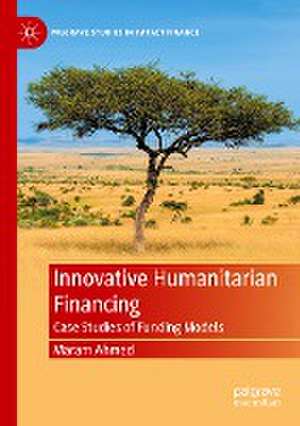
Innovative Humanitarian Financing: Palgrave Studies in Impact Finance
Autor Maram Ahmeden Limba Engleză Paperback – 20 oct 2022
Din seria Palgrave Studies in Impact Finance
- 18%
 Preț: 910.50 lei
 - 18%
 Preț: 965.54 lei
 - 18%
 Preț: 751.25 lei
 -
 Preț: 363.90 lei
 -
 Preț: 480.23 lei
 - 18%
 Preț: 962.85 lei
 - 18%
 Preț: 806.20 lei
 - 18%
 Preț: 909.67 lei
 - 18%
 Preț: 740.15 lei
 - 18%
 Preț: 957.01 lei
 - 15%
 Preț: 662.19 lei
 -
 Preț: 500.58 lei
 -
 Preț: 433.00 lei
 - 15%
 Preț: 666.02 lei
 -
 Preț: 395.06 lei
 - 18%
 Preț: 930.89 lei
 - 18%
 Preț: 1038.25 lei
 - 18%
 Preț: 978.89 lei
 - 15%
 Preț: 667.41 lei
 - 18%
 Preț: 905.97 lei
 - 18%
 Preț: 963.52 lei
 -
 Preț: 430.38 lei
 -
 Preț: 467.23 lei
 - 18%
 Preț: 762.17 lei
 - 15%
 Preț: 725.71 lei
 - 18%
 Preț: 1151.03 lei
 - 15%
 Preț: 617.63 lei
 - 18%
 Preț: 1145.08 lei
 - 15%
 Preț: 665.66 lei
 - 18%
 Preț: 924.21 lei
 - 15%
 Preț: 726.64 lei
Preț: 664.28 lei
Preț vechi: 781.51 lei
-15%
Puncte Express: 996
Carte tipărită la comandă
Livrare economică 07-21 decembrie
Livrare prin curier în România Termenul estimat este afișat lângă disponibilitate.
Transport gratuit pentru acest produs Plată online sau ramburs, în funcție de opțiunile comenzii.
Retur gratuit în 14 zile Comandă securizată și suport în română.
Specificații
ISBN-13: 9783030832117
ISBN-10: 3030832112
Pagini: 256
Ilustrații: XI, 243 p. 1 illus.
Dimensiuni: 148 x 210 x 15 mm
Greutate: 0.34 kg
Ediția:1st ed. 2021
Editura: birkhäuser
Colecția Palgrave Studies in Impact Finance
Seria Palgrave Studies in Impact Finance
Locul publicării:Cham, Switzerland
ISBN-10: 3030832112
Pagini: 256
Ilustrații: XI, 243 p. 1 illus.
Dimensiuni: 148 x 210 x 15 mm
Greutate: 0.34 kg
Ediția:1st ed. 2021
Editura: birkhäuser
Colecția Palgrave Studies in Impact Finance
Seria Palgrave Studies in Impact Finance
Locul publicării:Cham, Switzerland
Cuprins
Chapter 1: Introduction.- Chapter 2: Humanitarian Funding in Crisis and The Rise of Innovative Humanitarian Finance.- Chapter 3: Innovative Vaccine and Immunization Funding: Advance Market Commitment.- Chapter 4: Performance Based Financing.- Chapter 5: Islamic Finance: Role of Traditional Faith-Based Mechanisms in Humanitarian Response.- Chapter 6: Financial Inclusion: Increasing Resilience by Expanding Access to Financial Services.- Chapter 7: Case Study: African Risk Capacity.- Chapter 8: Remittances.- Chapter 9: Harnessing Digital Financial Solutions.- Chapter 10: Conclusion.- Index.
Textul de pe ultima copertă
Humanitarian crises have become more frequent, complex and protracted. If current trends continue, it is estimated that by 2030, humanitarian assistance costs could increase to $50 billion per year. By then, two-thirds of the world’s poor are at risk of living in conflict-affected countries. To bridge the gap, humanitarian organizations are increasingly utilizing innovative financing tools such as impact bonds, faith-based finance and other innovative financial products and services to mobilize greater funding to address humanitarian needs. This book is among the first to assess a set of innovative financing mechanisms that have been transforming the humanitarian sector and explores their key opportunities, challenges and future prospects. This book will be of interest to academics, practitioners, humanitarian organizations and policy makers involved in humanitarian financing and to the humanitarian sector in general.
Maram Ahmed teaches at the Faculty of Law and SocialSciences, SOAS, University of London. Maram has published in various key academic and policy journals and has also published and been featured in mainstream media publications such as the Financial Times, CNBC, Reuters, the World Economic Forum, Devex and others. Maram frequently speaks at conferences and industry summits across the globe and has worked internationally with a range of government, corporate and humanitarian agencies. To find out more, visit www.maramahmed.com.
Maram Ahmed teaches at the Faculty of Law and SocialSciences, SOAS, University of London. Maram has published in various key academic and policy journals and has also published and been featured in mainstream media publications such as the Financial Times, CNBC, Reuters, the World Economic Forum, Devex and others. Maram frequently speaks at conferences and industry summits across the globe and has worked internationally with a range of government, corporate and humanitarian agencies. To find out more, visit www.maramahmed.com.
Caracteristici
Provides a road map of priorities and policy strategies for further development The first to assess a set of innovative financing mechanisms Explores the range of non-traditional financing mechanisms and approaches