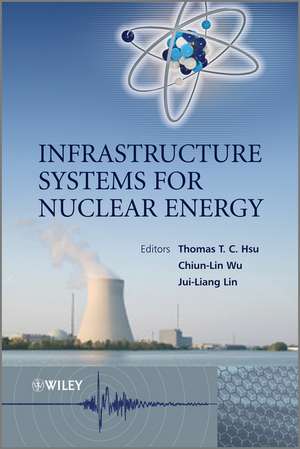
Infrastructure Systems for Nuclear Energy
Editat de Thomas T C Hsu, Chiun-Lin Wu, Jui-Liang Linen Limba Engleză Hardback – 10 feb 2014
Infrastructure Systems for Nuclear Energy addresses the analysis and design of infrastructures associated with nuclear energy. It provides an overview of the current and future nuclear power industry and the infrastructure systems from the perspectives of regulators, operators, practicing engineers, and research academics. This book also provides details on investigation of containment structures, nuclear waste storage facilities, and applications of commercial/academic computer software.
Specific environments that challenge the behavior of nuclear power plant infrastructure systems, such as earthquake, blast, high temperature, irradiation effects, soil-structure interaction effect, etc., are also discussed.
Key features:
- Includes contributions from global experts representing academia and industry
- Provides an overview of the nuclear power industry and nuclear infrastructure systems
- Presents the state-of-the-art as well as the future direction for nuclear civil infrastructure systems
Preț: 746.25 lei
Preț vechi: 1085.40 lei
-31%
Puncte Express: 1119
Carte indisponibilă temporar
Doresc să fiu notificat când acest titlu va fi disponibil:
Se trimite...
Specificații
ISBN-13: 9781119975854
ISBN-10: 1119975859
Pagini: 576
Dimensiuni: 170 x 244 x 33 mm
Greutate: 1.04 kg
Ediția:New.
Editura: Wiley
Locul publicării:Chichester, United Kingdom
ISBN-10: 1119975859
Pagini: 576
Dimensiuni: 170 x 244 x 33 mm
Greutate: 1.04 kg
Ediția:New.
Editura: Wiley
Locul publicării:Chichester, United Kingdom
Public țintă
Practising engineers & researchers in civil & earthquake engineeringPracticing engineers & researchers in mechanical engineering, Graduate students in civil and earthquake engineering
Descriere
Developing sufficient energy resources to replace coal, oil and gas is a globally critical necessity. Alternatives to fossil fuels such as wind, solar, or geothermal energies are desirable, but the usable quantities are limited and each has inherent deterrents.