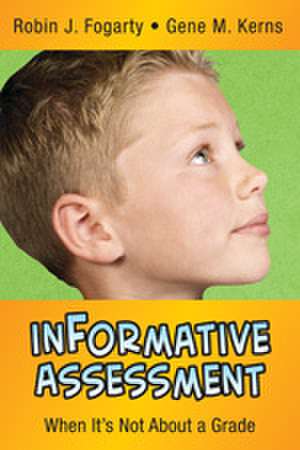
inFormative Assessment: When It's Not About a Grade: In A Nutshell Series
Editat de Robin J. Fogarty, Gene M. Kernsen Limba Engleză Electronic book text – 27 noi 2012
- Routine inFormative Assessments to weave into everyday instruction
- Reflective inFormative Assessments to foster self-assessment for students and teachers
- Rigorous inFormative Assessments to provide continuous tools that inform teaching practices and student learning



Preț: 137.27 lei
Puncte Express: 206
Indisponibil temporar
Doresc să fiu notificat când acest titlu va fi disponibil:
Se trimite...
Specificații
ISBN-13: 9781452213040
ISBN-10: 1452213046
Pagini: 136
Dimensiuni: 152 x 229 mm
Ediția:1
Editura: SAGE Publications
Colecția Corwin
Seria In A Nutshell Series
Locul publicării:Thousand Oaks, United States
ISBN-10: 1452213046
Pagini: 136
Dimensiuni: 152 x 229 mm
Ediția:1
Editura: SAGE Publications
Colecția Corwin
Seria In A Nutshell Series
Locul publicării:Thousand Oaks, United States
V-ar putea interesa
-
 Assessment in Early Childhood SettingsMargaret CarrPreț: 405.08 lei
 -
 AssessmentHoward Tanner-45%Preț: 79.72 lei145.00 lei
 -
 101 Essential Lists on AssessmentTabatha Rayment-41%Preț: 71.62 lei121.73 lei
 -
 Preț: 60.95 lei
 -
 Preț: 49.40 lei
 -
 Succeeding with Your DoctorateJerry Wellington-15%Preț: 602.82 lei709.20 lei
 -
 Standard SettingGregory J. Cizek-18%Preț: 821.70 lei1002.07 lei
 -
 Assessment of LearningWynne Harlen-15%Preț: 614.74 lei723.22 lei
 -
 How to Assess Authentic LearningKathleen B. BurkePreț: 322.63 lei
 -
 Preț: 260.11 lei
 -
 Assessment for Learning in the Early Years Foundation StageJonathan GlazzardPreț: 381.25 lei
Recenzii
"Fogarty
and
Kerns
provide
far
more
than
theory
and
rhetoric—they
have
effectively
created
a
treasure
trove
of
tools
and
ideas
that
every
teacher
can
and
should
be
using.
This
is a
wonderful
resource
for
mentors,
instructional
coaches,
administrators,
and
professional
development
trainers."
"Provides new and veteran educators with clear descriptions of assessment methods and offers a rich array of instructional strategies that can be implemented immediately."
"Promotes the kind of reflective practice that energizes teaching, leading, and learning for all. This book is an important resource for professional learning communities dedicated to 1) assessment of students and their achievement, 2) collaborative teams focused on improved teaching and learning, and 3) continuous improvement."
"Provides new and veteran educators with clear descriptions of assessment methods and offers a rich array of instructional strategies that can be implemented immediately."
"Promotes the kind of reflective practice that energizes teaching, leading, and learning for all. This book is an important resource for professional learning communities dedicated to 1) assessment of students and their achievement, 2) collaborative teams focused on improved teaching and learning, and 3) continuous improvement."
Cuprins
Preface
Acknowledgments
About the Authors
Opening Quote
Introduction
Part I: Purpose/Goals
Part II: "A Suite of Assessments"
Part III: Background/Research
Part IV: Overview of the Book and Chapter Format
1. Routine Formative Assessments: All Day, Everyday-Flow
Teachings
Scene of Scenario (for Reader's Theater Activity)
Define, Describe, and Give Real-World Examples
Tools
Responders/"2Know!"
Lap Boards
Traffic Light Cards
Color-Coded Multiple Choice Cards
Tongue Depressors
Name Cards
Mr. Parnes' Questions
Mr. Pete's Questions
Techniques
Questioning Procedures
Pose Question
Allow Wait Time
Choose a Respondent Using a Random Method
Provide Some "Save Face" Option
HOT Questions
Delving
Woven Questions
Rhetorical Questions
Hands Up Only to Ask a Question Policy
Cooperative Learning (Informal)
TTYPA
Shoulder
Elbow
TESA
Wait Time
Equal Opportunity to Respond
Unpacking the Language of Standards/Tests/Instructions
Tasks
Tips
2. Reflective Informative Assessments: Many Days-Conversations
Teachings
Scene or Scenario (for Reader's Theater)
Define, Describe, and Give Real-World Examples
Tools
Agree/Disagree
People Search
Human Graph
Rubrics/Checklists (Criteria in Kid-Friendly Terms)
Journals
Little Book of Reflective Tools
Step Book
Cooperative Learning Roles and Responsibilities
Peer Tutors
PMI
Traffic Light Indicators
Student Portfolios
Blogs
Tear Share
Magic Book
Mrs. Potters' Questions
Ms. Poindexter's Questions
Techniques
Range Finding Questions (Prior Knowledge)
Hinge Point Questions (During Instruction)
Rubric Development With the Class
Use of Benchmark Papers
Descriptive Feedback
Reflective Questions (Metacognition)
Peer Assessment (Peer Editing)
Cooperative Learning
Interactive Conversations
Teacher - Student/Student - Teacher
Student - Student
Student - Self
Email Buddies
Comments That Reference Criteria, Instead of Grades
"There Are _ Wrong. Find Which Ones."
Focused Marking (One Aspect of Element)
Grading: Omit Zeros, Omit Averages, Require Students to Do Missing Assignments
Tasks
Tips
3. Rigorous Informative Assessments: Some Days - Philosophical Shift
Teachings
Scene or Scenario (for Reader's Theater)
Define, Describe, and Give Real-World Examples
Tools
Performance Tasks
Performance Checklists
Performance Rubrics
Grading Practices
Informative Grading
Informative Grade Book
Gray Area About Grade Books
Standards-Based Grade Books
Color-Coded Grade Books
Electronic Grade Book
Electronic Test Creation Software
Techniques
HOT
Inductive
Deductive
Performance Based
Tests, Test Questions, Test Analysis
Ungraded Practice Test
Developing Test Questions
Test Questions: Fat/Skinny (or Whale/Minnow) Questions
Test and Work Analysis: Examining Student Work
Summative Assessment as Informative Assessment
Philosophical Shift, Between Formative and Summative Assessments
How Can You Use a Summative Assessment in a Formative Manner?
Data
Item Analysis
Robust Distractors
Tasks
Application Activity
Tips
4. Closure
Attribution Theory (Dweck, 2007)
Afterword
Tomlinson Summary Points
References
Index
Acknowledgments
About the Authors
Opening Quote
Introduction
Part I: Purpose/Goals
Part II: "A Suite of Assessments"
Part III: Background/Research
Part IV: Overview of the Book and Chapter Format
1. Routine Formative Assessments: All Day, Everyday-Flow
Teachings
Scene of Scenario (for Reader's Theater Activity)
Define, Describe, and Give Real-World Examples
Tools
Responders/"2Know!"
Lap Boards
Traffic Light Cards
Color-Coded Multiple Choice Cards
Tongue Depressors
Name Cards
Mr. Parnes' Questions
Mr. Pete's Questions
Techniques
Questioning Procedures
Pose Question
Allow Wait Time
Choose a Respondent Using a Random Method
Provide Some "Save Face" Option
HOT Questions
Delving
Woven Questions
Rhetorical Questions
Hands Up Only to Ask a Question Policy
Cooperative Learning (Informal)
TTYPA
Shoulder
Elbow
TESA
Wait Time
Equal Opportunity to Respond
Unpacking the Language of Standards/Tests/Instructions
Tasks
Tips
2. Reflective Informative Assessments: Many Days-Conversations
Teachings
Scene or Scenario (for Reader's Theater)
Define, Describe, and Give Real-World Examples
Tools
Agree/Disagree
People Search
Human Graph
Rubrics/Checklists (Criteria in Kid-Friendly Terms)
Journals
Little Book of Reflective Tools
Step Book
Cooperative Learning Roles and Responsibilities
Peer Tutors
PMI
Traffic Light Indicators
Student Portfolios
Blogs
Tear Share
Magic Book
Mrs. Potters' Questions
Ms. Poindexter's Questions
Techniques
Range Finding Questions (Prior Knowledge)
Hinge Point Questions (During Instruction)
Rubric Development With the Class
Use of Benchmark Papers
Descriptive Feedback
Reflective Questions (Metacognition)
Peer Assessment (Peer Editing)
Cooperative Learning
Interactive Conversations
Teacher - Student/Student - Teacher
Student - Student
Student - Self
Email Buddies
Comments That Reference Criteria, Instead of Grades
"There Are _ Wrong. Find Which Ones."
Focused Marking (One Aspect of Element)
Grading: Omit Zeros, Omit Averages, Require Students to Do Missing Assignments
Tasks
Tips
3. Rigorous Informative Assessments: Some Days - Philosophical Shift
Teachings
Scene or Scenario (for Reader's Theater)
Define, Describe, and Give Real-World Examples
Tools
Performance Tasks
Performance Checklists
Performance Rubrics
Grading Practices
Informative Grading
Informative Grade Book
Gray Area About Grade Books
Standards-Based Grade Books
Color-Coded Grade Books
Electronic Grade Book
Electronic Test Creation Software
Techniques
HOT
Inductive
Deductive
Performance Based
Tests, Test Questions, Test Analysis
Ungraded Practice Test
Developing Test Questions
Test Questions: Fat/Skinny (or Whale/Minnow) Questions
Test and Work Analysis: Examining Student Work
Summative Assessment as Informative Assessment
Philosophical Shift, Between Formative and Summative Assessments
How Can You Use a Summative Assessment in a Formative Manner?
Data
Item Analysis
Robust Distractors
Tasks
Application Activity
Tips
4. Closure
Attribution Theory (Dweck, 2007)
Afterword
Tomlinson Summary Points
References
Index
Descriere
This
resource
examines
how
Routine
inFormative
Assessments,
Reflective
inFormative
Assessments,
and
Rigorous
inFormative
Assessments
can
inform
and
improve
teaching
practices
and
student
learning.