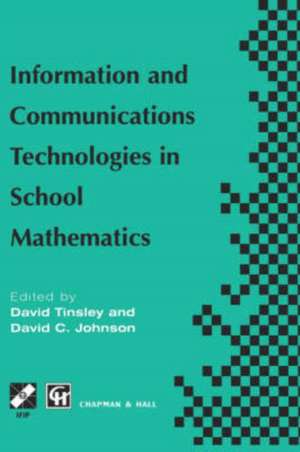
Information and Communications Technologies in School Mathematics
Editat de David Tinsley, David B Johnsonen Limba Engleză Hardback – 28 feb 1998
Preț: 627.06 lei
Preț vechi: 783.83 lei
-20%
Puncte Express: 941
Preț estimativ în valută:
110.87€ • 131.56$ • 96.40£
110.87€ • 131.56$ • 96.40£
Carte tipărită la comandă
Livrare economică 01-15 aprilie
Specificații
ISBN-13: 9780412821004
ISBN-10: 0412821001
Pagini: 306
Ilustrații: X, 306 p.
Dimensiuni: 160 x 241 x 22 mm
Greutate: 0.65 kg
Ediția:1998 edition
Editura: Springer Us
Locul publicării:New York, NY, United States
ISBN-10: 0412821001
Pagini: 306
Ilustrații: X, 306 p.
Dimensiuni: 160 x 241 x 22 mm
Greutate: 0.65 kg
Ediția:1998 edition
Editura: Springer Us
Locul publicării:New York, NY, United States
V-ar putea interesa
-
 Elementary and Middle School MathematicsJohn A. Van de Walle-23%Preț: 700.90 lei910.26 lei
 -
 -15%Preț: 416.82 lei490.38 lei
 -
 International Handbook of Mathematics EducationAlan Bishop-24%Preț: 5046.15 lei6639.68 lei
 -
 Understanding and Teaching Primary MathematicsTony CottonPreț: 272.35 lei
 -
 Learning to Teach in the Primary SchoolTeresa CreminPreț: 364.08 lei
 -
 Readers Read. Writers Write. Mathers Math!Deborah Peart CraytonPreț: 286.51 lei
 -
 Preț: 280.77 lei
 -
 Preț: 331.14 lei
 -
 -18%Preț: 181.49 lei221.10 lei
 -
 -18%Preț: 179.91 lei220.20 lei
 -
 -19%Preț: 176.46 lei218.26 lei
 -
 -29%Preț: 594.06 lei833.03 lei
 -
 -29%Preț: 593.75 lei832.84 lei
 -
 -29%Preț: 591.41 lei831.41 lei
 -
 -38%Preț: 106.80 lei173.45 lei
 -
 Teaching Mathematics Using ICTAdrian OldknowPreț: 142.93 lei
 -
 Secondary Maths in ActionEmma McCrea-20%Preț: 113.14 lei141.44 lei
 -
 -15%Preț: 617.89 lei726.93 lei
 -
 Mathematics Curriculum Reforms Around the World: The 24th ICMI StudyYoshinori ShimizuPreț: 426.21 lei
 -
 Preț: 467.85 lei
Public țintă
ResearchCuprins
1 ICT’s and secondary school mathematics—themes, visions and realities.- 2 The impact of informatics on the teaching of mathematics.- 3 Towards an embodied view of the mathematics curriculum in a world of technology.- 4 Social uses of the Internet and the construction of new models for mathematics teaching and learning.- 5 Young students and future teachers as passengers on the Logo engine.- 6 How informatics and discrete thinking return to school.- 7 For the development of mathematics education: from the viewpoint of computer science.- 8 Using the history of mathematics as a source of technology-rich problems.- 9 Towards more natural interfaces.- 10 Spreadsheets: just smart calculators or a new paradigm for thinking about mathematical structures?.- 11 Personal computing technology: use and possibilities.- 12 Computer-supported mathematical learning in the information age: mathematical modelling learned through hypertexts.- 13 A genetic way to conic sections and planetary motion with Cabri-Géomètre.- 14 Construction of meaning and teacher control of learning.- 15 Teacher training as a key issue for the integration of computer technologies.- 16 The computer in mathematics teaching: scenes from the classroom.- 17 The integration of IT and teacher training: supporting teachers in their use of hardware and software tools in the school mathematics classroom.- 18 Teachers and technology: the case of mathematical learning.- 19 Teachers and technology: pre-service training for mathematics.- 20 Moving from fashions to a continuous stream of change: teacher development and IT.- 21 A culture of proving in school mathematics?.- 22 Relationship between the spatial and theoretical in geometry: the role of computer dynamic representations in problem solving.- 23 Computers andapplied constructivism.- 24 Cognitive development and classroom interaction: a theoretical foundation for teaching and learning.- 25 Preparing for the computer age at an early age.- 26 Construction of personal meaning through the use of advanced geometrical software: the case of trigonometry.- 27 Complementing different software environments to mediate the introduction of variable, parameter and unknown.- 28 Authority and responsibility when learning mathematics in a technology-enhanced environment.- 29 Human and social issues in the age of informatics.- 30 Challenge, conflict and culture: issues for secondary school mathematics educators.- 31 Spreadsheets for mathematics in a developing nation.- 32 Educational experiments of distance learning and reorganization of mathematics education.- 33 On-line communities as a vehicle for developing secondary mathematics educators.- Focus Group reports.- IFIP country codes for Focus Group participants.- IFIP and Working Group 3.1.- Conference participants.- Keyword index.