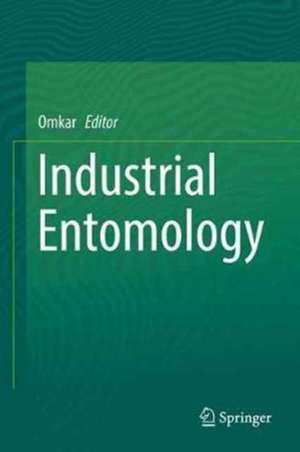
Industrial Entomology
Editat de Omkaren Limba Engleză Hardback – 20 feb 2017
Considerăm că Industrial Entomology vine să completeze o lacună majoră în literatura academică de profil, care s-a concentrat istoric aproape exclusiv pe controlul dăunătorilor și limitarea populațiilor de insecte. În timp ce majoritatea tratatelor de entomologie aplicată tratează insectele ca pe un inamic al agriculturii, acest volum coordonat de Omkar propune o schimbare de paradigmă: insecta ca resursă industrială și motor economic. Ediția de față investighează nu doar produsele convenționale precum mierea, mătasea și lacul, ci explorează în profunzime potențialul neexploatat al insectelor în medicină (entomoceutice), polenizare și managementul biologic al buruienilor.
Lucrarea acoperă aceeași arie tematică precum Commercial Insects, însă Industrial Entomology se distinge printr-o abordare mult mai tehnică și aplicată, oferind protocoale specifice pentru producție și procesare. Dacă în lucrări anterioare precum Polyphagous Pests of Crops sau Sucking Pests of Crops, Omkar analiza impactul devastator al insectelor asupra culturilor, în volumul de față autorul își recalibrează viziunea către serviciile ecosistemice și produsele comerciale.
Structura cărții este riguros organizată în 17 capitole, facilitând o progresie logică de la biologia și ciclurile de viață ale speciilor de interes (albine, insecte producătoare de lac, viermi de mătase), către tehnici avansate de recoltare și procesare industrială. Ultimele capitole sunt dedicate frontierelor entomologiei moderne: utilizarea insectelor ca hrană și producția de masă a agenților de biocontrol. Prin această abordare, volumul transformă entomologia dintr-o disciplină pur biologică într-una cu valențe economice și industriale clare.
Preț: 1346.10 lei
Preț vechi: 1641.58 lei
-18%
Carte disponibilă
Livrare economică 18 mai-01 iunie
Specificații
ISBN-10: 981103303X
Pagini: 465
Ilustrații: XI, 465 p. 173 illus., 103 illus. in color.
Dimensiuni: 155 x 235 x 33 mm
Greutate: 1.01 kg
Ediția:1st ed. 2017
Editura: Springer Nature Singapore
Colecția Springer
Locul publicării:Singapore, Singapore
V-ar putea interesa
-
 -22%Preț: 610.49 lei785.42 lei
 -
 Evolution of Insect PestsKe Chung Kim-9%Preț: 2557.96 lei2810.95 lei
 -
 The Biology of the Honey BeeMark L. WinstonPreț: 255.63 lei
 -
 Crickets and Katydids, Concerts and SolosVincent G DethierPreț: 454.76 lei
 -
 The Social Biology of WaspsKenneth G. Ross-23%Preț: 577.97 lei750.60 lei
 -
 Alien Species and Insect ConservationTim R. New-15%Preț: 622.16 lei731.95 lei
 -
 Mutualisms and Insect ConservationTim R. New-18%Preț: 911.34 lei1111.40 lei
 -
 Trends in Insect Molecular Biology and BiotechnologyDhiraj Kumar-18%Preț: 1077.24 lei1313.71 lei
 -
 Zoogeography of ArachnidaPetar Beron-24%Preț: 1656.69 lei2179.85 lei
 -
 Brazilian Sand Flies : Biology, Taxonomy, Medical Importance and ControlElizabeth F. Rangel-18%Preț: 923.78 lei1126.56 lei
 -
 Stingless Bees of Mexico: The Biology, Management and Conservation of an Ancient HeritageJosé Javier G. Quezada-Euán-18%Preț: 1071.02 lei1306.11 lei
 -
 Forests and Insect Conservation in AustraliaTim R. New-15%Preț: 624.63 lei734.85 lei
 -
 Integrated Pest Control in ViticultureR. Cavalloro-15%Preț: 468.90 lei551.65 lei
 -
 -18%Preț: 1077.51 lei1314.04 lei
 -
 The Larvae of the Gall MigesB.M. Mamaev-18%Preț: 2224.94 lei2713.34 lei
 -
 European Research on Varroatosis ControlCommission of the European Communities-15%Preț: 461.64 lei543.10 lei
 -
 Fundamentals of Applied AcarologyManjit Singh Dhooria-18%Preț: 1341.40 lei1635.85 lei
 -
 -24%Preț: 1702.19 lei2239.71 lei
 -
 The Black spotted, Yellow Borer, Conogethes punctiferalis Guenée and Allied SpeciesAkshay Kumar Chakravarthy-24%Preț: 875.26 lei1151.65 lei
 -
 Sucking Pests of CropsOmkar-18%Preț: 1341.26 lei1635.67 lei
 -
 -18%Preț: 1498.21 lei1827.09 lei
De ce să citești această carte
Recomandăm această lucrare studenților, cercetătorilor și planificatorilor de politici agricole care doresc să înțeleagă potențialul economic real al insectelor. Cititorul câștigă acces la date tehnice despre sericultură, apicultură și entomoceutice, prezentate dintr-o perspectivă de producție. Este un instrument esențial pentru cei care caută alternative sustenabile în industria alimentară și farmaceutică, oferind o bază științifică solidă pentru afaceri bazate pe resurse biologice regenerabile.
Despre autor
Omkar este un editor și cercetător de renume, specializat în entomologie, cu o activitate vastă dedicată managementului insectelor și utilizării acestora în beneficiul uman. Expertiza sa este reflectată într-o serie de lucrări fundamentale care acoperă atât combaterea dăunătorilor prin metode moleculare și microbiene, cât și valorificarea insectelor ca furnizori de servicii ecosistemice. Prin Industrial Entomology, el reușește să sintetizeze experiența experților globali, aducând în prim-plan perspectiva Indiei în acest domeniu și promovând o viziune sustenabilă asupra entomologiei comerciale la nivel mondial.
Descriere scurtă
The book highlights the all pervasive role of insects in improving human lives at multiple levels. Accordingly, while most books on insects concentrate on how to limit growth in their population, it instead focuses on how to propagate them. In each chapter, the book brings to the fore how insects are far more beneficial to us than their well publicised harmful roles.
This book approaches both unconventional and conventional insect products, such as honey, silk and lac in much more depth than theavailable literature. It investigates different aspects of the production of these insects, such as the related processes, problems and utilities, in dedicated chapters.
Because this book deals with the production of insects or their produce, it has been named Industrial Entomology, perhaps the only book that truly reveals the tremendous potential of insects to help humans live better lives. Based on the research and working experience of the contributors, who are global experts in their respective fields, it provides authentic, authoritative and updated information on these topics.
The book offers a unique guide for students, teachers, policy planners, small scale industrialists, and government ministries of agriculture and industry across the globe. It will provide a much required stimulus to insect appreciation and generate enthusiasm for research and the broader acceptance for insect produce. Hopefully, it will also present the Indian perspective on these topics to aglobal readership.
Cuprins
Notă biografică
Prof. Omkar has published more than 150 research papers in international journals and 62 in Indian journals, 21 book chapters and 14 popular science articles. His research primarily concerns identifying and harnessing the potential of beneficial insects, in particular ladybird beetles, for which he is globally recognized. He has supervised 20 Ph.D. theses and completed ten research projects funded by state and central govt. agencies. He is a member of the editorial board for the Journal of Tropical Insect Science, Cambridge University Press and chief editor of the Journal of Applied Bioscience besides being President of the International Society of Applied Biology. He works as a referee for nearly 40 international and 20 prominent Indian journals, in addition to serving as a subject expert on grant applications for the Swiss National Science Foundation and other central and state govt. funding agencies. He has received prestigious travel awards from the Indian National Science Academy, New Delhi, which have allowed him to travel and collaborate with global experts on ladybird biology at the University of East Anglia, UK and the University of South Bohemia and Czech Academy of Sciences, Czech Republic