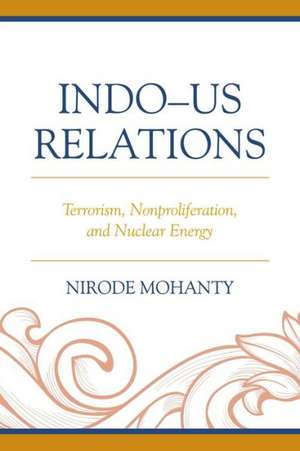
Indo–US Relations: Terrorism, Nonproliferation, and Nuclear Energy
Autor Nirode Mohantyen Limba Engleză Hardback – 18 dec 2014
Preț: 697.66 lei
Preț vechi: 1055.00 lei
-34%
Puncte Express: 1046
Carte tipărită la comandă
Livrare economică 27 noiembrie-11 decembrie
Livrare prin curier în România Termenul estimat este afișat lângă disponibilitate.
Transport gratuit pentru acest produs Plată online sau ramburs, în funcție de opțiunile comenzii.
Retur gratuit în 14 zile Comandă securizată și suport în română.
Specificații
ISBN-13: 9781498503921
ISBN-10: 1498503926
Pagini: 242
Ilustrații: 2 tables; 2 charts
Dimensiuni: 163 x 238 x 23 mm
Greutate: 0.49 kg
Editura: Bloomsbury Publishing
Colecția Lexington Books
Locul publicării:New York, United States
ISBN-10: 1498503926
Pagini: 242
Ilustrații: 2 tables; 2 charts
Dimensiuni: 163 x 238 x 23 mm
Greutate: 0.49 kg
Editura: Bloomsbury Publishing
Colecția Lexington Books
Locul publicării:New York, United States
Cuprins
Chapter 1 The Cold War
Chapter 2 Terrorism
Chapter 3 Nonproliferation
Chapter 4 Nuclear Energy
Chapter 5 The Strategic Alliance
Chapter 2 Terrorism
Chapter 3 Nonproliferation
Chapter 4 Nuclear Energy
Chapter 5 The Strategic Alliance
Recenzii
The book will be useful for the general reader as well as those interested in learning more about the dynamics of a relationship which might well determine the future of the Asian and global order.
Dr. Mohanty deserves the highest accolades for writing a book at such a timely juncture when, after a relative 'lull' in US-India relations in recent years, the leadership in both countries is more determined than ever to give true meaning to the ties between the world's largest democracy and the world's most powerful that in President Obama's own words will be the 'defining partnership' of the Century. The book provides all the necessary tools, nuts and bolts to understand the intrinsic nature of the bilateral relationship and its future direction, in simple, yet elegant, and very pleasurably readable, prose.
The US-India relationship is likely to be one of the most important bilateral relationships shaping global politics in the coming years. This book explores the three critical pillars-terrorism, non-proliferation, and nuclear energy-which will be key to the future of this relationship. Nirode Mohanty succeeds in capturing the essence of the debate in Washington and Delhi that has at times confounded practitioners and scholars alike.
With insightful analysis and extensive supporting information, Dr. Nirode Mohanty's book provides a valuable account of how the complicated and occasionally strained relations between the United States and India have evolved over time. The book is an important contribution to the literature on this subject.
Dr. Mohanty deserves the highest accolades for writing a book at such a timely juncture when, after a relative 'lull' in US-India relations in recent years, the leadership in both countries is more determined than ever to give true meaning to the ties between the world's largest democracy and the world's most powerful that in President Obama's own words will be the 'defining partnership' of the Century. The book provides all the necessary tools, nuts and bolts to understand the intrinsic nature of the bilateral relationship and its future direction, in simple, yet elegant, and very pleasurably readable, prose.
The US-India relationship is likely to be one of the most important bilateral relationships shaping global politics in the coming years. This book explores the three critical pillars-terrorism, non-proliferation, and nuclear energy-which will be key to the future of this relationship. Nirode Mohanty succeeds in capturing the essence of the debate in Washington and Delhi that has at times confounded practitioners and scholars alike.
With insightful analysis and extensive supporting information, Dr. Nirode Mohanty's book provides a valuable account of how the complicated and occasionally strained relations between the United States and India have evolved over time. The book is an important contribution to the literature on this subject.