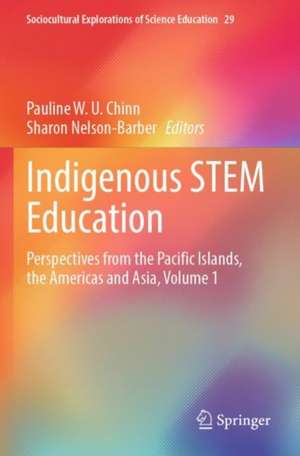
Indigenous STEM Education: Sociocultural Explorations of Science Education, cartea 29
Editat de Pauline W. U. Chinn, Sharon Nelson-Barberen Limba Engleză Paperback – 22 aug 2024




Preț: 915.46 lei
Preț vechi: 1204.55 lei
-24%
Puncte Express: 1373
Carte tipărită la comandă
Livrare economică 10-16 noiembrie
Livrare prin curier în România Termenul estimat este afișat lângă disponibilitate.
Transport gratuit pentru acest produs Plată online sau ramburs, în funcție de opțiunile comenzii.
Retur gratuit în 14 zile Comandă securizată și suport în română.
Specificații
ISBN-13: 9783031304538
ISBN-10: 3031304535
Pagini: 312
Dimensiuni: 155 x 235 x 17 mm
Greutate: 0.48 kg
Editura: Springer
Colecția Sociocultural Explorations of Science Education
Seria Sociocultural Explorations of Science Education
ISBN-10: 3031304535
Pagini: 312
Dimensiuni: 155 x 235 x 17 mm
Greutate: 0.48 kg
Editura: Springer
Colecția Sociocultural Explorations of Science Education
Seria Sociocultural Explorations of Science Education
Cuprins
Preface (SHARON NELSON-BARBER AND PAULINE W. U. CHINN).- Foreword - An Indigenous Sense of Place (GREGORY CAJETE).- PART I: CULTURE, LANGUAGE, KNOWLEDGE, AND PLACE AS FOUNDATION FOR LEARNING.- Chapter 1. Native Astronomy: A Skyward View (GREG CAJETE).- Chapter 2. Listening to the People: Reforming science education through incorporation of Chuukese traditional knowledge (MARGARITA B. CHOLYMAY).- Chapter 3. E ‘Imi I ke ‘Alanui, To Find the Way: A Native Hawaiian educator's Journey (ALYSON NAPUA BARROWS).- Chapter 4. KahuaAʻo: Science education through Hawaiian-language newspapers (JASON K. ELLINWOOD AND JOHANNA KAPŌMAIKA‘I STONE).- Chapter 5. ‘O kekumukeka‘ao, The story is the source: The discipline of ancestral stories in nurturing Native Hawaiian scientists (HUIHUI KANAHELE-MOSSMAN).- Chapter 6. Developing a Framework for Integrating Systems of Local Indigenous Knowledge with Climate Education in the Mariana Islands (SHARON NELSON-BARBER, ELIZABETH DIAZ RECHEBEI, JOSE TILIPAO LIMES, ZANETTE JOHNSON).- Chapter 7. Culturally responsive science education for rural students: Connecting school science with local heritages in Thailand (NANTANA TAPTAMAT).- PART II: RESEARCH THAT TELLS OUR STORIES AND INFORMS POLICY AND PRACTICE.- Chapter 8. Perspective taking and psychological distance in children’s picture books: differences between Native and Non-native authored books (MEGAN BANG, JASMINE GURNEAU, LORI FABER, ANANDA MARIN, MICHAEL MARIN, DOUGLAS MEDIN, SANDRA WAXMAN, JENNIFER WOODRING).- Chapter 9. Integrating Place, Indigenous and Western Science: Implications for Teacher Agency, Expertise, and Identity (PAULINE W. U. CHINN).- Chapter 10. Keystone characteristics that support cultural resilience in Karen refugee parents (SUSAN HARPER).- Chapter 11. Symmetry and halving: A way to teach mathematical foundations, based on the everyday knowledge of Yupiaq and Caroline Islanders (JERRY LIPKA, DORA ANDREW-IRHKE, MIUTY NOKAR, DAVID KOESTER, DONALD H. RUBENSTEIN, WALKIE CHARLES, EVELYN YANES, CAL HACHIBMA, RAPHAEL JIMMY).- Chapter 12. Understanding the geology of the Colombian Amazon through indigenous eyes: educational potential of an ethnogeology of the Uitoto territory (CAROLINA LONDOÑO, STEVEN SEMKEN, ELIZABETH BRANDT, CRISTINA GARZON).- Chapter 13. Indigenous rural students' attitudes and perceptions about ethnoscience in STEM instruction (SHARON NELSON-BARBER, ELISE TRUMBULL, URSULA SEXTON, ZANETTE JOHNSON).- Chapter 14. Researching Māori and Māori-medium science education (GEORGINA STEWART).- Chapter 15. Forum Kaupapa Māori science: A science fiction? (ELIZABETH MCKINLEY).
Notă biografică
Pauline W. U. Chinn’s great-grandparents arrived in Hawaiʻi when it was the Kingdom of Hawaiʻi and Hawaiian was the official language. After the Kingdomʻs illegal overthrow in 1893 and annexation by the United States in 1898, Hawaiian language was forbidden in education and government until a constitutional amendment in 1978. As a science teacher in Hawaiʻi’s public schools, she used textbooks from the continental U.S. except in Plants and Animals of Hawaiʻi, a class for non-college bound students. Creating a place-based curriculum allowed her to intersect her fishing, hiking, and gardening experiences with western biology frameworks. Seeing students in this “terminal” class become engaged as their lives and places entered the curriculum led to doctoral research exploring the roles of culture, gender, language, place, and power in underrepresentation of Kānaka Maʻoli, descendants of Polynesian voyagers, in science, technology, engineering, and mathematics (STEM). At the University of Hawaiʻi at Mānoa, her teacher education and professional development projects funded by the U.S. Department of Education and the National Science Foundation support research and education to develop teacher leaders who create place-based, culturally sustaining, inquiry-oriented curricula inclusive of diverse and underrepresented students. This work led to establishing an Interdisciplinary M.Ed. Place-based, Sustainability and a Graduate Certificate in Sustainability and Resilience Education.
Sharon Nelson-Barber, a sociolinguist and Senior Program Director at WestEd, has lifelong personal and professional experience in Indigenous communities. Her interests in STEM began early on as she accompanied her father and grandfather while subsistence hunting and fishing. Much of her research, funded by the National Science Foundation, centers on understanding ways in which students’ cultural backgrounds influence how they make sense of mathematics and science education. She also conducts studies aimed at developing more equitable assessment and testing methods that account for cultural influences. She closely collaborates with other Indigenous researchers and community partners across the US, the Northern Pacific islands of Micronesia, and parts of Polynesia. She is co-founder of POLARIS (Pivotal Opportunities to Learn, Advance and Research Indigenous Systems), a research and development network that promotes healthier communities by integrating Indigenous perspectives for thriving education futures. An ongoing project convenes Indigenous elders and scientists to document technical solutions to climate change from both Indigenous and western academic perspectives, and heighten international attention to the need to preserve cultures and societies amidst rising waters.
Textul de pe ultima copertă
This book builds upon the range of Indigenous theory and research found in Volume I and applies these learnings to interventions in schools, communities, teacher education and professional development. It is part of a two-volume set addresses a growing recognition that interdisciplinary, cross-cultural and cross-hybrid learning is needed to foster scientific and cultural understandings and move STEM learning toward more just and sustainable futures for all learners.
Authors working in Eurocentric settings of schools and colleges—whether in the continental or island United States, Canada, Thailand, Taiwan or Chuuk—utilize storytelling, place, language and experiential learning to engage students in meaningful, highly contextualized study that honors ancestral knowledge and practices. They recognize that their disciplines have been structured and colonized by Eurocentric/American frameworks that lack storied, ethical contexts developed through living sustainablyin particular places. Recognizing that students seeking to enter STEM majors and careers now must be knowledgeable in multiple ways, authors describe innovative ways to immerse precollege learners as well as developing and practicing teachers in settings that intersect culture, place, heritage language, and praxis that enable Indigenous and local knowledge to become central to learning. Twenty-first century technologies of distance learning, digital story-telling, and mapping technologies now enable formerly marginalized, minoritized groups to share their worldviews and systems of knowledge.
Caracteristici
Describes and analyses STEM learning in Indigenous communities Presents how technology is used for sharing worldviews of minoritized groups Describes ways of teaching and learning based on indigenous knowledge