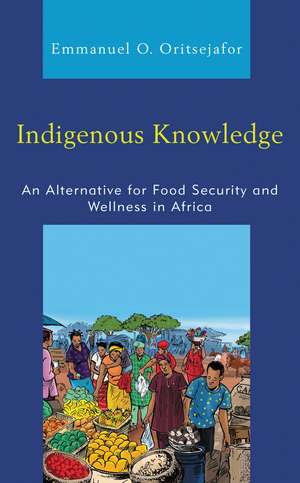
Indigenous Knowledge: An Alternative for Food Security and Wellness in Africa
Autor Emmanuel O. Oritsejaforen Limba Engleză Hardback – 20 iul 2022
Oristejafor establishes the severity and breadth of food insecurity on the continent of Africa and critiques the western-led development model which has proven to be inadequate in solving Africa's food security needs. In this regard, Oritsejafor suggests that indigenous knowledge(IK) should serve as one of the central models for addressing food security because it takes into account consideration for the specificities of local conditions and relies on the knowledge and the environment of African communities. Contrarily, he posits that the reliance on modern technologies have not been able to halve hunger and poverty in Africa.
Preț: 524.42 lei
Preț vechi: 815.47 lei
-36%
Puncte Express: 787
Carte tipărită la comandă
Livrare economică 26 octombrie-09 noiembrie
Livrare prin curier în România Termenul estimat este afișat lângă disponibilitate.
Transport gratuit pentru acest produs Plată online sau ramburs, în funcție de opțiunile comenzii.
Retur gratuit în 14 zile Comandă securizată și suport în română.
Specificații
ISBN-13: 9781793615084
ISBN-10: 179361508X
Pagini: 186
Ilustrații: 4 b/w illustrations;11 tables;
Dimensiuni: 154 x 232 x 18 mm
Greutate: 0.45 kg
Editura: Bloomsbury Publishing
Colecția Lexington Books
Locul publicării:New York, United States
ISBN-10: 179361508X
Pagini: 186
Ilustrații: 4 b/w illustrations;11 tables;
Dimensiuni: 154 x 232 x 18 mm
Greutate: 0.45 kg
Editura: Bloomsbury Publishing
Colecția Lexington Books
Locul publicării:New York, United States
Cuprins
Preface
Acknowledgments
Introduction
Chapter 1: Theoretical Issues
Chapter 2: Development Strategies
Chapter 3: Traditional Food Regimes and Food Security in Africa
Chapter 4: Food Security in War Torn Countries: The case of Liberia and Democratic Republic of Congo (DRC)
Chapter 5: Indigenous Knowledge (IK)and Agro-Eco-systems: The Case of Nigeria and Ghana
Chapter 6: Alternative Energy
Chapter 7: The COVID-19 Pandemic and Indigenous Knowledge - A Case Study
Chapter 8: Land Tenure and the Role of Women in Economic Development in Africa
Chapter 9: The Way Forward
References
Acknowledgments
Introduction
Chapter 1: Theoretical Issues
Chapter 2: Development Strategies
Chapter 3: Traditional Food Regimes and Food Security in Africa
Chapter 4: Food Security in War Torn Countries: The case of Liberia and Democratic Republic of Congo (DRC)
Chapter 5: Indigenous Knowledge (IK)and Agro-Eco-systems: The Case of Nigeria and Ghana
Chapter 6: Alternative Energy
Chapter 7: The COVID-19 Pandemic and Indigenous Knowledge - A Case Study
Chapter 8: Land Tenure and the Role of Women in Economic Development in Africa
Chapter 9: The Way Forward
References
Recenzii
"Finally, we have 'the' book that explains why more than sixty years of projects from the World Bank, the IMF, and USAID have failed to overcome global hunger and malnutrition. Emmanuel Oritsejafor doesn't just show where modern science has failed Africa, he offers a solution by showing how Indigenous Knowledge actually provides many scientific principles that can complement Western technologies that address food security and wellness. Oritsejafor also shows the shortcomings of corporate food management regimes and land tenure systems, as well as how integrating women more fully into the wellness sectors of African economies can help overcome food insecurities. His analysis of Indigenous Knowledge borrows from African sources as well as South Asian, Native American, and the Aboriginals of Australia."
Food insecurity is one of Africa's major paradoxes. This is because the African continent is endowed with fertile land for agricultural production that could ensure food self-sufficiency for the constituent states. Emmanuel Oritsejafor has done a masterful job in deciphering the various external models of food production that are currently being used in Africa and concluded that they are not adequate frameworks. Alternatively, he proposes the use of indigenous African models of food production as the pathways to food security on the African continent. Thus, this is a major contribution to the debate on food security in Africa.
Emmanuel Oritsejafor demonstrates how the international agrotechnology industry has weakened the food production capacity of sub-Saharan Africa, making the continent food insecure and dependent on food import. Drawing expertly on the various indigenous food production systems among farming communities, he illuminates how African Indigenous Knowledge can be useful in addressing the continent's food insecurity challenge.
"This book debunks the ethnocentric views of agricultural development and advocates for the utilization of sustainable Indigenous Knowledge as an alternative approach for food security in Africa. It is a must-read for all development scholars and policymakers with keen interest in finding sustainable solutions to global food insecurity."
Food insecurity is one of Africa's major paradoxes. This is because the African continent is endowed with fertile land for agricultural production that could ensure food self-sufficiency for the constituent states. Emmanuel Oritsejafor has done a masterful job in deciphering the various external models of food production that are currently being used in Africa and concluded that they are not adequate frameworks. Alternatively, he proposes the use of indigenous African models of food production as the pathways to food security on the African continent. Thus, this is a major contribution to the debate on food security in Africa.
Emmanuel Oritsejafor demonstrates how the international agrotechnology industry has weakened the food production capacity of sub-Saharan Africa, making the continent food insecure and dependent on food import. Drawing expertly on the various indigenous food production systems among farming communities, he illuminates how African Indigenous Knowledge can be useful in addressing the continent's food insecurity challenge.
"This book debunks the ethnocentric views of agricultural development and advocates for the utilization of sustainable Indigenous Knowledge as an alternative approach for food security in Africa. It is a must-read for all development scholars and policymakers with keen interest in finding sustainable solutions to global food insecurity."