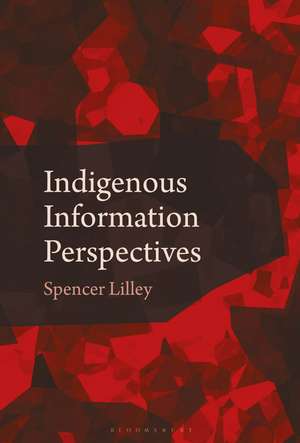
Indigenous Information Perspectives: Bloomsbury Libraries Unlimited
Autor Spencer Lilleyen Limba Engleză Hardback – iul 2027
Libraries, archives, and other information institutions have historically focused on Western knowledge systems, marginalizing or misappropriating Indigenous ways of knowing. This important book demonstrates how Indigenous information perspectives can and must provide a critical lens for decolonizing or indigenizing these institutions. It helps academics, professionals, and library and information science (LIS) students to rethink and transform existing library and information frameworks, cataloging systems, and epistemologies. Its focus on information policy issues enhances LIS curricula and provides readers with a critical understanding of what equity, diversity, and inclusion looks like when viewed through an indigenizing lens.
Chapters highlight timely topics such as freedom of information, digitization and repatriation of Indigenous resources, Indigenous cultural and intellectual property rights, and Indigenizing or decolonizing libraries and library workforce development.
Din seria Bloomsbury Libraries Unlimited
- 11%
 Preț: 539.62 lei
 - 15%
 Preț: 355.21 lei
 - nou
 Preț: 553.61 lei
 - 24%
 Preț: 300.54 lei
 - 16%
 Preț: 290.41 lei
 - 29%
 Preț: 613.82 lei
 - 25%
 Preț: 213.53 lei
 - 16%
 Preț: 394.66 lei
 - 32%
 Preț: 630.61 lei
 - 29%
 Preț: 630.98 lei
 - 26%
 Preț: 484.77 lei
 - 26%
 Preț: 453.35 lei
 - nou
 Preț: 218.12 lei
 - nou
 Preț: 611.80 lei
 - nou
 Preț: 550.90 lei
 - nou
 Preț: 618.34 lei
 - nou
 Preț: 182.76 lei
 - nou
 Preț: 246.78 lei
 - nou
 Preț: 243.05 lei
 - nou
 Preț: 628.49 lei
 - nou
 Preț: 627.32 lei
 - nou
 Preț: 300.28 lei
 - nou
 Preț: 423.40 lei
 - nou
 Preț: 279.19 lei
 - nou
 Preț: 344.43 lei
 - nou
 Preț: 218.47 lei
 - nou
 Preț: 396.31 lei
 - nou
 Preț: 210.11 lei
Preț: 612.94 lei
Preț vechi: 910.23 lei
-33% Precomandă
Puncte Express: 919
Carte nepublicată încă
Livrare prin curier în România Precomanda se expediază când titlul devine disponibil.
Transport gratuit pentru acest produs Plată online sau ramburs, în funcție de opțiunile comenzii.
Retur gratuit în 14 zile Comandă securizată și suport în română.
Doresc să fiu notificat când acest titlu va fi disponibil:
Se trimite...
Specificații
ISBN-13: 9798216371687
Pagini: 192
Dimensiuni: 156 x 235 mm
Editura: Bloomsbury Publishing
Colecția Bloomsbury Libraries Unlimited
Seria Bloomsbury Libraries Unlimited
Locul publicării:New York, United States
Pagini: 192
Dimensiuni: 156 x 235 mm
Editura: Bloomsbury Publishing
Colecția Bloomsbury Libraries Unlimited
Seria Bloomsbury Libraries Unlimited
Locul publicării:New York, United States
Cuprins
Acknowledgments
List of Abbreviations
Glossary of Indigenous Words and Phrases
Introduction
Part I: Foundations
1 Indigenous Identity
2 Colonization
3 Decolonization and Indigenization
Part II: Information Policy and Indigenous Information
4 Freedom of Expression and Access to Information
5 Indigenous Information Ethics
6 Indigenous Cultural and Intellectual Property Rights
Part III: Embedding Indigenous Perspectives in Information Practice
7 Organizing Indigenous Knowledge
8 Using a Critical Indigenous Lens
Part 4: Indigenous Information, Technology, and the Future
9 Indigenous Knowledge in a Digital World
10 Digitization and Repatriation
11 Controlling and Managing Indigenous Data
12 Future Directions
References
Index
List of Abbreviations
Glossary of Indigenous Words and Phrases
Introduction
Part I: Foundations
1 Indigenous Identity
2 Colonization
3 Decolonization and Indigenization
Part II: Information Policy and Indigenous Information
4 Freedom of Expression and Access to Information
5 Indigenous Information Ethics
6 Indigenous Cultural and Intellectual Property Rights
Part III: Embedding Indigenous Perspectives in Information Practice
7 Organizing Indigenous Knowledge
8 Using a Critical Indigenous Lens
Part 4: Indigenous Information, Technology, and the Future
9 Indigenous Knowledge in a Digital World
10 Digitization and Repatriation
11 Controlling and Managing Indigenous Data
12 Future Directions
References
Index
Recenzii
Indigenous perspectives in libraries and information institutions have been long overlooked and undervalued in the profession. Spencer Lilley's Indigenous Information Perspectives provides an essential foundation for library and information professionals, leaders, students, faculty, and others who are on a journey to build better relationships with Indigenous Peoples. Lilley's carefully written text will help readers better understand Indigenous information issues, including information ethics, Indigenous cultural property rights, and Indigenous knowledge in the digital world. I look forward to introducing this text to my colleagues and my students.
Spencer Lilley has given the Indigenous library and information field the book it has long needed. Indigenous Information Perspectives moves through the foundations of Indigenous identity and colonization through to data governance and digital futures, holding theory and practice together throughout. What makes it vital is the way it treats decolonization and indigenization not as rhetoric, but as living practices the GLAM sector must actively take up. A critical text for scholarship, students and practitioners alike.
Spencer Lilley makes a compelling case for engaging with Indigenous information perspectives across LIS scholarship and practice. Grounded in personal experience and international in scope, this is a wonderfully accessible and erudite guide to the essential work of learning, relationship building, and changemaking needed for libraries and archives to respectfully engage with Indigenous peoples. This book should be in the hands of every LIS educator and professional.
Spencer Lilley has given the Indigenous library and information field the book it has long needed. Indigenous Information Perspectives moves through the foundations of Indigenous identity and colonization through to data governance and digital futures, holding theory and practice together throughout. What makes it vital is the way it treats decolonization and indigenization not as rhetoric, but as living practices the GLAM sector must actively take up. A critical text for scholarship, students and practitioners alike.
Spencer Lilley makes a compelling case for engaging with Indigenous information perspectives across LIS scholarship and practice. Grounded in personal experience and international in scope, this is a wonderfully accessible and erudite guide to the essential work of learning, relationship building, and changemaking needed for libraries and archives to respectfully engage with Indigenous peoples. This book should be in the hands of every LIS educator and professional.
Notă biografică
Spencer Lilley is an Associate Professor of Information Studies at Te Herenga Waka - Victoria University of Wellington, Aotearoa, New Zealand. He has genealogical affiliations to Maori (Te Atiawa, Muaupoko and Ngapuhi), Samoa, and the United Kingdom. His research on Maori and Indigenous engagement with libraries and other cultural heritage institutions has been published extensively in international journals and monographs. He has received three funding awards from the Royal Society of New Zealand's Marsden Fund, two as Primary Investigator.