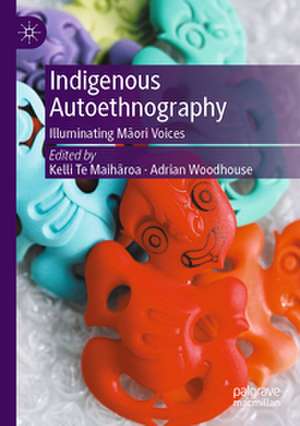
Indigenous Autoethnography
Editat de Kelli Te Maih¿roa, Adrian Woodhouseen Limba Engleză Paperback – 2 mai 2025
Preț: 803.82 lei
Preț vechi: 883.32 lei
-9%
Puncte Express: 1206
Carte tipărită la comandă
Livrare economică 16-23 noiembrie
Livrare prin curier în România Termenul estimat este afișat lângă disponibilitate.
Transport gratuit pentru acest produs Plată online sau ramburs, în funcție de opțiunile comenzii.
Retur gratuit în 14 zile Comandă securizată și suport în română.
Specificații
ISBN-13: 9789819967209
ISBN-10: 9819967201
Pagini: 224
Dimensiuni: 148 x 210 x 13 mm
Greutate: 0.3 kg
Editura: Palgrave MacMillan
ISBN-10: 9819967201
Pagini: 224
Dimensiuni: 148 x 210 x 13 mm
Greutate: 0.3 kg
Editura: Palgrave MacMillan
Cuprins
Chapter 1: Introduction to Indigenous Autoethnography Handbook.- Chapter 2: Me aro koe ki te hā o Hine-ahu-one.- Chapter 3: Ko Wai Tenei?.- Chapter 4: “F*** You I Won't Do What You Tell Me”.- Chapter 5: Wisdom is Universal.- Chapter 6: Waipuna-a-Raki.- Chapter 7: A Chant to Ancestral Landscapes.- Chapter 8: Identity Matters.- Chapter 9: Growing up in Aotearoa as Māori in the Education System.- Chapter 10: The Shroud of Whiteness.
Textul de pe ultima copertă
This book opens new pathways for decolonial autoethnography, presented as a series of reflective stories that showcase how Māori have negotiated and navigated their personal and professional identities within contemporary society. Framed within the academic methodology of Indigenous Autoethnography, authors recount their personal and professional experiences to address their encounters with cultural trauma and personal enlightenment. As a culturally responsive methodology, Indigenous Autoethnography embraces reflective practice and critical awakening to validate Indigenous knowledge, ensuring that it remains meaningful and responsive to the needs of Māori. Utilising metaphorical storytelling as a primary means of sensemaking, this work reinforces the importance of Māori and other Indigenous People to seek wisdom from the past to guide them into the future. With Indigenous knowledge historically ignored and misrepresented in higher education, this seminal text provides invaluable guidance for global Indigenous researchers seeking to produce story work that genuinely encompasses physical, emotional, and spiritual dimensions.
Kelli Te Maihāroa (Waitaha, Ngāti Rārua Ātiawa, Taranaki, Ngāti Maniapoto) is the Kaihautū: Te Kāhui Whetū / Capable Māori at Te Pūkenga ki Otago, working with cohorts of Māori undergraduate learners and mentors on the doctoral programme. Her research areas include Indigenous methodologies, autoethnography, peace traditions and decolonization.
Adrian Woodhouse (Kāi Tahu) is the Head of Programmes at the Food Design Institute, Te Pūkenga ki Otago, Dunedin, New Zealand. Adrian’s research explores the explicit and implicit institutional systems and structures of society and their influence on kai (food), power and identity formation.
Caracteristici
Includes Indigenous voices rising out of colonization and racism through cultural resurgence as Māori storytellers Presents experiences of Māori navigating their personal, professional, and cultural identities Draws on Indigenous Autoethnography as a methodology to illuminate the lived experiences of Māori