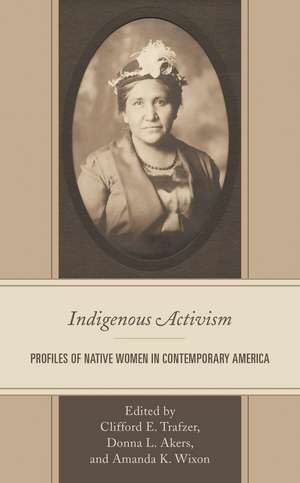
Indigenous Activism: Profiles of Native Women in Contemporary America
Editat de Cliff Trafzer, Donna L. Akers, Amanda Wixon Contribuţii de Daniel Archuleta, Renae M. Bredin, Julia Coates, Theodor Gordon, Richard A. Hanks, Benjamin Jenkins, Joshua Thunder Little, Thomas Long, Michelle Lorimer, Vera Parham, Elvia Rodriguez, Michael Seager, Jeffrey Allen Smith, Shannon Smith, Daniel Stahl-Kovell, Susan Wooden Limba Engleză Hardback – 7 iul 2021
Preț: 525.10 lei
Preț vechi: 815.86 lei
-36%
Puncte Express: 788
Carte tipărită la comandă
Livrare economică 30 noiembrie-14 decembrie
Livrare prin curier în România Termenul estimat este afișat lângă disponibilitate.
Transport gratuit pentru acest produs Plată online sau ramburs, în funcție de opțiunile comenzii.
Retur gratuit în 14 zile Comandă securizată și suport în română.
Specificații
ISBN-13: 9781793645401
ISBN-10: 179364540X
Pagini: 188
Dimensiuni: 161 x 228 x 21 mm
Greutate: 0.45 kg
Editura: Bloomsbury Publishing
Colecția Lexington Books
Locul publicării:New York, United States
ISBN-10: 179364540X
Pagini: 188
Dimensiuni: 161 x 228 x 21 mm
Greutate: 0.45 kg
Editura: Bloomsbury Publishing
Colecția Lexington Books
Locul publicării:New York, United States
Cuprins
Chapter 1: Red Power in the Northwest: Ramona Bennet
Chapter 2: It Isn't Easy: Mary Crow Dog
Chapter 3: Power of Voice, Power of Land: Ada Deer
Chapter 4: Cheyenne and Hodulgee Muscogee Activist: Suzan Shown Harjo
Chapter 5: Strikes With Puha-Power! LaDonna Harris
Chapter 6: Tribal Community and National Activist: Wilma Mankiller
Chapter 7: Numakshi Mihe, The Lead Woman of the Three Affiliated Tribes: Alyce Spotted Bear
Chapter 8: Navajo Judge, Crownpoint District: Irene Toledo
Chapter 9: "In Unity There Is Strength," Writer and Activist: Marie Potts
Chapter 10: Cultural Activist: Zitkala-Sa, Gertrude Simmons Bonnin
Chapter 11: Where is Victory? Harriette Shelton Dover
Chapter 12: Ending Termination in Indian Country: Lucy Covington
Chapter 13: Good Hearted Woman: Cecilia Fire Thunder
Chapter 14: The Necessary Evil: Dolly Smith Cusker Akers
Chapter 15: Champion of the National Congress of the American Indian: Ruth Muskrat Bronson
Chapter 16: Seeking Justice through Storytelling: Leslie Marmon S
Chapter 2: It Isn't Easy: Mary Crow Dog
Chapter 3: Power of Voice, Power of Land: Ada Deer
Chapter 4: Cheyenne and Hodulgee Muscogee Activist: Suzan Shown Harjo
Chapter 5: Strikes With Puha-Power! LaDonna Harris
Chapter 6: Tribal Community and National Activist: Wilma Mankiller
Chapter 7: Numakshi Mihe, The Lead Woman of the Three Affiliated Tribes: Alyce Spotted Bear
Chapter 8: Navajo Judge, Crownpoint District: Irene Toledo
Chapter 9: "In Unity There Is Strength," Writer and Activist: Marie Potts
Chapter 10: Cultural Activist: Zitkala-Sa, Gertrude Simmons Bonnin
Chapter 11: Where is Victory? Harriette Shelton Dover
Chapter 12: Ending Termination in Indian Country: Lucy Covington
Chapter 13: Good Hearted Woman: Cecilia Fire Thunder
Chapter 14: The Necessary Evil: Dolly Smith Cusker Akers
Chapter 15: Champion of the National Congress of the American Indian: Ruth Muskrat Bronson
Chapter 16: Seeking Justice through Storytelling: Leslie Marmon S
Recenzii
Much has been written of late on the role that Native American women have played in preserving ancestral homelands and lifeways. This beautifully constructed collection of essays is unique for its focus on the modern era, when an array of new threats to indigenous America caused Native women to employ both old and new sources of power to advance the welfare of their peoples. Rich in Native stories and voices, this volume should be required reading for all those seeking a deeper understanding of contemporary Indian affairs.
If you want to know why Indian women are strong, read this book. This valuable collection of insightful biographies shares the lives of resilient Indigenous women. They fought for their people's rights and communities during the twentieth century, while the general public believed that Indians were a 'vanishing race.' These women are role models for everyone, and this powerful volume earns new respect for American Indian women.
The Native women profiled in this collection show the vibrancy and power of indigenous women as leaders and activists engaged in preserving, recovering, and shaping their cultures and communities. These women's efforts and strategies were not only indispensable to their peoples, but were also inspirational and instructive for American Indian activism and resistance, past and present, in the continuing fight against assimilation and cultural genocide.
Indigenous Activism offers an important addition to the story of twentieth-century Native American women activism. The profiles illuminate their leadership in numerous organizations, in tribal governments, and as cultural bearers. Further, it demonstrates that motivating Native American women activists is concern for future of family and tribal nation.
If you want to know why Indian women are strong, read this book. This valuable collection of insightful biographies shares the lives of resilient Indigenous women. They fought for their people's rights and communities during the twentieth century, while the general public believed that Indians were a 'vanishing race.' These women are role models for everyone, and this powerful volume earns new respect for American Indian women.
The Native women profiled in this collection show the vibrancy and power of indigenous women as leaders and activists engaged in preserving, recovering, and shaping their cultures and communities. These women's efforts and strategies were not only indispensable to their peoples, but were also inspirational and instructive for American Indian activism and resistance, past and present, in the continuing fight against assimilation and cultural genocide.
Indigenous Activism offers an important addition to the story of twentieth-century Native American women activism. The profiles illuminate their leadership in numerous organizations, in tribal governments, and as cultural bearers. Further, it demonstrates that motivating Native American women activists is concern for future of family and tribal nation.