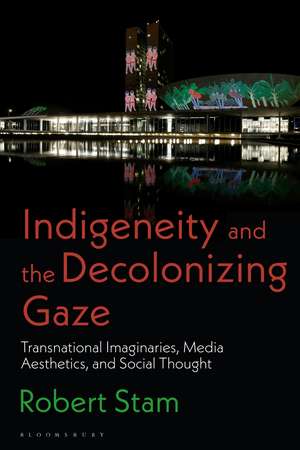
Indigeneity and the Decolonizing Gaze: Transnational Imaginaries, Media Aesthetics, and Social Thought
Autor Robert Stamen Limba Engleză Paperback – 23 feb 2023
Spanning national and transnational media in countries including the US, Brazil, Canada, France, Germany, and Italy, Stam orchestrates a dialogue between the western mediated gaze on the 'Indian' and the indigenous gaze itself, especially as incarnated in the burgeoning movement of "indigenous media," that is, the use of audio-visual-digital media for the social and cultural purposes of indigenous peoples themselves. Drawing on examples from cinema, literature, music, video, painting and stand-up comedy, Stam shows how indigenous artists, intellectuals and activists are responding to the multiple crises - climatological, economic, political, racial, and cultural - confronting the world. Significant attention is paid to the role of arts-based activism in supporting the struggle of indigenous artistic activism, of the Yanomami people specifically, to save the Amazon forest and the planet.
Preț: 187.69 lei
Preț vechi: 244.38 lei
-23%
Puncte Express: 282
Carte disponibilă
Livrare economică 30 octombrie-13 noiembrie
Livrare express 16-22 octombrie pentru 102.99 lei
Livrare prin curier în România Termenul estimat este afișat lângă disponibilitate.
Transport gratuit de la 400.00 lei Plată online sau ramburs, în funcție de opțiunile comenzii.
Retur gratuit în 14 zile Comandă securizată și suport în română.
Specificații
ISBN-13: 9781350282353
ISBN-10: 1350282359
Pagini: 416
Dimensiuni: 156 x 232 x 20 mm
Greutate: 0.74 kg
Editura: Bloomsbury Publishing
Colecția Bloomsbury Academic
Locul publicării:London, United Kingdom
ISBN-10: 1350282359
Pagini: 416
Dimensiuni: 156 x 232 x 20 mm
Greutate: 0.74 kg
Editura: Bloomsbury Publishing
Colecția Bloomsbury Academic
Locul publicării:London, United Kingdom
Cuprins
Acknowledgments
Introduction
The Terms of Debate
A 1492 Project: Conquest and Discovery
The Protocols of Anti-Indigenism
The Sacred Land
Native Arts and Aesthetics
Indigenous Media
Chapter One: From France Antartique To Shamanic Critique: The Tupinization Of Social Thought
France Antartique and Tupi Theory
Filming France Antartique
Montaigne and Tupi Theory
From France Antartique to the Carib Revolution
From the French Philosophes to the American Revolution
The French Missions, Lévi-Strauss, and the Indian
Pierre Clastres, the Anarchist Indigene, and the Wari
The Franco-Brazilian Dialogue and the Politics of The Falling Sky
Chapter Two: The Indigenous "Cunhã:" The Metamorphosis of a Gendered Trope
The Tupinization of Manhattan
The "Cunhã" as Filmmaker
The Cunhã as Myth: Paraguaçu
Caramuru: The Invention of Brazil
The Filmic and Televisual Cunhã
The Cunhã Degraded
The Cunhã as Warrior
The Cunhã as Forest Princess
The Cunhã as Hyper-Woman
The Ecological Cunhã
The "Cunhã" as Activist/Artist
Myths of Extinction: The Return of the Vanished Indigene
Chapter Three: The Transnational "Indian"
Land and the Frontier Western
Going Native
Europe's "White Indians"
The Indian Hobbyists
Transmedial Indigeneity
The Strategic Uses of Humor
Painterly Tricksterism
Indigeneity and Music
First Peoples, First Features
Indigenization of Horror
Chapter Four: Cross-National Comparabilities: The Indigenization Of Brazilian Media
Centennial Commemorations and First Contact Films
Variations on a Westward Theme
Proto-Indigenist Cinema in Brazil
Indigenous Media in Brazil
Video nas Aldeias
The Archival Turn
Corumbiara: on the Trail of Massacres
The Guaraní and Contrapuntal Narration
The Martyrdom of the Guaraní-Kaiowá
The Transmediatic Indigene of Popular Culture
Chapter Five: Triumphs and the Travails of the Yanomami
Juan Downey and "The Laughing Alligator"
Crossed Filmic Gazes
The Poetics of The Falling Sky
The Cinematic Imaginary of the Yanomami
Cinematizing Shamanism: Xapiri
The Last Forest
Conclusion: The Theoretical Indigene: Becoming Indian, And The Elsewhere Of Capitalism
Colonial Ambivalence and the Transnational Gaze
Transformational Becomings
From Republican Constitutions to the Carib Revolution
The Theoretical Indigene
Indigeneity and the Postcolonial Left
Before and After the Nation-State
Postcolonialism and the Nurture of Nature
The Fear of a Red Academe: Indigenous Decoloniality
The Power of Shamanic Critique
Capitalism vs. the Planet
The Transnational Trope of Indigenous Happiness
Coda
Index
Introduction
The Terms of Debate
A 1492 Project: Conquest and Discovery
The Protocols of Anti-Indigenism
The Sacred Land
Native Arts and Aesthetics
Indigenous Media
Chapter One: From France Antartique To Shamanic Critique: The Tupinization Of Social Thought
France Antartique and Tupi Theory
Filming France Antartique
Montaigne and Tupi Theory
From France Antartique to the Carib Revolution
From the French Philosophes to the American Revolution
The French Missions, Lévi-Strauss, and the Indian
Pierre Clastres, the Anarchist Indigene, and the Wari
The Franco-Brazilian Dialogue and the Politics of The Falling Sky
Chapter Two: The Indigenous "Cunhã:" The Metamorphosis of a Gendered Trope
The Tupinization of Manhattan
The "Cunhã" as Filmmaker
The Cunhã as Myth: Paraguaçu
Caramuru: The Invention of Brazil
The Filmic and Televisual Cunhã
The Cunhã Degraded
The Cunhã as Warrior
The Cunhã as Forest Princess
The Cunhã as Hyper-Woman
The Ecological Cunhã
The "Cunhã" as Activist/Artist
Myths of Extinction: The Return of the Vanished Indigene
Chapter Three: The Transnational "Indian"
Land and the Frontier Western
Going Native
Europe's "White Indians"
The Indian Hobbyists
Transmedial Indigeneity
The Strategic Uses of Humor
Painterly Tricksterism
Indigeneity and Music
First Peoples, First Features
Indigenization of Horror
Chapter Four: Cross-National Comparabilities: The Indigenization Of Brazilian Media
Centennial Commemorations and First Contact Films
Variations on a Westward Theme
Proto-Indigenist Cinema in Brazil
Indigenous Media in Brazil
Video nas Aldeias
The Archival Turn
Corumbiara: on the Trail of Massacres
The Guaraní and Contrapuntal Narration
The Martyrdom of the Guaraní-Kaiowá
The Transmediatic Indigene of Popular Culture
Chapter Five: Triumphs and the Travails of the Yanomami
Juan Downey and "The Laughing Alligator"
Crossed Filmic Gazes
The Poetics of The Falling Sky
The Cinematic Imaginary of the Yanomami
Cinematizing Shamanism: Xapiri
The Last Forest
Conclusion: The Theoretical Indigene: Becoming Indian, And The Elsewhere Of Capitalism
Colonial Ambivalence and the Transnational Gaze
Transformational Becomings
From Republican Constitutions to the Carib Revolution
The Theoretical Indigene
Indigeneity and the Postcolonial Left
Before and After the Nation-State
Postcolonialism and the Nurture of Nature
The Fear of a Red Academe: Indigenous Decoloniality
The Power of Shamanic Critique
Capitalism vs. the Planet
The Transnational Trope of Indigenous Happiness
Coda
Index
Recenzii
With this book, Indigeneity and the Decolonizing Gaze: Transnational Imaginaries, Media Aesthetics, and Social Thought, the always brilliant scholar Bob Stam has given us another tour de force. In this new work he tracks how -- over 500 years -- the possibilities of contemporary Indigenous media emerged in the Americas, with special attention to Brazil. He traces the colonial circumstances and European imaginaries that produced "the Protocols of Anti-Indigenism," morphed into the "transnational Indian", and landed in the rich dialogue emerging from contemporary Indigenous media. Witty, erudite, and politically engaged, this book is essential reading for those who hope to decolonize cinema studies and locate Indigenous media making in a rich historical context.
Building on research in media studies, anthropology, and social philosophy, this timely book offers an in depth account of the recent indigenous turn in global scholarship, politics, and culture. Particularly impressive is Stam's ability to relationalize processes and events from diverse historical epochs and geographical regions.
Eclectic and breathtaking in its scope, transnational and trans-medial, this book puts on full display Stam's unique capacity to think across myriad sources and cultural forms in an insightful, sophisticated, and generous way. The book should be an important contribution not only to scholars across but also to cultural producers, activists, and even nonspecialized readers interested in the past and future of indigenous people.
Through a "trans-methodology" that crosses disciplines and boundaries of historical periods and countries, Stam shows us how indigenous peoples have constructed a global and intercontinental response to colonialism over the centuries. As a result, the modern world's history emerges as an "intertextual mise-en-abyme", in which indigenous progressive social thought, political practices and arts interpose the colonial imaginary.
Building on research in media studies, anthropology, and social philosophy, this timely book offers an in depth account of the recent indigenous turn in global scholarship, politics, and culture. Particularly impressive is Stam's ability to relationalize processes and events from diverse historical epochs and geographical regions.
Eclectic and breathtaking in its scope, transnational and trans-medial, this book puts on full display Stam's unique capacity to think across myriad sources and cultural forms in an insightful, sophisticated, and generous way. The book should be an important contribution not only to scholars across but also to cultural producers, activists, and even nonspecialized readers interested in the past and future of indigenous people.
Through a "trans-methodology" that crosses disciplines and boundaries of historical periods and countries, Stam shows us how indigenous peoples have constructed a global and intercontinental response to colonialism over the centuries. As a result, the modern world's history emerges as an "intertextual mise-en-abyme", in which indigenous progressive social thought, political practices and arts interpose the colonial imaginary.