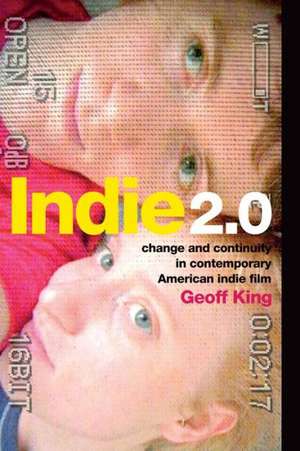
Indie 2.0: Change and Continuity in Contemporary American Indie Film
Autor Geoff Kingen Limba Engleză Paperback – 21 apr 2014 – vârsta de la 22 ani
În volumul Indie 2.0, Geoff King ne propune o explorare detaliată a cinematografiei americane independente din a doua decadă a secolului XXI, demontând previziunile pesimiste despre sfârșitul acestui sector creativ. Remarcăm modul în care autorul definește noul val prin termenul „Indie 2.0”, o etapă marcată de democratizarea tehnologică și de folosirea mediului online ca instrument alternativ de promovare și vânzare. Pe raftul de artă cinematografică, alături de Contemporary American Independent Film, acest album se distinge prin focalizarea pe estetica digitală și pe modul în care platformele sociale au redefinit supraviețuirea economică a filmului de autor.
Suntem de părere că forța acestui studiu rezidă în echilibrul dintre rigoarea academică și analiza senzorială a texturii filmice. King analizează contrastul dintre producțiile „quirky”, precum Little Miss Sunshine, și realismul social auster semnat de Kelly Reichardt sau Ramin Bahrani. Putem afirma că experiența lecturii este îmbogățită de cele 27 de ilustrații care punctează momentele cheie ale analizei, oferind cititorului o ancoră vizuală în universul „mumblecore” sau în estetica experimentală a unor pelicule precum Tarnation. Volumul continuă direcțiile de cercetare din lucrările anterioare ale autorului, precum American Independent Cinema sau Quality Hollywood, dar se adaptează contextului actual, investigând cum „esența indie” supraviețuiește într-o eră a blockbusterelor de franciză. Structura cărții ghidează cititorul de la dezbaterile teoretice despre starea industriei către studii de caz aplicate, oferind o panoramă completă a rezilienței culturale a filmului independent.
Preț: 247.20 lei
Carte indisponibilă temporar
Specificații
ISBN-10: 0231167954
Pagini: 301
Dimensiuni: 155 x 231 x 25 mm
Greutate: 0.5 kg
Editura: Columbia University Press
V-ar putea interesa
-
 Documentary FilmmakingJohn Hewitt-23%Preț: 605.19 lei785.97 lei
 -
 -26%Preț: 89.85 lei122.07 lei
 -
 Voice & Vision: A Creative Approach to Narrative FilmmakingMick Hurbis-Cherrier-8%Preț: 543.81 lei591.10 leiRecomandat
 -
 Preț: 302.16 lei
 -
 The Greengrass PapersTom ShonePreț: 230.85 lei
 -
 -25%Preț: 92.88 lei123.86 lei
 -
 Lost in TranslationGeoff King-10%Preț: 142.12 lei157.10 lei
 -
 Us Independent Film After 1989Claire Perkins-24%Preț: 612.38 lei808.52 lei
 -
 -25%Preț: 143.91 lei190.79 lei
 -
 -47%Preț: 127.65 lei242.16 lei
 -
 Indie ReframedLinda Badley-16%Preț: 211.19 lei250.65 lei
 -
 Breaking Into New Hollywood: A Career Guide to a Changing IndustryThe Los Angeles Times-18%Preț: 120.26 lei145.83 leiRecomandat
 -
 Scene: A MemoirAbel Ferrara-19%Preț: 116.33 lei143.50 leiRecomandat
 -
 Dark Matter: Independent Filmmaking in the 21st CenturyMichael Winterbottom-34%Preț: 102.28 lei154.11 lei
 -
 Hollywood in the New MillenniumTino Balio-30%Preț: 187.29 lei267.49 lei
 -
 -20%Preț: 178.23 lei223.39 lei
 -
 Independent CinemaDK D K Holm-28%Preț: 59.97 lei83.07 lei
 -
 Single and PsychoCaroline YoungPreț: 93.56 lei
 -
 -19%Preț: 116.28 lei143.43 leiRecomandat
De ce să citești această carte
Recomandăm această carte pasionaților de cinema care doresc să înțeleagă mecanismele din spatele filmelor independente actuale. Cititorul câștigă o perspectivă avizată asupra modului în care bugetele ultra-reduse și tehnologia digitală pot genera artă autentică. Este un ghid esențial pentru a distinge între marketingul „indie” și inovația estetică reală, oferind instrumentele necesare pentru o vizionare critică și informată a cinematografiei contemporane.
Despre autor
Geoff King este profesor de studii de film și televiziune la Universitatea Brunel din Londra. Este recunoscut la nivel internațional pentru expertiza sa în cinematografia americană, publicând numeroase volume de referință la editura I.B.Tauris. Printre lucrările sale notabile se numără American Independent Cinema, Indiewood, USA și New Hollywood Cinema. Deși a explorat și domenii diverse în alte scrieri, precum Brilliant Baby Names, nucleul carierei sale rămâne analiza critică a industriei de film, de la blockbusterele spectaculoase până la producțiile de nișă din zona Arthouse Crime Scenes.
Notă biografică
Cuprins
Descriere scurtă
Descriere
What is the state of American indie cinema in the second decade of the twenty-first century? Some have forecast an end to the viability of an indie sector marked by the appearance of films with ambitions significantly beyond those of the commercial mainstream. But, as this book demonstrates, plenty of distinctively indie productions continue to thrive, even in the face of difficult economic circumstances. Using the term indie 2.0 to denote the particular form of independent feature production that achieved cultural prominence in this contemporary period, Geoff King explores new opportunities for indie films, including the use of low-cost digital video and the pursuit of the internet and social media as alternative means of funding, distribution, promotion and sales.
Other detailed case studies focus on the ultra-low-budget 'mumblecore' movement; the social realism of filmmakers such as Kelly Reichardt and Ramin Bahrani; the 'digital desktop' aesthetics of Susan Buice and Arin Crumley's "Four Eyed Monsters" and Jonathan Caouette's "Tarnation", and the articulation of notions of 'true' indie in opposition to what are seen by some as the quirky contrivances of cross-over hits such as "Little Miss Sunshine" and "Juno".