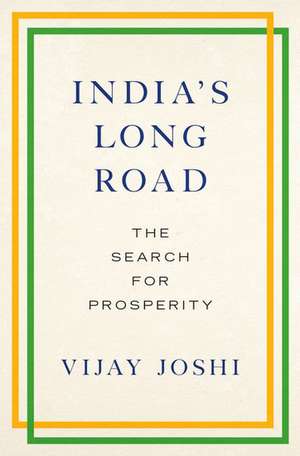
India's Long Road: The Search for Prosperity
Autor Vijay Joshien Limba Engleză Hardback – 6 apr 2017
Preț: 365.50 lei
Preț vechi: 398.36 lei
-8%
Puncte Express: 548
Carte disponibilă
Livrare economică 06-17 noiembrie
Livrare prin curier în România Termenul estimat este afișat lângă disponibilitate.
Transport gratuit de la 400.00 lei Plată online sau ramburs, în funcție de opțiunile comenzii.
Retur gratuit în 14 zile Comandă securizată și suport în română.
Specificații
ISBN-13: 9780190610135
ISBN-10: 0190610131
Pagini: 360
Dimensiuni: 239 x 157 x 36 mm
Greutate: 0.61 kg
Editura: Oxford University Press
Colecția OUP USA
Locul publicării:New York, United States
ISBN-10: 0190610131
Pagini: 360
Dimensiuni: 239 x 157 x 36 mm
Greutate: 0.61 kg
Editura: Oxford University Press
Colecția OUP USA
Locul publicării:New York, United States
V-ar putea interesa
-
 The Silent TakeoverNoreena HertzPreț: 110.33 lei
 -
 Understanding PovertyAbhijit Vinayak Banerjee-21%Preț: 365.75 lei461.68 lei
 -
 The Japanese Firm: The Sources of Competitive StrengthMasahiko Aoki-33%Preț: 758.66 lei1125.56 lei
 -
 The Economics of Post-Communist TransitionOlivier Blanchard-21%Preț: 298.87 lei378.60 lei
 -
 Governments, Globalization, and International BusinessJohn H. Dunning-28%Preț: 433.12 lei598.08 lei
 -
 -29%Preț: 363.58 lei508.94 lei
 -
 The Globalizing Learning EconomyDaniele Archibugi-28%Preț: 367.02 lei510.98 lei
 -
 -28%Preț: 441.78 lei614.51 lei
 -
 -21%Preț: 424.51 lei535.91 lei
 -
 The Competitive Advantage of NationsMichael E. Porter-20%Preț: 434.70 lei543.37 lei
 -
 Competition PolicyMassimo Motta-8%Preț: 505.29 lei549.23 lei
 -
 Between the Eagle and the DragonThomas BarlowPreț: 146.62 lei
 -
 Dealing with ChinaHank Paulson-26%Preț: 74.66 lei101.10 lei
Recenzii
...this book will remain a stellar contribution to the analysis of India's economy for a long time. It presents a clear vision of India's principal economic problems and pro-vides well-reasoned, sound advice on how to go about addressing these. The economics community the world over will thank Prof. Joshi for writing such a fine book.
Indias Long Road, is a work that anyone who has spent a lifetime thinking about their home country would be happy to have written. It is insightful, comprehensive, practical, and every page displays an impressive depth of knowledge and thinking... Joshi has provided a blueprint for policy reform in India that is compelling: thoughtful, well argued and drawing both on economic theory and realpolitik.
Highly Recommended.
India could do far better. That, in a sentence, is the conclusion of Vijay Joshi's superb book. While the focus of India's Long Road is on the economy, its analysis is appropriately comprehensive. It considers the post-independence growth record, the failure to create remunerative employment, the excessive role of publicly owned enterprises, the poor quality of Indian infrastructure and the inadequacy of environmental regulation. Joshi combines enthusiastic engagement with the detachment of a scholar who has passed much of his life abroad. No better guide to India's contemporary economy exists.
At a time when the Indian scene is flooded with many books, Vijay Joshi's latest contribution towers above all others. India's Long Road will only add to Joshi's reputation for profound insight into India's economic problems.
This is a very compelling book that makes a strong case for a comprehensive agenda of economic reforms that would enable India to emerge as a high income economy over the next quarter century.
A brilliant book. It is broad and deep in its coverage, and balanced and judicious in its assessments. India's current position is viewed against its long history since independence. The author's academic objectivity cannot disguise his passionate engagement with India, its economy, and its future. Where the leading problems are to be found, and what needs to be done, are clearly revealed. A must-read for any student of modern India.
India has a complex economy; Joshi makes the issues intelligible in lucid prose, without compromising on the complexity. He also provides a balanced perspective on many controversial questions. In today's partisan and shrill policy debates this book will set an example of clear thinking.
Vijay Joshi's analysis of the Indian economy is wide-ranging, thorough, detailed, and convincing. His policy prescriptions carefully balance concerns for alleviation of poverty, economic efficiency and sustainability, without carrying any ideological baggage. This outstanding book will become required reading for everyone interested in India.
A tour de force: a brilliant, lucid and comprehensive analysis of what could be put right in the Indian economy, and especially in government policy. The good news is that many of the proposed changes are surely feasible and have been practised in other countries. They might really lead India to fulfil its potential. For the world, the economic transformation of a nation of more than one billion people would be a huge event.
India's Long Road by Vijay Joshi, a leading macroeconomist, deserves to be required reading for anyone interested in India's performance and prospects. While being strongly grounded in economic theory, it succeeds in setting out a superb descriptive and prescriptive analysis of India's political economy in a readable style, without jargon or algebra. Its sensible and firm policy recommendations are based on careful argument and evidence. In consequence, the book will be valuable not only for the general reader but also for policymakers. It would also make an excellent text for students of the Indian economy.
I only wish that this book had been available 20 years earlier, when I was appointed Chief Economist for South Asia in the World Bank. To have had available such a well-argued and reasonable guide to the many problems confronting India in its quest to join the modern world by a leading member of the Indian diaspora would have been invaluable. I would particularly have valued the chapters on political economy.
India's Long Road is a tour de force: it will be the new standard for those who want to learn about the Indian economy. Joshi provides lucid economic analysis and broad insights into the current and coming global context for India's future development.
A cogent and sobering analysis of the enormity of the challenges India faces in ensuring inclusive, enduring and sustainable economic growth. Vijay Joshi lays out with rare clarity the necessary reforms that India must undertake -- and the obstacles rooted in the country's political economy -- if it is to fulfill its historical responsibility to improve the well-being of a sixth of humanity. One of the best -- and most accessible -- books on a complex and contentious subject.
India could (and should) do far better. That is the main conclusion of Joshi's superb book. The performance of the economy is vastly improved since the reforms of the 1990s. But a great deal more needs to be done. Those who care about India's future must hope that prime minister Narendra Modi will do what is required. Joshi provides good reasons for scepticism.
Joshi's book is a concise, engaging and very personal review of much of the vast canvas of growth and poverty in contemporary India.
Indias Long Road, is a work that anyone who has spent a lifetime thinking about their home country would be happy to have written. It is insightful, comprehensive, practical, and every page displays an impressive depth of knowledge and thinking... Joshi has provided a blueprint for policy reform in India that is compelling: thoughtful, well argued and drawing both on economic theory and realpolitik.
Highly Recommended.
India could do far better. That, in a sentence, is the conclusion of Vijay Joshi's superb book. While the focus of India's Long Road is on the economy, its analysis is appropriately comprehensive. It considers the post-independence growth record, the failure to create remunerative employment, the excessive role of publicly owned enterprises, the poor quality of Indian infrastructure and the inadequacy of environmental regulation. Joshi combines enthusiastic engagement with the detachment of a scholar who has passed much of his life abroad. No better guide to India's contemporary economy exists.
At a time when the Indian scene is flooded with many books, Vijay Joshi's latest contribution towers above all others. India's Long Road will only add to Joshi's reputation for profound insight into India's economic problems.
This is a very compelling book that makes a strong case for a comprehensive agenda of economic reforms that would enable India to emerge as a high income economy over the next quarter century.
A brilliant book. It is broad and deep in its coverage, and balanced and judicious in its assessments. India's current position is viewed against its long history since independence. The author's academic objectivity cannot disguise his passionate engagement with India, its economy, and its future. Where the leading problems are to be found, and what needs to be done, are clearly revealed. A must-read for any student of modern India.
India has a complex economy; Joshi makes the issues intelligible in lucid prose, without compromising on the complexity. He also provides a balanced perspective on many controversial questions. In today's partisan and shrill policy debates this book will set an example of clear thinking.
Vijay Joshi's analysis of the Indian economy is wide-ranging, thorough, detailed, and convincing. His policy prescriptions carefully balance concerns for alleviation of poverty, economic efficiency and sustainability, without carrying any ideological baggage. This outstanding book will become required reading for everyone interested in India.
A tour de force: a brilliant, lucid and comprehensive analysis of what could be put right in the Indian economy, and especially in government policy. The good news is that many of the proposed changes are surely feasible and have been practised in other countries. They might really lead India to fulfil its potential. For the world, the economic transformation of a nation of more than one billion people would be a huge event.
India's Long Road by Vijay Joshi, a leading macroeconomist, deserves to be required reading for anyone interested in India's performance and prospects. While being strongly grounded in economic theory, it succeeds in setting out a superb descriptive and prescriptive analysis of India's political economy in a readable style, without jargon or algebra. Its sensible and firm policy recommendations are based on careful argument and evidence. In consequence, the book will be valuable not only for the general reader but also for policymakers. It would also make an excellent text for students of the Indian economy.
I only wish that this book had been available 20 years earlier, when I was appointed Chief Economist for South Asia in the World Bank. To have had available such a well-argued and reasonable guide to the many problems confronting India in its quest to join the modern world by a leading member of the Indian diaspora would have been invaluable. I would particularly have valued the chapters on political economy.
India's Long Road is a tour de force: it will be the new standard for those who want to learn about the Indian economy. Joshi provides lucid economic analysis and broad insights into the current and coming global context for India's future development.
A cogent and sobering analysis of the enormity of the challenges India faces in ensuring inclusive, enduring and sustainable economic growth. Vijay Joshi lays out with rare clarity the necessary reforms that India must undertake -- and the obstacles rooted in the country's political economy -- if it is to fulfill its historical responsibility to improve the well-being of a sixth of humanity. One of the best -- and most accessible -- books on a complex and contentious subject.
India could (and should) do far better. That is the main conclusion of Joshi's superb book. The performance of the economy is vastly improved since the reforms of the 1990s. But a great deal more needs to be done. Those who care about India's future must hope that prime minister Narendra Modi will do what is required. Joshi provides good reasons for scepticism.
Joshi's book is a concise, engaging and very personal review of much of the vast canvas of growth and poverty in contemporary India.
Notă biografică
Vijay Joshi, a distinguished economist, is an Emeritus Fellow of Merton College, Oxford. His past books on India (co-authored with I.M.D. Little) include India - Macroeconomics and Political Economy 1964-1991 (OUP and World Bank 1994), and India's Economic Reforms 1991-2001 (OUP 1996). He has been Special Adviser to the Governor, Reserve Bank of India; Officer on Special Duty, Ministry of Finance, Government of India; Director, J.P. Morgan India Investment Trust; and Consultant to various international organizations such as the World Bank.
Cuprins
- Part I Setting the Stage
- 1. India at the Cusp
- 2. 1947-2016: A Tour d'Horizon
- 3. Ends and Means, State and Market
- Part II The Growth Challenge
- 4. Capital Accumulation and Animal Spirits
- 5. Growth and the Employment Problem
- 6. Productivity and Economic Reform
- 7. Ownership, Infrastructure, and the Environment
- Part III Stability and Inclusion
- 8. The Requisites of Macroeconomic Stability
- 9. Education and Health Care: A Question of Quality
- 10. Safety Nets and Social Protection
- Part IV Political Economy
- 11. The State of the State
- 12. India and the World Economy
- Part V The Future: Long is the Way, and Hard
- 13. What is to be Done? What Lies Ahead?