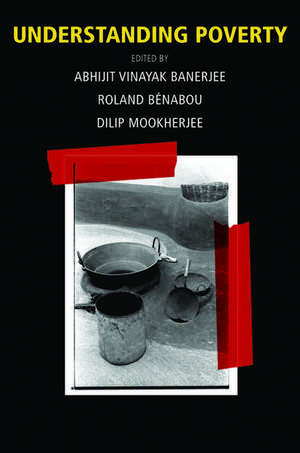
Understanding Poverty
Editat de Abhijit Vinayak Banerjee, Roland Benabou, Dilip Mookherjeeen Limba Engleză Paperback – 11 mai 2006
Preț: 377.68 lei
Preț vechi: 468.06 lei
-19%
Puncte Express: 567
Carte tipărită la comandă
Livrare economică 04-15 decembrie
Livrare prin curier în România Termenul estimat este afișat lângă disponibilitate.
Transport gratuit de la 400.00 lei Plată online sau ramburs, în funcție de opțiunile comenzii.
Retur gratuit în 14 zile Comandă securizată și suport în română.
Specificații
ISBN-13: 9780195305203
ISBN-10: 0195305205
Pagini: 496
Ilustrații: 16 line illus.
Dimensiuni: 234 x 156 x 32 mm
Greutate: 0.7 kg
Editura: Oxford University Press
Colecția OUP USA
Locul publicării:New York, United States
ISBN-10: 0195305205
Pagini: 496
Ilustrații: 16 line illus.
Dimensiuni: 234 x 156 x 32 mm
Greutate: 0.7 kg
Editura: Oxford University Press
Colecția OUP USA
Locul publicării:New York, United States
V-ar putea interesa
-
 The Value of EverythingMariana Mazzucato-30%Preț: 65.71 lei93.81 lei
 -
 The Economics of Poverty: History, Measurement, and PolicyMartin Ravallion-28%Preț: 502.53 lei693.54 lei
 -
 New Perspectives on Poverty: Policies, Programs, and PracticeElissa D. Giffords-30%Preț: 544.93 lei774.81 lei
 -
 -6%Preț: 214.14 lei227.25 lei
 -
 -31%Preț: 678.43 lei977.90 lei
 -
 -23%Preț: 353.08 lei456.23 lei
 -
 The Economics of Post-Communist TransitionOlivier Blanchard-20%Preț: 309.02 lei385.24 lei
 -
 Governments, Globalization, and International BusinessJohn H. Dunning-27%Preț: 439.65 lei598.97 lei
 -
 -27%Preț: 375.75 lei517.89 lei
 -
 -11%Preț: 338.83 lei381.22 lei
 -
 -14%Preț: 298.38 lei347.32 lei
 -
 -18%Preț: 296.56 lei359.64 lei
 -
 -21%Preț: 215.57 lei273.33 lei
 -
 -27%Preț: 456.61 lei625.33 lei
 -
 -23%Preț: 949.88 lei1235.25 lei
 -
 Human Security Report 2009/2010Human Security Report ProjectPreț: 288.07 lei
 -
 Preț: 424.32 lei
 -
 Patronage, Power and Poverty in Southern ItalyJudith ChubbPreț: 331.28 lei
 -
 Democracy and ProsperityTorben IversenPreț: 187.97 lei
 -
 Beyond the Ruins – The Meanings of DeindustrializationJefferson CowiePreț: 346.88 lei
 -
 Preț: 475.05 lei
 -
 Between the Eagle and the DragonThomas BarlowPreț: 146.62 lei
 -
 Dealing with ChinaHank Paulson-26%Preț: 74.66 lei101.10 lei
Recenzii
A serious examination of where we stand and what we need to do.
Mass poverty is mankind's oldest, yet still most pressing, problem. Understanding Poverty describes the attack that economists are making to understand it on many different fronts. Every reader of the essays in this superb volume will appreciate the currrent excitement of development economics and the enormous progress it has made in the last two decades.
Mass poverty is mankind's oldest, yet still most pressing, problem. Understanding Poverty describes the attack that economists are making to understand it on many different fronts. Every reader of the essays in this superb volume will appreciate the currrent excitement of development economics and the enormous progress it has made in the last two decades.
Notă biografică
Abhijit Vinayak Banerjee is Ford Foundation International Professor of Economics and Director, Poverty Action Lab at Massachusetts Institute of Technology, where he has taught since 1993. He holds a PhD from Harvard University, an MA from Jawaharlal University, and a BSc from the University of Calcutta.Roland Bénabou is Professor of Economic and Public Affairs at Princeton University. He holds a PhD in Economics from Massachusetts Instite of Technology and Engineering diplomas from the Ecole Polytechnique and the Ecole Nationale des Ponts at Chaussés in Paris.Dilip Mookherjee is Professor of Economics at Boston University, where he has taught since 1995. He has also been Director of the Institute for Economic Development there since 1998. He studied Economics at Presidency College, Calcutta, the Delhi School of Economics, and the London School of Economics.