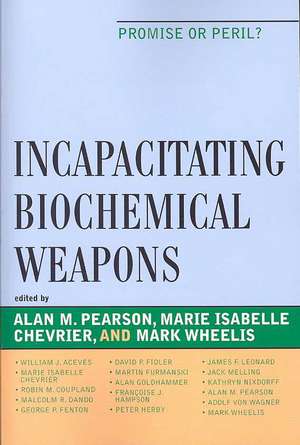
Incapacitating Biochemical Weapons: Promise or Peril?
Editat de Alan Pearson, Marie Chevrier, Mark Wheelisen Limba Engleză Paperback – 6 noi 2007
Governments, international organizations, and society as a whole have critical decisions to make about whether and how to pursue the development, or conversely the effective prohibition, of incapacitating biochemical weapons. This book provides a comprehensive survey of the scientific, military, humanitarian, legal, and political issues associated with the development and use of incapacitating biochemical weapons. The expert contributing authors explore a wide range of issues pertinent to the topic from science to history to current military interest, arms control, and international law.Incapacitating Biochemical Weapons: Promise or Peril? will be of interest to scientists, the military and law enforcement communities, policy-makers, and all who are concerned about the proliferation of such weapons.
Preț: 406.59 lei
Preț vechi: 607.59 lei
-33%
Puncte Express: 610
Carte tipărită la comandă
Livrare economică 08-22 iunie
Specificații
ISBN-13: 9780739114391
ISBN-10: 0739114395
Pagini: 306
Dimensiuni: 154 x 228 x 26 mm
Greutate: 0.49 kg
Editura: Bloomsbury Publishing
Colecția Lexington Books
Locul publicării:New York, United States
ISBN-10: 0739114395
Pagini: 306
Dimensiuni: 154 x 228 x 26 mm
Greutate: 0.49 kg
Editura: Bloomsbury Publishing
Colecția Lexington Books
Locul publicării:New York, United States
V-ar putea interesa
-
 The ABM Treaty: To Defend or not to Defend?Walther Stützle-13%Preț: 227.09 lei260.39 lei
 -
 -15%Preț: 284.42 lei334.18 lei
 -
 -23%Preț: 357.26 lei464.44 lei
 -
 Preț: 163.73 lei
 -
 The Soviet Nuclear Weapon LegacyMarco de Andreis-19%Preț: 200.95 lei247.01 lei
 -
 Confidence and Security Building Measures in the New EuropeZdzislaw Lachowski-13%Preț: 307.23 lei351.64 lei
 -
 SIPRI Yearbook 2002: Armaments, Disarmament and International SecurityStockholm International Peace Research Institute-34%Preț: 1579.57 lei2383.79 lei
 -
 -13%Preț: 304.87 lei350.39 lei
 -
 -58%Preț: 95.76 lei230.47 lei
 -
 -13%Preț: 179.05 lei206.60 lei
 -
 European Security and Defence Policy: An Implementation PerspectiveMichael MerlingenPreț: 444.11 lei
 -
 Sanctions, Statecraft, and Nuclear ProliferationEtel SolingenPreț: 284.53 lei
 -
 The International Arms TradeRachel StohlPreț: 207.74 lei
 -
 Politics of FearProfessor Frank FurediPreț: 253.32 lei
 -
 Non-Proliferation Law as a Special RegimeDaniel H. JoynerPreț: 445.75 lei
 -
 Preț: 170.78 lei
 -
 Proliferation Security MeasuresRodrick D Cooke-30%Preț: 815.72 lei1169.29 lei
Cuprins
Chapter 1 1. Introduction
Chapter 2 2. Nonconsensual Manipulation of Human Physiology Using Biochemicals
Chapter 3 3. Drug Development in the Twenty First Century and the Role of New Biotechnologies
Chapter 4 4. Historical Military Interest in Low-lethality Biochemical Agents: Avoiding and Augmenting Lethal Force
Chapter 5 5. Late and Post-Cold War Research and Development of Incapacitating Biochemical Weapons
Chapter 6 6. Current and Prospective Military and Law Enforcement Use of Chemical Agents for Incapacitation
Chapter 7 7. Scientific Outlook for the Development of Incapacitants
Chapter 8 8. Potential Long-term Physiological Consequences of Exposure to Incapacitating Biochemicals
Chapter 9 9. Incapacitating Chemical and Biochemical Weapons and Law Enforcement Under the Chemical Weapons Convention
Chapter 10 10. Toxic Chemicals for Law Enforcement Including Domestic Riot Control Purposes Under the Chemical Weapons Convention
Chapter 11 11. Incapacitating Biochemicals and the Biological Weapons Convention
Chapter 12 12. Incapacitating Biochemical Weapons: Risks and Uncertainties
Chapter 13 13. International Law and the Regulation of Weapons
Chapter 14 14. Human Rights Law and the Use of Incapacitating Biochemical Weapons
Chapter 15 15. Protecting and Reinforcing Humanitarian Norms: The Way Forward
Chapter 16 16. Conclusion and Recommendations
Chapter 2 2. Nonconsensual Manipulation of Human Physiology Using Biochemicals
Chapter 3 3. Drug Development in the Twenty First Century and the Role of New Biotechnologies
Chapter 4 4. Historical Military Interest in Low-lethality Biochemical Agents: Avoiding and Augmenting Lethal Force
Chapter 5 5. Late and Post-Cold War Research and Development of Incapacitating Biochemical Weapons
Chapter 6 6. Current and Prospective Military and Law Enforcement Use of Chemical Agents for Incapacitation
Chapter 7 7. Scientific Outlook for the Development of Incapacitants
Chapter 8 8. Potential Long-term Physiological Consequences of Exposure to Incapacitating Biochemicals
Chapter 9 9. Incapacitating Chemical and Biochemical Weapons and Law Enforcement Under the Chemical Weapons Convention
Chapter 10 10. Toxic Chemicals for Law Enforcement Including Domestic Riot Control Purposes Under the Chemical Weapons Convention
Chapter 11 11. Incapacitating Biochemicals and the Biological Weapons Convention
Chapter 12 12. Incapacitating Biochemical Weapons: Risks and Uncertainties
Chapter 13 13. International Law and the Regulation of Weapons
Chapter 14 14. Human Rights Law and the Use of Incapacitating Biochemical Weapons
Chapter 15 15. Protecting and Reinforcing Humanitarian Norms: The Way Forward
Chapter 16 16. Conclusion and Recommendations
Recenzii
This book, with its essays by leading players in the field, provides an excellent and urgently needed analysis of incapacitating biochemical weapons. Diplomats, scientists and policy-makers in all States Parties to Biological and Chemical Weapons Conventions should read this book so as to ensure the maintenance and strengthening of the conventions in the face of the very real and present danger presented by these weapons.
Addressing a topic that is both urgent and complex, this book provides a comprehensive, current, and remarkably readable exposition of the potential benefits and dangers of the ongoing biochemical revolution. Combining the disciplines of medicine, science, history, law, military strategy, and arms control, the diverse authors contribute a broad-gauged guide to intensely controversial issues, rendering them accessible to the non-specialist and informative to the policy-maker.
Addressing a topic that is both urgent and complex, this book provides a comprehensive, current, and remarkably readable exposition of the potential benefits and dangers of the ongoing biochemical revolution. Combining the disciplines of medicine, science, history, law, military strategy, and arms control, the diverse authors contribute a broad-gauged guide to intensely controversial issues, rendering them accessible to the non-specialist and informative to the policy-maker.