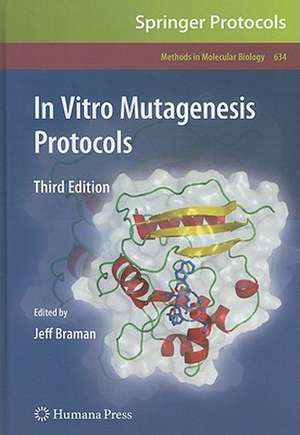
In Vitro Mutagenesis Protocols
Editat de Jeff Bramanen Limba Engleză Hardback – 12 iul 2010
Remarcăm în In Vitro Mutagenesis Protocols o abordare practică riguroasă, concepută ca o trusă de instrumente esențială pentru laboratorul modern de biologie moleculară. Raportul dintre fundamentarea teoretică și execuția tehnică este optimizat pentru a facilita reproductibilitatea: fiecare capitol debutează cu o introducere concisă, urmată imediat de liste detaliate de reactivi și protocoale de lucru explicate etapizat. Subliniem faptul că această a treia ediție, editată de Jeff Braman, nu se rezumă la metodele clasice, ci introduce strategii avansate pentru sisteme microbiene complexe, oferind soluții pentru organisme dificile precum speciile Brucella sau Plasmodium falciparum. Ca și Andrew Reeves în In Vitro Mutagenesis, autorul distilează experiență reală în principii acționabile, punând un accent deosebit pe evitarea capcanelor tehnice prin secțiuni dedicate de „troubleshooting”. Structura volumului indică o progresie logică, pornind de la mutageneza in vivo în diverse medii microbiene și avansând către tehnici de precizie bazate pe PCR, cum ar fi mutageneza direcționată pe sit (site-directed mutagenesis) sau designul de oligonucleotide in silico. Notăm cu interes includerea unor metode de scanare rapidă a secvențelor, precum MegaWHOP, care permit cercetătorilor să investigheze funcția nucleotidelor cu o eficiență sporită. Această ediție publicată de Humana rămâne un reper tehnic, oferind instrumentarul necesar pentru a descifra rețeaua complexă de interacțiuni din cadrul proteomului.
Preț: 689.19 lei
Preț vechi: 810.81 lei
-15%
Carte tipărită la comandă
Livrare economică 21 noiembrie-05 decembrie
Specificații
ISBN-10: 1607616513
Pagini: 456
Ilustrații: XIV, 442 p.
Dimensiuni: 183 x 260 x 34 mm
Greutate: 1.09 kg
Ediția:3rd edition 2010
Editura: Humana
Locul publicării:Totowa, NJ, United States
V-ar putea interesa
-
 Molecular Biology: Principles of Genome FunctionNancy Craig-18%Preț: 547.86 lei671.99 lei
 -
 BIOS Instant Notes in MicrobiologySimon BakerPreț: 268.65 lei
 -
 Diagnostic Pathology: Molecular OncologyMohammad A. Vasef-28%Preț: 1919.18 lei2652.30 lei
 -
 -31%Preț: 840.65 lei1218.05 lei
 -
 Introduction to Protein StructureCarl Ivar Branden-9%Preț: 697.95 lei766.98 lei
 -
 Yeast Functional GenomicsFrédéric Devaux-18%Preț: 800.95 lei976.77 lei
 -
 Genetic Theory and AnalysisDanny E Miller-19%Preț: 583.16 lei719.95 lei
 -
 Bioinformatics and Functional GenomicsJonathan Pevsner-23%Preț: 833.61 lei1082.62 lei
 -
 Brock Biology of Microorganisms, Global EditionMichael Madigan-9%Preț: 593.77 lei652.50 lei
 -
 Fungal Biology 4eDeacon-19%Preț: 443.19 lei547.15 lei
 -
 Essential Medical Genetics, Includes Desktop EditionEdward S. Tobias-5%Preț: 402.99 lei424.20 lei
 -
 Herpes Simplex VirusRussell J. Diefenbach-5%Preț: 1346.56 lei1417.44 lei
 -
 DNA-Protein InteractionsBenoît P. Leblanc-5%Preț: 711.13 lei748.56 lei
 -
 Manual of Molecular MicrobiologyRandall T Hayden-5%Preț: 1594.19 lei1678.10 lei
 -
 FermentTim Spector-5%Preț: 116.95 lei123.10 lei
 -
 Yeast Functional Genomics and ProteomicsIgor Stagljar-15%Preț: 675.19 lei794.34 lei
 -
 Nucleic Acid and Peptide AptamersGünter Mayer-9%Preț: 898.60 lei987.48 lei
 -
 YeastHorst Feldmann-11%Preț: 538.87 lei605.47 lei
 -
 Principles in Microbiome EngineeringM. Chang-14%Preț: 867.52 lei1008.75 lei
Public țintă
Professional/practitionerDe ce să citești această carte
Această resursă este indispensabilă cercetătorilor care activează în biochimie și genetică, oferind protocoale gata de utilizare pentru manipularea secvențelor de nucleotide. Cititorul câștigă acces la metode verificate de experți pentru studierea structurii proteinelor și a funcțiilor genetice, beneficiind de sfaturi tehnice care reduc timpul de optimizare în laborator. Este un ghid practic ce transformă teoriile complexe ale mutagenezei în rezultate experimentale concrete și reproductibile.
Descriere scurtă
Authoritative and up-to-date, In Vitro Mutagenesis Protocols, Third Edition offers today's researchers a valuable compendium of reliable and powerful techniques with which to illuminate the proteome and its rich web of biological implications.
Cuprins
Recenzii
“This well-illustrated book details specialty tools successfully employed to unravel the intricacies of protein-protein interaction, protein-structure function, protein regulation of biological processes, and protein activity and mutagenesis methods for unique microbes as a guide to the generalization of mutagenesis strategies for a host of microbial systems. … Scientists, students, and others interested in the field of in vitro mutagenesis will find this extremely useful. … This book successfully describes a variety of in vitro mutagenesis protocols for scientists working in this area.” (Omer Iqbal, Doody’s Review Service, November, 2010)