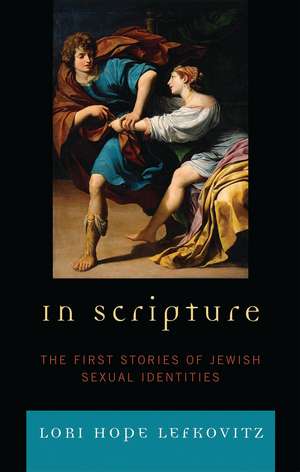
In Scripture: The First Stories of Jewish Sexual Identities
Autor Lori Hope Lefkovitzen Limba Engleză Hardback – 15 ian 2010
Recomandăm volumul In Scripture studenților la teologie, cercetătorilor în studii de gen și practicienilor din domeniul psihanalizei care doresc să exploreze rădăcinile identitare ale textelor sacre. Suntem de părere că această lucrare oferă o perspectivă necesară asupra modului în care narațiunile biblice funcționează ca texte fundamentale pentru construcția identităților sexuale evreiești. Lori Hope Lefkovitz propune o interpretare provocatoare, utilizând instrumentele teoriei de gen pentru a analiza instabilitatea conceptelor despre sexualitate și roluri de familie în Geneză sau Cartea lui Rut.
Spre deosebire de alte lucrări ale autoarei, precum Translated Memories, care se concentrează pe memoria Holocaustului și trauma transgenerațională, In Scripture privește mult mai înapoi în timp, căutând mecanismele de formare a sinelui în „grădina semnelor”. Structura cărții urmărește o progresie logică, de la nuditatea Evei și râsul Sarei, până la miturile masculinității în povestea lui Iosif și identitatea fluidă a lui Miriam. Credem că această abordare transformă lectura Scripturii dintr-una dogmatică într-o explorare critică a „performanțelor de gen”.
In Scripture reprezintă o alternativă viabilă la Sexuality, Ideology and the Bible de Caroline Blyth pentru cursurile de hermeneutică biblică. Dacă volumul lui Blyth se concentrează pe contextul cultural al interpretului, lucrarea lui Lori Hope Lefkovitz aduce avantajul unei analize psihanalitice profunde aplicate direct pe textul sursă. De asemenea, în timp ce The Intercourse of Knowledge de Athalya Brenner se axează pe date lingvistice și semantice, Lefkovitz pune accent pe narațiune și pe modul în care aceste povești au modelat percepția asupra corpului politic și individual.
Preț: 473.86 lei
Preț vechi: 689.35 lei
-31%
Carte tipărită la comandă
Livrare economică 19 noiembrie-03 decembrie
Specificații
ISBN-10: 0742547043
Pagini: 191
Dimensiuni: 161 x 239 x 18 mm
Greutate: 0.45 kg
Editura: Bloomsbury Publishing
Colecția Rowman & Littlefield
Locul publicării:New York, United States
V-ar putea interesa
-
 -14%Preț: 768.53 lei893.64 lei
 -
 -14%Preț: 1212.60 lei1410.00 lei
 -
 Characters and Characterization in the Gospel of JohnDr Christopher W. Skinner-24%Preț: 963.89 lei1275.46 lei
 -
 -17%Preț: 232.22 lei280.23 lei
 -
 On Enemy LinesC. S. HartPreț: 75.65 lei
 -
 The Teachings of Jesus ChristMR Wallace M. ThomasPreț: 130.45 lei
 -
 The Books of ElishaCarmella Elisha-SolomonPreț: 122.68 lei
 -
 Free to FlourishApril MotlPreț: 89.10 lei
 -
 Walk This WayAce McClintonPreț: 99.68 lei
 -
 Revelation - The End of Times?Hoffman PrinslooPreț: 93.22 lei
 -
 The Father's Business and the Spiritual CrossFestus Enumah M. D.Preț: 188.11 lei
 -
 Preț: 157.54 lei
 -
 New Thought ExodusRev Donald Errol Welsh DDPreț: 75.81 lei
 -
 Preț: 56.43 lei
 -
 Reading the MapSmith, Dr Randall D.Preț: 41.64 lei
 -
 The Royal Candlelight and YouMrs Lynn WilliamsPreț: 102.56 lei
 -
 Places in the Book of ActsSmith, Dr Randall D.Preț: 41.26 lei
 -
 Ontrack Devotions Expedition SeriesJoshua WilhitePreț: 35.69 lei
 -
 Old Testament Reading Plan & WorkbookLaura R. LanghoffPreț: 72.29 lei
 -
 Knowing JesusSmith, Dr Randall D.Preț: 60.47 lei
 -
 Living HopeSmith, Dr Randall D.Preț: 41.86 lei
 -
 Preț: 121.38 lei
 -
 Dispelling Twelve Myths about the GospelSmith, Dr Randall D.Preț: 41.64 lei
 -
 The Korans Teaching Christianity Reference BookWilliam ZecPreț: 231.24 lei
De ce să citești această carte
Această carte este esențială pentru cei care vor să înțeleagă cum textele biblice au definit, de-a lungul mileniilor, normele de gen și identitatea sexuală. Cititorul câștigă o perspectivă critică asupra personajelor biblice clasice, văzute acum prin prisma psihanalizei. Este o recomandare solidă pentru oricine este interesat de intersecția dintre religie, sociologie și studiile de gen, oferind un argument convingător despre relevanța continuă a Scripturii în definirea sinelui modern.
Descriere
Cuprins
Introduction
Chapter 1: Knowledge and Nakedness: Eve in the Garden of Signs
Chapter 2: Sarah's Laughter: Matriarchal Incoherence and the Vexed Sign of Woman
Chapter 3: Passing as a Man: Patriarchal Gender Performances
Chapter 4: Leah Behind the Veil: Sex with Sisters from the Bible through Woody Allen
Chapter 5: Coats and Tales: Joseph and Myths of Jewish Masculinity
Chapter 6: Miriam's Fluid Identity
Chapter 7: Bedrooms and Battlefields: Command Performances of Femininity
Chapter 8: Bodies Politic: Violence and Mediated Boundaries
Chapter 9: Oy! Was that a Close Call: Ruth and the Fundamental Jewish Story
Recenzii
Lefkovitz is both sharp and playful in her application of a variety of post-modern gender theories in each of the chapters. In accessible language, she explains such potentially difficult ideas as the semiotics of linguistic classification, French feminist theory, Queer theory and the idea of fluid gender identity, comparative cultural norms, and counter-cultural traditions, among others, and skillfully applies them to her selected biblical texts. Readers who are curious about these contemporary concepts will find clear and useful introductions in these pages. . . . Lefkovitz, a professor of Gender and Judaism at the Reconstructionist Rabbinical College, writes in a readable, personable prose, underpinned by sound scholarship, as the solid and informative endnotes testify. This book will shake up many assumptions, as it cuts a wide swath through biblical, rabbinic, and Western cultures, applying a range of gender theories in surprising ways.
Lori Lefkovitz's stimulating book confirms the arrival of feminist biblical studies-with its particular set of questions and concerns-as a given in contemporary scholarship on the Hebrew Bible. . . . There is much to admire in this work. I appreciate Lefkovitz's application of gender theory in original readings of both female and male. Her language is often poetic, her handling of different texts and genres over time is skillfully done, and her passion to clarify the enduring legacy of sexual limitations and subversions for our time is moving. . . . In Scripture strikes me as very much of our time. We live in a culture in which all bets are off, in a world made strange, and it is in this setting that Lefkovitz's book finds its place, leaving us with a richer and more nuanced appreciation for the shifting and multiple ways in which we take on, and discard, our identities as sexual and gendered readers of biblical texts.
Like the scriptural narratives it discusses, Lefkovitz's volume is the result of many years of reflection on the facts of biblical life. ...This is an extremely rich book. . . there are a wealth of insightful observations. ... many of Lefkovitz's readings are stunningly multi-textured and perceptive, showing that new treasures can indeed be drawn from these old indeed, ancient texts by the skillful interpreter of Torah. . . .it is a treasury of trenchant observations effortlessly linking the then of the texts with the now of (post) modernity in a fascinating tapestry of gender and identity.
I really delighted in this book. It deals in such clarity with complexity; it reads these ancient biblical texts and finds subtleties that I had never discovered or appreciated before, and opened a new world of meaning. And I had such pleasure in the writing itself.
Thrilling to read. . . . In Scripture has such depth that it's difficult to grasp its complexities in one reading. Its ideas will resonate not only in [the] study of the biblical text, but in analysis of other religious and secular works.
'Brilliant,' 'magisterial,' and 'epiphanic,' are not adjectives I use promiscuously, yet all three aptly describe In Scripture, Lori Lefkovitz's radical re-visioning of Biblical origin stories from Genesis through Ruth. The impact of our sacred texts on the construction of gender, Judaism, sex roles and family dynamics is explained in tightly-reasoned, gracefully-literate prose that one rarely finds in a work of scholarship. Because Lefkovitz delivers, at minimum, one dazzling insight per page, I guarantee that this great book will alter your perception of the Good Book forever.
'In the Hebrew Bible, the bedroom is the battlefield where men always lose,' is one of Lori Lefkovitz' eye-opening observations in this book. Provocatively and lucidly argued, In Scripture examines the Biblical connection of the body to the body politic from many angles, including those of Freud, Woody Allen, and contemporary queer theory, demonstrating through close reading how the multiple fluidities, ambiguities and reversals around the representations of gender simultaneously establish and subvert what we 'mean' by man and woman, masculinity and femininity, motherhood and fatherhood, the family, and our ultimate need for oppositional categories.
Lori Lefkovitz's In Scripture is a cutting edge exploration of the Hebrew Bible as a foundational text, that is literature which has influenced our very being, our identity. Using the tools of postmodern and critical theory, gender and queer theory, feminism, Jewish studies, and contemporary psychoanalysis, in this important contribution, Lefkovitz traces the mutual influence of the Bible on our sexual and bodily identity and our socio-psycho sexual experience on our reading of the Bible. This groundbreaking book will change how you read Bible stories, relate to Biblical characters, and it will shake up how you think of your own body, gender and sexuality in light of Biblical texts.
Lori Lefkovitz's engagement with Biblical scripture is both learned and literary. She regularly reveals the strange inside the familiar and then manages to show how the old stories, strange as they may be, nonetheless haunt our perceptions of the social world and of ourselves. Layered, subtle, and original, this book makes the very notion of originality a narrative paradox in which sexual and ethnic identities move fluidly and often invisibly to trouble and regenerate the cultural roles to which they appear fundamental.
This wonderful book is challenging in the best ways: it challenges conventional notions about the Bible, gender, sexuality and tradition. Even better, it challenges each of us to read the foundational texts of our culture more deeply, and to be open to new readings and to the rethinking of our own selves that these readings will prompt. The book is also sheer pleasure, a delectable treat for those who love words, Lefkovitz is a word-weaver of the highest order.
Without any loss of scholarly rigor, Lefkovitz moves seamlessly from theory to folk wisdom, from humor to wonderfully imaginative and cogent readings of major texts. In Scripture illuminates crucial issues with remarkable subtlety and clarity.
Reading In Scripture is reading on the edge, out of the habit, and in-between patriarchal beginnings and newly gendered futures.
Now you see it, now you don't! Lefkovitz's dazzling readings of biblical narratives destabilize both the texts and the assumptions that we bring to them. The result is a complex and multi-layered view of familiar stories that also deepens our understanding of gender and sexuality as cultural categories.
In Scripture challenges everything we thought we knew about Bible, disrupting assumptions about gender and selfhood, destabilizing our wholesome and sanitized readings of the familiar narratives. Lefkovitz's transgressive, reconstructive, and poetic reading renders Scripture newly sacred.