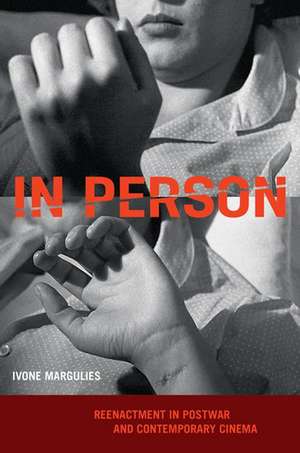
In Person: Reenactment in Postwar and Contemporary Cinema
Autor Ivone Marguliesen Limba Engleză Paperback – 7 feb 2019
In Person: Reenactment in Postwar and Contemporary Cinema delineates a new performative genre based on replay and self-awareness. The book argues that in-person reenactment, an actual person reenacting her past on camera, departs radically from other modes of mimetic reconstruction. In Person theorizes this figure's protean temporality and revisionist capabilities and it considers its import in terms of social representativity and exemplarity. Close readings of select, historicized examples define an alternate, confessional-performative vein to understand the self-reflexive nature of postwar and post-holocaust testimonial cinemas. The book contextualizes Zavattini's proposal that in neorealism everyone should act his own story in a sort of anti-individualist, public display (Love in the City and We the Women). It checks the convergence between verité experiments, a heightened self-critique in France and the reception ofpsychodrama in France (Chronicle of a summer and The Human Pyramid) in the late fifties. And, through Bazin, it reflects on the quandaries of celebrity biopics: how the circularity of the star's iconography is checked by her corporeal limits (Sophia her Own Story and the docudrama Torero!). In Person traces a shift from the exemplary and transformative ethos of fifties reenactment towards the un-redemptive stance of contemporary reenactment films such as Lanzmann's Shoah, Zhang Yuan's Sons, Andrea Tonacci's Hills of Chaos. It defines continuities between verite testimony (Chronicle, and Moi un Noir) and later para-juridical films such as the Karski Report and Rithy Panh's S21, the Khmer Rouge KillingMachine suggesting the power of co-presence and in person actualization for an ethics of viewership.
Preț: 260.27 lei
Preț vechi: 294.86 lei
-12%
Carte tipărită la comandă
Livrare economică 19-25 noiembrie
Specificații
ISBN-10: 0190496835
Pagini: 352
Ilustrații: 227 photographs
Dimensiuni: 234 x 165 x 20 mm
Greutate: 0.59 kg
Editura: Oxford University Press
Colecția OUP USA
Locul publicării:New York, United States
V-ar putea interesa
-
 Made to StickChip Heath-31%Preț: 64.35 lei93.15 lei
 -
 Famine, Affluence, and MoralityPeter Singer-20%Preț: 56.31 lei70.45 lei
 -
 Picture Theory: Essays on Verbal and Visual RepresentationProfessor W. J. T. MitchellPreț: 298.91 lei
 -
 Ethics ManagementS. P. Kaptein-18%Preț: 1186.98 lei1447.54 lei
 -
 Plato's PersonaDenis J -J Robichaud-11%Preț: 564.16 lei633.89 lei
 -
 Rites of RealismIvone MarguliesPreț: 289.99 lei
 -
 PortraitJean-Luc NancyPreț: 192.60 lei
 -
 -28%Preț: 201.80 lei279.64 lei
 -
 Preț: 391.84 lei
 -
 Preț: 417.08 lei
 -
 Preț: 379.75 lei
 -
 Cognitive PsychologyE. Goldstein-23%Preț: 1504.69 lei1954.14 lei
 -
 Creating Augmented and Virtual RealitiesErin Pangilinan-20%Preț: 281.25 lei351.56 lei
 -
 -20%Preț: 171.30 lei214.12 lei
 -
 Preț: 396.40 lei
 -
 Play Therapy: Where the Sky Meets the UnderworldAnn Cattanach-26%Preț: 198.85 lei268.68 lei
 -
 Interactive StorytellingFrank NackPreț: 387.47 lei
 -
 -18%Preț: 1080.30 lei1317.44 lei
Recenzii
As the first full-length treatment of in-person reenactment as a cinematic genre, In Person, with its astonishing scope and robust yet focused bibliography, will serve as an indispensable resource for scholars wishing to take up its spark.
The book is a remarkable feat; it maintains exceptional rigor, precision, and theoretical astuteness while also leaving room for the central concept to adapt to varying sociohistorical contexts. Like the works that it examines, wrestles with, and unlocks, In Person demands careful attention; it should not be rushed through.
a crucial addition to the field ... Deftly argued and intricately constructed
Inventive, incisive, subtle. An essential book for understanding what is at stake when a person replays her own past on camera. At that fertile place where aesthetics and history meet, Margulies offers us an exceptionally relevant analysis of post-Holocaust cinema.
Margulies demonstrates just how complex this question is with richly interdisciplinary research, an amazing range of examples, and an astounding number of insights. This book is destined to be a classic.
This most necessary book will serve as the foundation for any future study of the cinematic mode of reenactment. Margulies moves artfully among the discourses of realist cinema and documentary, theater and performance studies, genre theory, contemporary philosophy and therapeutic practice with a globe-spanning analysis of the existential quandaries to which this fascinating style of filmmaking gives rise.
Notă biografică
Ivone Margulies is Professor in the Department of Film & Media at Hunter College of the City University of New York.