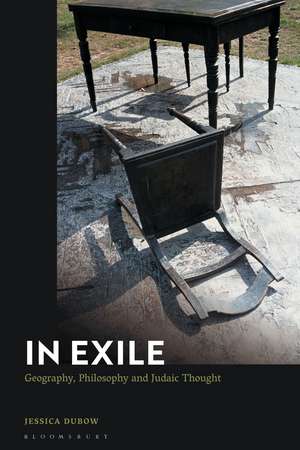
In Exile: Geography, Philosophy and Judaic Thought
Autor Jessica Dubowen Limba Engleză Paperback – 19 mai 2022
Analysing key Jewish intellectual figures such as Walter Benjamin, Isaiah Berlin and Hannah Arendt, Dubow presents exile as a form of thought and action and reconsiders attachments of identity, history, time, and territory. In her unique combination of geography, philosophy and some of the key themes in Judaic thought, she has constructed more than a study of interdisciplinary fluidity. She delivers a striking case for understanding the critical imagination in spatial terms and traces this back to a fundamental - if forgotten - exilic pull at the heart of Judaic thought.
Preț: 214.07 lei
Preț vechi: 288.27 lei
-26%
Puncte Express: 321
Carte tipărită la comandă
Livrare economică 17-31 octombrie
Livrare prin curier în România Termenul estimat este afișat lângă disponibilitate.
Transport gratuit de la 400.00 lei Plată online sau ramburs, în funcție de opțiunile comenzii.
Retur gratuit în 14 zile Comandă securizată și suport în română.
Specificații
ISBN-13: 9781350191778
ISBN-10: 1350191779
Pagini: 240
Dimensiuni: 152 x 232 x 16 mm
Greutate: 0.36 kg
Editura: Bloomsbury Publishing
Colecția Bloomsbury Academic
Locul publicării:London, United Kingdom
ISBN-10: 1350191779
Pagini: 240
Dimensiuni: 152 x 232 x 16 mm
Greutate: 0.36 kg
Editura: Bloomsbury Publishing
Colecția Bloomsbury Academic
Locul publicării:London, United Kingdom
V-ar putea interesa
-
 Spirit in the WorldProfessor Johannes Metz-38%Preț: 204.91 lei331.51 lei
 -
 -20%Preț: 232.22 lei291.42 lei
 -
 The Non-Philosophy of Gilles DeleuzeGregg Lambert-22%Preț: 468.62 lei598.94 lei
 -
 Introduction to the Philosophy of Gilles DeleuzeJean Khalfa-11%Preț: 469.26 lei527.26 lei
 -
 The New HeideggerProfessor Miguel de BeisteguiPreț: 235.39 lei
 -
 Sartre's 'Being and Nothingness': A Reader's GuideSebastian Gardner-27%Preț: 371.94 lei506.65 lei
 -
 Dictionary of Irish PhilosophersDr Thomas Duddy-24%Preț: 585.89 lei770.93 lei
 -
 -17%Preț: 177.30 lei213.32 lei
 -
 Berkeley's 'Three Dialogues': A Reader's GuideAaron Garrett-17%Preț: 190.22 lei230.10 lei
 -
 Nouveau cours de philosophieEugène GéruzezPreț: 145.92 lei
 -
 Preț: 192.04 lei
 -
 Traité de logiqueEdmond GoblotPreț: 215.37 lei
 -
 Preț: 184.74 lei
 -
 Preț: 124.22 lei
 -
 Le Journal philosophique de Berkeley, Commonplace bookRaymond GourgPreț: 124.59 lei
 -
 Preț: 176.70 lei
 -
 Panthéisme et matérialismeGustave GrandPreț: 79.84 lei
 -
 La crise morale et le positivismePériclès GrimanelliPreț: 200.54 lei
 -
 Une échappée sur l'infiniÉdouard GrimardPreț: 207.86 lei
 -
 Vrais principes de philosophie scolastiqueÉmile GuersPreț: 223.75 lei
 -
 Témoignages spiritualistes des plus grands savants du XIXe siècleC. -L. GuillemetPreț: 101.04 lei
 -
 La culture de l'âme dans l'enfanceV. GuilmotPreț: 192.51 lei
 -
 Remarques autour de la guerre (1914-1915)Albert GuinonPreț: 117.06 lei
 -
 Preț: 101.31 lei
 -
 Les énigmes de l'universErnst HaeckelPreț: 216.09 lei
 -
 Les principes du positivisme contemporainJean HalleuxPreț: 185.20 lei
 -
 Philosophie de l'économie politiqueÉtienne HaméliusPreț: 138.26 lei
 -
 ToujoursA. de HautelucePreț: 87.59 lei
Cuprins
Introduction: Exile at the Origin
Chapter 1 - "A Patch of Ground Between Four Tent Pegs"
Chapter 2 - The Second Commandment in the Second Empire
Chapter 3 - Liberal Pluralism and the Mourning Work of Assimilation
Chapter 4 - 'Wherever you go you will be a polis": Hannah Arendt via Rahel Varnhagen
Chapter 5 - Posthumous Place: W.G. Sebald and the Problem of Landscape
Epilogue: Exile as Source and Resource
Chapter 1 - "A Patch of Ground Between Four Tent Pegs"
Chapter 2 - The Second Commandment in the Second Empire
Chapter 3 - Liberal Pluralism and the Mourning Work of Assimilation
Chapter 4 - 'Wherever you go you will be a polis": Hannah Arendt via Rahel Varnhagen
Chapter 5 - Posthumous Place: W.G. Sebald and the Problem of Landscape
Epilogue: Exile as Source and Resource
Recenzii
In Exile is an eloquently written book, even as it covers an impressive amount of dense literature ... [it] is a strong and impressive intellectual exercise, which invites readers to take its findings and mount a weighty political challenge.
This is a brilliant and profound study of the spatial basis of Judaic thought. Thanks to a constellatory investigation of thinkers such as Franz Rosenzweig, Walter Benjamin, Hannah Arendt and Isaiah Berlin, she shows how exile produces a form of critical surplus, a distinct form of critical consciousness.
From a cultural geographer's appreciation for landscape, emplacement, and subjectivity, Jessica Dubow brilliantly explores the valencies of exile, rootedness, territoriality, and belonging. With eloquence and erudition, she draws on the deepest knowledge of the history of art and aesthetics, literary theory, history of philosophy, and the widest possibilities of Frankfurt-inclined critical theory.
In beautifully evocative prose, the author offers the fresh voice of a cultural geographer to the analysis of secular Jewish thought. In doing so, Dubow gifts us with a genuinely novel approach to the dialectics of secularism and theology. This book opens our understanding of the space that exile can carve out for intellectual creativity.
This is a brilliant and profound study of the spatial basis of Judaic thought. Thanks to a constellatory investigation of thinkers such as Franz Rosenzweig, Walter Benjamin, Hannah Arendt and Isaiah Berlin, she shows how exile produces a form of critical surplus, a distinct form of critical consciousness.
From a cultural geographer's appreciation for landscape, emplacement, and subjectivity, Jessica Dubow brilliantly explores the valencies of exile, rootedness, territoriality, and belonging. With eloquence and erudition, she draws on the deepest knowledge of the history of art and aesthetics, literary theory, history of philosophy, and the widest possibilities of Frankfurt-inclined critical theory.
In beautifully evocative prose, the author offers the fresh voice of a cultural geographer to the analysis of secular Jewish thought. In doing so, Dubow gifts us with a genuinely novel approach to the dialectics of secularism and theology. This book opens our understanding of the space that exile can carve out for intellectual creativity.