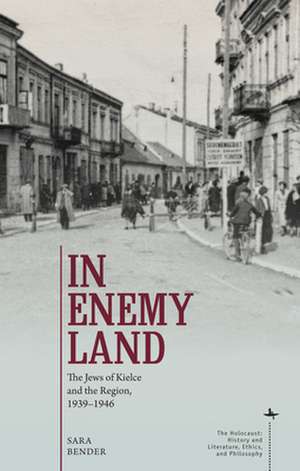
In Enemy Land
Autor Sara Bender Traducere de Naftali Greenwood, Saadya Sternbergen Limba Engleză Hardback – 22 mar 2019
Preț: 696.99 lei
Preț vechi: 905.18 lei
-23%
Puncte Express: 1045
Carte tipărită la comandă
Livrare economică 06-20 iunie
Specificații
ISBN-13: 9781618118714
ISBN-10: 1618118714
Pagini: 356
Dimensiuni: 156 x 234 x 21 mm
Greutate: 0.67 kg
Editura: Academic Studies Press
ISBN-10: 1618118714
Pagini: 356
Dimensiuni: 156 x 234 x 21 mm
Greutate: 0.67 kg
Editura: Academic Studies Press
Descriere
Offers a study of the Jewish community in Kielce and its environs during World War II and the Holocaust: it is the first of its kind in providing a comprehensive account of Kielce's Jews and their history as victims under the German occupation.
Cuprins
Preface
Introduction
Chapter 1. The Jews of Kielce between the World Wars
Chapter 2. From Occupation to Ghettoization—September 1939–April 1941
Chapter 3. The Ghetto (April 1941–August 1942)
Chapter 4. Deportation of the Jews of Kielce and Surrounding Areas (August 1942–January 1943)
Chapter 5. The “Small Ghetto” and the Labor Camps (September 1942–August 1944)
Chapter 6. Jews and Poles in Kielce Subdistrict during the German Occupation
Epilogue
Introduction
Chapter 1. The Jews of Kielce between the World Wars
Chapter 2. From Occupation to Ghettoization—September 1939–April 1941
Chapter 3. The Ghetto (April 1941–August 1942)
Chapter 4. Deportation of the Jews of Kielce and Surrounding Areas (August 1942–January 1943)
Chapter 5. The “Small Ghetto” and the Labor Camps (September 1942–August 1944)
Chapter 6. Jews and Poles in Kielce Subdistrict during the German Occupation
Epilogue
Recenzii
“Sara Bender’s In Enemy Land: The Jews of Kielce and theRegion, 1939-1946, appears at a time when Holocaust history is under newpressures. These pressures are most evident in Poland, where a nationalistgovernment has seen fit – and has largely failed – to limit certain kinds ofHolocaust-related terminology if it ascribes guilt to Poles during wartime. … Bender’scarefully researched and tightly focused study of Kielce and its environs isnot directly engaged with these discussions until its concluding chapter. ButKielce, as is well known, was the site, in the spring of 1946, of the worstpostwar pogrom in liberated Poland. Likethe wartime events in the smaller northern town of Jedwabne, the events atKielce, in which 47 Holocaust survivors were murdered in mob violence, remain aflashpoint in any postwar account of Polish-Jewish relations.” —Norman Ravvin, CanadianJewish News
“Most [researchers] believe it necessary to study the Holocaust in Kielce to understand Polish-Jewish relations afterward. Sara Bender, a renowned Holocaust scholar and long-time professor of Jewish history at the University of Haifa, shares this conviction and devotes her book primarily to the Holocaust in the region. Her description of the murder of the Jews of Kielce by the Germans and their local helpers is so terrifying that writing a review of her text almost feels wrong. There is no doubt: thousands had been murdered in Kielce or sent from there to be murdered, and the details Bender provides highlight the magnitude of the crime.”
—Piotr J. Wróbel, University of Toronto, Holocaust and Genocide Studies
“Most [researchers] believe it necessary to study the Holocaust in Kielce to understand Polish-Jewish relations afterward. Sara Bender, a renowned Holocaust scholar and long-time professor of Jewish history at the University of Haifa, shares this conviction and devotes her book primarily to the Holocaust in the region. Her description of the murder of the Jews of Kielce by the Germans and their local helpers is so terrifying that writing a review of her text almost feels wrong. There is no doubt: thousands had been murdered in Kielce or sent from there to be murdered, and the details Bender provides highlight the magnitude of the crime.”
—Piotr J. Wróbel, University of Toronto, Holocaust and Genocide Studies