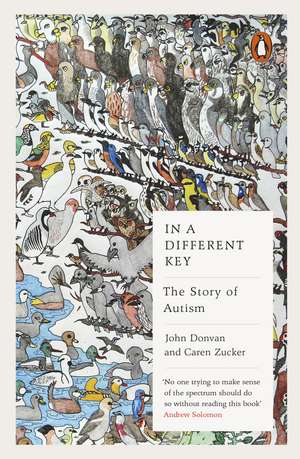
In a Different Key
Autor Caren Zucker, John Donvanen Limba Engleză Paperback – 30 mar 2017
Această monografie narativă semnată de John Donvan și Caren Zucker reprezintă una dintre cele mai ambițioase cronici sociale dedicate înțelegerii neurodiversității. Apreciem rigoarea cu care autorii reconstruiesc șapte decenii de istorie medicală și socială, pornind de la cazul primului copil diagnosticat oficial cu autism, Donald Triplett. Volumul nu este doar un text medical, ci o istorie a drepturilor civile, documentând lupta părinților împotriva instituționalizării și a teoriilor stigmatizante, precum cea a „mamelor-frigider” susținută de Ruth Sullivan. Descoperim aici o perspectivă critică asupra figurilor centrale din domeniu; autorii nu se feresc de zonele întunecate, prezentând dovezi tulburătoare despre colaborarea lui Hans Asperger cu regimul nazist sau experimentele brutale cu LSD și șocuri electrice asupra copiilor. In a Different Key reușește să echilibreze rigoarea academică cu o scriitură alertă, de tip reportaj, care dă voce atât pionierilor precum Leo Kanner, cât și figurilor emblematice contemporane ca Temple Grandin. În comparație cu A History of Autism de Adam Feinstein, care oferă o privire de ansamblu globală prin interviuri cu pionieri din diverse țări, lucrarea de față se concentrează mai intens pe dimensiunea umană și pe bătăliile juridice din Statele Unite. De asemenea, deși acoperă teme similare cu Autism de Mitzi Waltz în ceea ce privește evoluția conceptului, In a Different Key are o abordare mult mai narativă și biografică, transformând datele clinice într-o epopee a rezilienței umane. Notăm cu interes modul în care autorii integrează tranziția de la modelul medical al „bolii” către filosofia modernă a neurodiversității, oferind un context esențial pentru înțelegerea dezbaterilor actuale despre incluziune.
Preț: 97.38 lei
Preț vechi: 124.06 lei
-22%
Carte disponibilă
Livrare economică 20 noiembrie-01 decembrie
Livrare express 31 octombrie-06 noiembrie pentru 51.66 lei
Specificații
ISBN-10: 0241958172
Pagini: 688
Dimensiuni: 126 x 198 x 40 mm
Greutate: 0.48 kg
Editura: Penguin Books
Locul publicării:London, United Kingdom
V-ar putea interesa
-
 Mad HouseClea SimonPreț: 127.83 lei
 -
 The Myth of SanityMartha StoutPreț: 147.12 lei
 -
 Against DepressionPeter D. KramerPreț: 136.66 lei
 -
 AnxiousJoseph Ledoux-5%Preț: 116.86 lei123.01 lei
 -
 Saving SammyBeth Alison MaloneyPreț: 119.52 lei
 -
 Preț: 132.67 lei
 -
 Life After SuicideCynthia L. LongPreț: 87.77 lei
 -
 Wellspring of CompassionSonia Connolly-5%Preț: 99.29 lei104.52 lei
 -
 The Art Of ArtifactingD. Corydon HammondPreț: 315.08 lei
 -
 -5%Preț: 108.29 lei113.99 lei
 -
 Living Life with AutismMarc William PulverPreț: 70.25 lei
 -
 A Lethal InheritanceVictoria Costello-5%Preț: 139.14 lei146.46 lei
 -
 Crash!: Overcoming Fear and TraumaMax Greenhalgh-5%Preț: 93.36 lei98.28 lei
 -
 Lacan and Addiction: An AnthologyYael Goldman Baldwin-5%Preț: 357.25 lei376.06 lei
 -
 -5%Preț: 420.14 lei442.25 lei
 -
 Visual Techniques for Developing Social SkillsRebecca A. MoyesPreț: 82.79 lei
 -
 PSYCHOPATHOLOGY AND WORLD POLITICSPettman Ralph-15%Preț: 598.27 lei703.84 lei
De ce să citești această carte
Recomandăm această carte oricărui cititor interesat de istoria medicinei și de evoluția drepturilor civile. Este o lectură fundamentală pentru a înțelege cum o condiție medicală a fost transformată dintr-un stigmat într-o identitate socială. Cititorul câștigă o perspectivă profundă asupra modului în care perseverența părinților poate schimba legislația și percepția unei societăți întregi, fiind un ghid esențial pentru profesioniști și familii deopotrivă.
Despre autor
John Donvan și Caren Zucker sunt jurnaliști americani de renume, cu o experiență vastă în televiziune (ABC News). John Donvan este corespondent și moderator, fiind premiat de mai multe ori pentru reportajele sale. Caren Zucker este producătoare și jurnalistă care și-a dedicat mare parte din carieră documentării autismului, fiind ea însăși mama unui copil cu această condiție. Colaborarea lor a dus la nominalizarea volumului „In a Different Key” pentru Premiul Pulitzer în 2017, lucrarea fiind considerată o piatră de temelie în jurnalismul de investigație medicală.
Notă biografică
John Donvan is a multiple Emmy Award-winning Nightline correspondent with a long career in journalism. Prior to Nightline, he was the chief White House correspondent for ABC News.
Caren Zucker (Author)
Caren Zucker is an award-winning veteran television news producer who has worked most extensively with ABC News. She also produced and cowrote a six-part series on autism for PBS in 2011.
Recenzii
Fast-paced and far-reaching... this is an important missing piece to the conversation about autism; no one trying to make sense of the spectrum should do so without reading this book
Descriere scurtă
*Pulitzer finalist 2017*
The stunning history of autism as it has been discovered and felt by parents, children and doctors
Nearly seventy-five years ago, Donald Triplett of Forest, Mississippi became the first child diagnosed with autism. In a Different Key tells the extraordinary story of the world his diagnosis created - a riveting human drama that takes us across continents and through some of the great social movements of the twentieth century.
The history of autism is, above all, the story of families fighting for a place in the world for their children. It is the story of women like Ruth Sullivan, who rebelled against a medical establishment that blamed "refrigerator mothers" for causing autism, of fathers who pushed scientists to dig harder for treatments, of parents who forced schools to accept their children. But many others played starring roles too: doctors like Leo Kanner, who pioneered our understanding of autism, scientists who sparred over how to treat autism, and those with autism, like Temple Grandin and Ari Ne'eman, who explained their inner worlds and championed a philosophy of 'neurodiversity'.
This is also a story of fierce controversy: from the question of whether there is truly an autism 'epidemic', and whether vaccines played a part in it, to scandals involving 'facilitated communication', one of many treatments that have proved to be blind alleys. And there are dark turns too: we learn about experimenters feeding LSD to children with autism, or shocking them with electricity to change their behaviour; and the authors reveal, for the first time, that Hans Asperger, discoverer of the syndrome named after him, may have cooperated with the Nazis in sending disabled children to their deaths.
By turns intimate and panoramic, In a Different Key takes us on a journey from an era when families were shamed and children were condemned to institutions, to one in which parents and people with autism push not simply for inclusion, but for a new understanding of autism: as difference rather than disability.