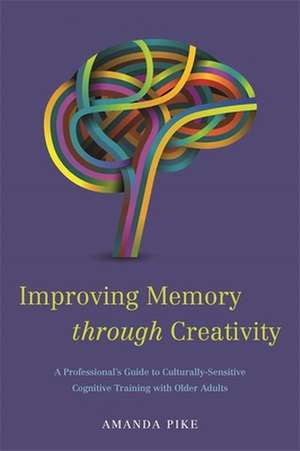
Improving Memory through Creativity: A Professional's Guide to Culturally Sensitive Cognitive Training with Older Adults
Autor Amanda Pikeen Limba Engleză Paperback – 21 feb 2014
Preț: 169.12 lei
Preț vechi: 240.66 lei
-30%
Puncte Express: 254
Carte disponibilă
Livrare economică 16-30 noiembrie
Livrare prin curier în România Termenul estimat este afișat lângă disponibilitate.
Transport gratuit de la 400.00 lei Plată online sau ramburs, în funcție de opțiunile comenzii.
Retur gratuit în 14 zile Comandă securizată și suport în română.
Specificații
ISBN-13: 9781849059534
ISBN-10: 1849059535
Pagini: 192
Ilustrații: 19 b+w figures
Dimensiuni: 150 x 227 x 10 mm
Greutate: 0.28 kg
Editura: JESSICA KINGSLEY PUBLISHERS
Colecția Jessica Kingsley Publishers
Locul publicării:London, United Kingdom
ISBN-10: 1849059535
Pagini: 192
Ilustrații: 19 b+w figures
Dimensiuni: 150 x 227 x 10 mm
Greutate: 0.28 kg
Editura: JESSICA KINGSLEY PUBLISHERS
Colecția Jessica Kingsley Publishers
Locul publicării:London, United Kingdom
V-ar putea interesa
-
 -13%Preț: 113.90 lei130.21 lei
 -
 -17%Preț: 121.01 lei146.25 lei
 -
 Your Brain on ArtSusan MagsamenPreț: 111.22 lei
 -
 -23%Preț: 95.64 lei124.90 lei
 -
 -16%Preț: 25.83 lei30.75 lei
 -
 Creative EngagementRachael Wonderlin-5%Preț: 108.10 lei113.80 lei
 -
 looking back at... Classic Coronation StreetMatt Singleton-5%Preț: 127.10 lei133.79 lei
 -
 Poetry and Dementia: A Practical GuideMr John Killick-25%Preț: 181.49 lei242.78 lei
 -
 -23%Preț: 228.55 lei297.48 lei
 -
 Craft Your CureGemma Longworth-5%Preț: 136.16 lei143.33 lei
 -
 The Creative Dementia Practice Handbook: Arts for Health and WellbeingMaria Pasiecznik Parsons-23%Preț: 142.16 lei184.33 lei
 -
 -19%Preț: 169.47 lei210.44 lei
 -
 Writing Creativity and SoulSue Monk KiddPreț: 122.27 lei
 -
 Doodle Therapy: Calm Your Mind Through the Art of DoodlingSummersdale Publishers-24%Preț: 49.51 lei64.99 lei
 -
 -28%Preț: 174.96 lei243.96 lei
 -
 -25%Preț: 219.03 lei291.52 lei
 -
 Playfulness and Dementia: A Practice GuideRobin Lang-21%Preț: 165.62 lei209.21 lei
 -
 -20%Preț: 107.96 lei134.77 leiRecomandat
 -
 The Creative Ambush: How to Unleash Your Fire into the WorldMatteo di Pascale-17%Preț: 103.15 lei124.76 leiRecomandat
Recenzii
This is the book I've been waiting for. With one fell swoop Dr Amanda Pike has answered all the questions I've been asking for over 20 years while developing art programs for older people and observing the remarkable improvement in quality of life as they become absorbed in creative expression. Dr Pike argues her case lucidly and logically. She explores the scientific evidence in depth without overwhelming the reader. An essential handbook for all art facilitators.
Art therapy has often been labelled inaccurately in the health profession as a past-time, “arts and crafts” modality. Amanda Alders Pike's well written and promising book sets the record straight. Improving Memory through Creativity demonstrates how art and science come together, and how creativity is an essential component to neural development. An inspiring book that validates the importance of art, memory and quality of life.
This book deals with complex neurological concepts around ageing, cognitive impairment and creativity in a very readable way. The theoretical knowledge Amanda presents from her own research and experience, as well as an overview of current thinking is fascinating. Throughout she shows how information might be practically applied, and makes suggestions of how to use this in therapeutic art sessions with older adults. Rather than a recipe book Amanda's ideas are a springboard, I'm really excited to see where they will take me!
The use of graphs, photographs, charts, art work of participating older people make this book accessible, user friendly and a joy to read.
Art therapy has often been labelled inaccurately in the health profession as a past-time, “arts and crafts” modality. Amanda Alders Pike's well written and promising book sets the record straight. Improving Memory through Creativity demonstrates how art and science come together, and how creativity is an essential component to neural development. An inspiring book that validates the importance of art, memory and quality of life.
This book deals with complex neurological concepts around ageing, cognitive impairment and creativity in a very readable way. The theoretical knowledge Amanda presents from her own research and experience, as well as an overview of current thinking is fascinating. Throughout she shows how information might be practically applied, and makes suggestions of how to use this in therapeutic art sessions with older adults. Rather than a recipe book Amanda's ideas are a springboard, I'm really excited to see where they will take me!
The use of graphs, photographs, charts, art work of participating older people make this book accessible, user friendly and a joy to read.
Cuprins
1. Late-Life Creative Self-Expression and Memory. 1.1. How-to-Apply Information Presented within this Text. 1.2. Normal and Abnormal Aging. 1.3. Alzheimer's disease. 1.4. Risk Factors of Memory Loss. 1.5. Mental Stimulation. 1.6. Stress. 1.7. Emotional Stress and Social Isolation. 1.8. Self-Expression in Late-Life. 1.9. Encouraging Mental Stimulation through Expressive Art-Making. 1.10. Incorporating Creativity into Older Adult Identity through Art-Making. 1.11. Creative Behavior. 1.12. Creative Thought. 1.13. Creative Self-Expression. 1.14. Summary. 2. Happiness, Social Creativity, and the Brain. 2.1. Happiness and Creative Self-Expression. 2.2. Elevating Mood during Creative Sessions. 2.3. Bodily/Sensory Pleasures. 2.4. Higher Order Pleasures. 2.5. Gratifications. 2.6. Happiness, Creativity and the Brain. 2.7. Neurotransmitters and Creativity. 2.8. Making Art that Expresses and Enhances Mood. 2.9. Visual Elements, Cognition and Mood. 2.10. Combining Visual Elements for Enhanced Mood. 2.11. Social Equality vs. Stratifications during Creativity and Happiness. 2.12. Summary. 3. Culture, Communication and Art. 3.1. Promoting Socialization during Memory Training. 3.2. Culture. 3.3. Providing Cultural Neutrality. 3.4. Communication. 3.5. Art in Communication. 3.6. Visual Literacy. 3.7. Social Sharing of Meaning through Art. 3.8. Social Roles. 3.9. Increased Socialization through Art. 3.10. Summary. 4. Cognitive Training through Creative Self-Expression. 4.1. Addressing Cognitive Abilities. 4.2 Emotion-Focused Interventions. 4.3. Targeting Cognitive Performance through Creativity. 4.4. Nature of Cognitive Impairment. 4.5. Type of Memory Impacted. 4.6. Short-term Working Memory vs Long-term Memory. 4.7. Cognitive Training. 4.8. Restorative Strategies. 4.9. Compensatory Strategies. 4.10. Expressivity-based Memory Techniques. 4.11. Neurobiology of Creativity and Expressivity. 4.12. Theory: Going Beyond “Recipes”. 4.13. Understanding Cerebral Activity in Art-Making. 4.14. Examples of artwork and corresponding ETC. 4.15. Educational vs Therapeutic Frameworks. 4.16. Summary. 5. Understanding Art to Understand the Mind. 5.1. Elements of Successful Sessions. 5.2. Additional Planning for Effective Sessions. 5.3. Rhythmic Structure and Versatility in Directives. 5.3. Outline of Ten-Weeks of Sessions. 5.4. A Single Directive for All Ten-Weeks. 5.5 Concluding the Ten Weeks. 5.6. Summary. 6. Going beyond the Book: Community Collaborations. 6.1. Scope-of-Practice. 6.2. Cultural Trends in Seeking Care. 6.3. Caregivers. 6.4. Inter-Generational Projects. 6.5. Services/Systems of Care across Settings. 6.6. Getting Started. 6.7. Identifying Symptoms Cross-Culturally. 6.8. Organizations. 6.9. Ways to Continue Learning. 6.10. Summary. 6.11. Learning Evaluation Quiz. References.