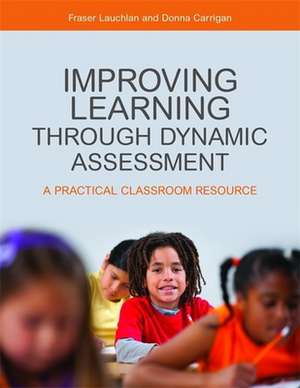
Improving Learning through Dynamic Assessment: A Practical Classroom Resource
Autor Fraser Lauchlan, Donna Carriganen Limba Engleză Paperback – 28 mar 2013
Contrasting with traditional 'static' assessment methods, this resource enables educational psychologists and related professionals to involve the child actively in the process of assessment - allowing them to measure not just what the child has learnt, but also how the child learns, how responsive they are to attempts to intevene, and what is holding them back from learning. It outlines the relevant theory and offers a staged assessment process to follow, with strategies for assessing cognitive and affective capacity. The resource contains all you need to carry out dynamic assessment, featuring photocopiable activities, checklists, handouts for teachers/parents to use with children and training materials which explain the approach in terms understandable to all participating adults.
The first practical resource on how to carry out this popular and innovative form of assessment, Improving Learning through Dynamic Assessment is an important resource for educational psychologists, speech and language therapists, special educational needs coordinators (SENCOs), specialist support teachers and other professionals working with children with learning challenges.
Preț: 345.99 lei
Preț vechi: 437.12 lei
-21%
Puncte Express: 519
Carte disponibilă
Livrare economică 06-20 noiembrie
Livrare express 22-28 octombrie pentru 128.44 lei
Livrare prin curier în România Termenul estimat este afișat lângă disponibilitate.
Transport gratuit de la 400.00 lei Plată online sau ramburs, în funcție de opțiunile comenzii.
Retur gratuit în 14 zile Comandă securizată și suport în română.
Specificații
ISBN-13: 9781849053730
ISBN-10: 1849053731
Pagini: 160
Ilustrații: Illustrations (black and white)
Dimensiuni: 217 x 279 x 10 mm
Greutate: 0.44 kg
Editura: JESSICA KINGSLEY PUBLISHERS
Colecția Jessica Kingsley Publishers
Locul publicării:London, United Kingdom
ISBN-10: 1849053731
Pagini: 160
Ilustrații: Illustrations (black and white)
Dimensiuni: 217 x 279 x 10 mm
Greutate: 0.44 kg
Editura: JESSICA KINGSLEY PUBLISHERS
Colecția Jessica Kingsley Publishers
Locul publicării:London, United Kingdom
V-ar putea interesa
-
 -18%Preț: 685.81 lei836.35 lei
 -
 Automatic Item Generation: Theory and PracticeMark J. Gierl-15%Preț: 591.36 lei695.73 lei
 -
 Passing the National Admissions Test for Law (LNAT)Rosalie HuttonPreț: 259.74 lei
 -
 -23%Preț: 411.74 lei534.73 lei
 -
 Assessment for EducationVal KlenowskiPreț: 356.91 lei
 -
 Learning AnalyticsBrandon White-18%Preț: 1031.10 lei1257.44 lei
 -
 Perfect Assessment (for Learning)Claire GadsbyPreț: 96.14 lei
Recenzii
Dynamic assessment sounds an interesting concept and should be practical to implement within the classroom. The materials contained in the book and on the website look as though they could add another layer of assessment input regarding the pupil. This resource would complement the toolkit of many professionals.
This will be an excellent resource for educational psychologists and fellow professionals for carrying out the sometimes complex ideas underpinning the dynamic assessment approach. Highly recommended.
Lauchlan and Carrigan have managed to do something that many attempt, and fail. They have produced a very usable book which bridges the gap between theory and practice in applied psychology. For too long dynamic assessment remained in the hands of academics and it always sounded like a good idea but in practice there was little guidance for practitioners to make the move from the more traditional forms of cognitive assessment to a dynamic approach. I cannot recommend this book highly enough and it should be in the hands of all practising educational (school) psychologists.
The book briefly summarises dynamic assessment and the basic principles... The emphasis of the book seems to be to provide lots of practical ideas and resources...it more accurately suits upper primary children... could be used with some secondary aged students with significant language or literacy difficulties... This book is as it describes, a very practical resource packed full of useful ideas and readymade resources that can be photocopied. These can be used with a variety of different presenting difficulties.
The book provides guidelines for all stages and divides DA into two broad themes-cognitive and effective-with checklists and principles for both. There are profile sheets, factors sheets, and tailored strategies that are matched to the learning profile checklists and break down learning principles by theme. Not only does each stage have accompanying photocopy-ready handouts, there are also professional development materials to provide to teachers. Involving teachers, parents, and the students themselves in the stages of DA is very important and this is made easy using the structures and tools supplied.
In all, this is a valuable, well-structured book. It is full of useable strategies and aids for planning and implementing interventions guided by dynamic assessments.
The intention behind this book is to provide an accessible and efficient version of dynamic assessment, which can be used by educational psychologists and others in schools to provide ideas for focused intervention... I thoroughly approve of the way this approach has been designed to be very accessible to classroom teachers and to provide a framework for collaboration in which insights from dynamic assessment can be integrated into a simple intervention plan, which is also accessible to the child. The handbook has some notable strengths, I found the checklists of learning and affective principles helpful in structuring observations and the child-friendly versions of the learning principles have been cleverly designed... I found this to be a theoretically-sound and practical handbook. It offers a useful entry point for those wanting to begin doing some dynamic assessment and a helpful additional resource for those with additional experience of the field.
This is a succinctly written, easily accessible and practical "how to"guide for dynamic assessment... Hard to find anything not to like about this resource as it does what it says on the tin... Recommended for: essential reading for educational psychologists and other professionals working with children and young people who are interested in the dynamic assessment approach.
This will be an excellent resource for educational psychologists and fellow professionals for carrying out the sometimes complex ideas underpinning the dynamic assessment approach. Highly recommended.
Lauchlan and Carrigan have managed to do something that many attempt, and fail. They have produced a very usable book which bridges the gap between theory and practice in applied psychology. For too long dynamic assessment remained in the hands of academics and it always sounded like a good idea but in practice there was little guidance for practitioners to make the move from the more traditional forms of cognitive assessment to a dynamic approach. I cannot recommend this book highly enough and it should be in the hands of all practising educational (school) psychologists.
The book briefly summarises dynamic assessment and the basic principles... The emphasis of the book seems to be to provide lots of practical ideas and resources...it more accurately suits upper primary children... could be used with some secondary aged students with significant language or literacy difficulties... This book is as it describes, a very practical resource packed full of useful ideas and readymade resources that can be photocopied. These can be used with a variety of different presenting difficulties.
The book provides guidelines for all stages and divides DA into two broad themes-cognitive and effective-with checklists and principles for both. There are profile sheets, factors sheets, and tailored strategies that are matched to the learning profile checklists and break down learning principles by theme. Not only does each stage have accompanying photocopy-ready handouts, there are also professional development materials to provide to teachers. Involving teachers, parents, and the students themselves in the stages of DA is very important and this is made easy using the structures and tools supplied.
In all, this is a valuable, well-structured book. It is full of useable strategies and aids for planning and implementing interventions guided by dynamic assessments.
The intention behind this book is to provide an accessible and efficient version of dynamic assessment, which can be used by educational psychologists and others in schools to provide ideas for focused intervention... I thoroughly approve of the way this approach has been designed to be very accessible to classroom teachers and to provide a framework for collaboration in which insights from dynamic assessment can be integrated into a simple intervention plan, which is also accessible to the child. The handbook has some notable strengths, I found the checklists of learning and affective principles helpful in structuring observations and the child-friendly versions of the learning principles have been cleverly designed... I found this to be a theoretically-sound and practical handbook. It offers a useful entry point for those wanting to begin doing some dynamic assessment and a helpful additional resource for those with additional experience of the field.
This is a succinctly written, easily accessible and practical "how to"guide for dynamic assessment... Hard to find anything not to like about this resource as it does what it says on the tin... Recommended for: essential reading for educational psychologists and other professionals working with children and young people who are interested in the dynamic assessment approach.
Cuprins
Section 1. Introduction. Section 2. Theory and Rationale. Section 3. Staged Process. Section 4. Intervention. Section 5. Materials. Appendix 1. Case study. Appendix 2. References.