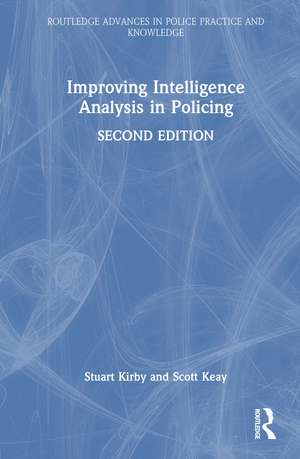
Improving Intelligence Analysis in Policing: Routledge Advances in Police Practice and Knowledge
Autor Stuart Kirby, Scott Keayen Limba Engleză Hardback – 26 feb 2026
This second edition has been updated with new research and material offering inventive modes of critical thinking, including both practical knowledge and an evaluative understanding of the applications and risks associated with intelligence. Some of the key features of the book include:
- Advances in theories of intelligence analysis
- Critical evaluation of intelligence sources
- Recommendations to improve practice
- Leadership and management approaches in intelligence-led policing
- Strategic applications of intelligence for crime reduction
- Technological innovation and data science integration in intelligence work
- Future-focused, offering new ideas to develop policy and practice



Preț: 1345.62 lei
Preț vechi: 1641.00 lei
-18%
Puncte Express: 2018
Carte tipărită la comandă
Livrare economică 03-17 decembrie
Livrare prin curier în România Termenul estimat este afișat lângă disponibilitate.
Transport gratuit pentru acest produs Plată online sau ramburs, în funcție de opțiunile comenzii.
Retur gratuit în 14 zile Comandă securizată și suport în română.
Specificații
ISBN-13: 9781032914824
ISBN-10: 1032914823
Pagini: 204
Ilustrații: 12
Dimensiuni: 156 x 234 mm
Greutate: 0.54 kg
Ediția:2. Auflage
Editura: Taylor & Francis
Colecția Routledge
Seria Routledge Advances in Police Practice and Knowledge
Locul publicării:Oxford, United Kingdom
ISBN-10: 1032914823
Pagini: 204
Ilustrații: 12
Dimensiuni: 156 x 234 mm
Greutate: 0.54 kg
Ediția:2. Auflage
Editura: Taylor & Francis
Colecția Routledge
Seria Routledge Advances in Police Practice and Knowledge
Locul publicării:Oxford, United Kingdom
Public țintă
Postgraduate, Professional Practice & Development, Professional Training, and Undergraduate AdvancedCuprins
1. Why intelligence analysis remains essential in policing 2. Understanding the value and danger of intelligence sources 3. How leaders/managers improve the intelligence process 4. How analysts can improve intelligence analysis 5. Intelligence and crime reduction 6. Intelligence techniques in reactive and proactive investigations 7. The enduring importance of partnership intelligence 8. Technology and data science 9. Improving intelligence analysis to meet future challenges
Recenzii
Improving Intelligence Analysis in Policing is one of the few academic books that succeeds on multiple levels. First, by combining clarity with insight and originality, Stuart Kirby and Scott Keay have created a resource that is as useful for scholars as it is for practitioners and students. Second, they have written a new edition that improves on rather than simply adds to the original. Finally, and perhaps most importantly, they have achieved their own goal, producing an outstanding study that lays the foundation for bridging the theory-practice gap.
Rafe McGregor, Reader in Criminology, Edge Hill University
This book represents a well-crafted fusion of research, theory, and practice from the intelligence and analysis in policing domain. I particularly like the chapter linking intelligence, analysis, and crime prevention. Unlike many second editions, it explores previous areas in more depth and also boasts additional areas not previously covered. An excellent resource for students, researchers, and police personnel alike.
Jason Roach, Professor of Psychology and Policing, University of Huddersfield
Intelligence analysis is critical for effective, efficient and fair policing. This book provides an authoritative and accessible account of what effective intelligence analysis involves. It is an important and timely resource for practitioners, researchers and students.
Aiden Sidebottom, Professor of Policing and Crime Prevention, UCL Jill Dando Institute of Security and Crime Science
Rafe McGregor, Reader in Criminology, Edge Hill University
This book represents a well-crafted fusion of research, theory, and practice from the intelligence and analysis in policing domain. I particularly like the chapter linking intelligence, analysis, and crime prevention. Unlike many second editions, it explores previous areas in more depth and also boasts additional areas not previously covered. An excellent resource for students, researchers, and police personnel alike.
Jason Roach, Professor of Psychology and Policing, University of Huddersfield
Intelligence analysis is critical for effective, efficient and fair policing. This book provides an authoritative and accessible account of what effective intelligence analysis involves. It is an important and timely resource for practitioners, researchers and students.
Aiden Sidebottom, Professor of Policing and Crime Prevention, UCL Jill Dando Institute of Security and Crime Science
Notă biografică
Stuart Kirby is a Chartered Psychologist who previously served as a Detective Chief Superintendent (Lancashire, UK), with responsibility for Intelligence, Forensic, Major Crime, Organised Crime and Counter Terrorism. On retirement from the police he became an academic and is now Emeritus Professor in Policing at the University of Lancashire.
Scott Keay is a senior lecturer in Policing at Edge Hill University (UK). He is a former intelligence analyst and worked in various analytical roles from criminal intelligence through to community safety and partnership intelligence. His research continues to develop and support crime and intelligence analysis.
Scott Keay is a senior lecturer in Policing at Edge Hill University (UK). He is a former intelligence analyst and worked in various analytical roles from criminal intelligence through to community safety and partnership intelligence. His research continues to develop and support crime and intelligence analysis.
Descriere
This book offers an accessible and critical account of how intelligence analysis can improve policing. The second edition has been updated with new research and material offering inventive modes of critical thinking, including both practical knowledge and an evaluative understanding of the applications and risks associated with intelligence.