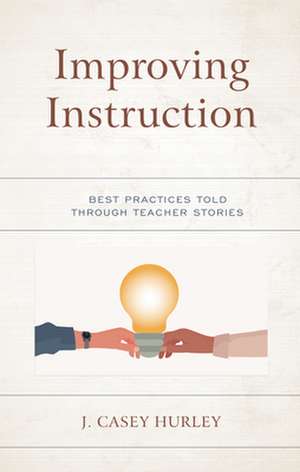
Improving Instruction: Best Practices Told through Teacher Stories
Autor J. Casey Hurleyen Limba Engleză Paperback – 8 oct 2021
Preț: 176.32 lei
Preț vechi: 237.13 lei
-26%
Puncte Express: 264
Carte tipărită la comandă
Livrare economică 04-18 decembrie
Livrare prin curier în România Termenul estimat este afișat lângă disponibilitate.
Transport gratuit de la 400.00 lei Plată online sau ramburs, în funcție de opțiunile comenzii.
Retur gratuit în 14 zile Comandă securizată și suport în română.
Specificații
ISBN-13: 9781475858686
ISBN-10: 147585868X
Pagini: 120
Dimensiuni: 148 x 226 x 10 mm
Greutate: 0.2 kg
Editura: Bloomsbury Publishing
Colecția Rowman & Littlefield
Locul publicării:New York, United States
ISBN-10: 147585868X
Pagini: 120
Dimensiuni: 148 x 226 x 10 mm
Greutate: 0.2 kg
Editura: Bloomsbury Publishing
Colecția Rowman & Littlefield
Locul publicării:New York, United States
Cuprins
Acknowledgements
Introduction
Part 1
Chapter 1: Stories from 5 elementary school teachers
Chapter 2: Stories from 4 middle school teachers
Chapter 3: Stories from 8 high school teachers
Part 2
Chapter 4: Stories from a GED tutor, a physical therapist, 2 athletic coaches, and a piano teacher
Chapter 5: Stories from 2 music teachers, a pastor, a Goodwill trainer and a Team building consultant
Bibliography
About the author
Introduction
Part 1
Chapter 1: Stories from 5 elementary school teachers
Chapter 2: Stories from 4 middle school teachers
Chapter 3: Stories from 8 high school teachers
Part 2
Chapter 4: Stories from a GED tutor, a physical therapist, 2 athletic coaches, and a piano teacher
Chapter 5: Stories from 2 music teachers, a pastor, a Goodwill trainer and a Team building consultant
Bibliography
About the author
Recenzii
I urge you to read Improving Instruction! It is highly accessible and unusually percipient. Through teachers' stories, Casey Hurley provides fascinating insights from teachers for other teachers. Teachers from diverse levels of school (elementary, middle, and secondary) and from adjacent teaching vocations tell compelling stories, and within these stories one finds virtues of intellect, character, and spirit expressed in myriad ways. The book shows that teacher stories are treasure troves for improved and inspired instruction.
Improving Instruction is a book I wish I had in my first year teaching. It combines theory, which we learned a great deal about in school, with real stories of strategy application that can really help. The stories at each level are inspiring, but also realistic--any teacher could apply the same techniques. The six principles are explained after each story, which helps to specifically demonstrate what new teachers (and veteran teachers, too!) should look for in their practice.
Casey Hurley reminds us that effective instruction is more artistry than science and provides the reader with a framework of six virtues to help guide and explain what makes teaching (and learning), in his words, "beautiful." He then allows K-12 educators, as well as instructors across a wide variety of professions, to share their practitioner wisdom and artistry, including how they attempt to engage "reluctant learners." Improving Instruction delivers on its promise.
In Improving Instruction: Best Practices Told through Teacher Stories, Dr. Hurley has modeled one of the oldest and most effective forms of instruction. The power of stories span the centuries from the experiences of every learner to the biographies of famous teachers. Many learners first experience story-telling at home from their first teachers among their families. From Aesop to rabbinical studies, fables, parables, and other forms of story-telling offer life lessons. By systematically capturing selected contemporary teachers' insights about their work, about their reflections of its effects, Dr. Hurley opens eyes to the world of teaching and the ongoing reflective nature of good teaching. He lifts teachers' voices and offers insightful highlights of those voices. If instruction is to improve, then this book demonstrates the power of enlisting the stories of teachers for that improvement.
Stories have been used to teach generations for centuries. Stories in this book highlight virtues with concrete examples across many different levels of learning and teaching styles. This work clearly demonstrates context on how anyone involved in teaching can reach and provide positive experiences with carryover to learners of all skills and abilities.
Improving Instruction is a book I wish I had in my first year teaching. It combines theory, which we learned a great deal about in school, with real stories of strategy application that can really help. The stories at each level are inspiring, but also realistic--any teacher could apply the same techniques. The six principles are explained after each story, which helps to specifically demonstrate what new teachers (and veteran teachers, too!) should look for in their practice.
Casey Hurley reminds us that effective instruction is more artistry than science and provides the reader with a framework of six virtues to help guide and explain what makes teaching (and learning), in his words, "beautiful." He then allows K-12 educators, as well as instructors across a wide variety of professions, to share their practitioner wisdom and artistry, including how they attempt to engage "reluctant learners." Improving Instruction delivers on its promise.
In Improving Instruction: Best Practices Told through Teacher Stories, Dr. Hurley has modeled one of the oldest and most effective forms of instruction. The power of stories span the centuries from the experiences of every learner to the biographies of famous teachers. Many learners first experience story-telling at home from their first teachers among their families. From Aesop to rabbinical studies, fables, parables, and other forms of story-telling offer life lessons. By systematically capturing selected contemporary teachers' insights about their work, about their reflections of its effects, Dr. Hurley opens eyes to the world of teaching and the ongoing reflective nature of good teaching. He lifts teachers' voices and offers insightful highlights of those voices. If instruction is to improve, then this book demonstrates the power of enlisting the stories of teachers for that improvement.
Stories have been used to teach generations for centuries. Stories in this book highlight virtues with concrete examples across many different levels of learning and teaching styles. This work clearly demonstrates context on how anyone involved in teaching can reach and provide positive experiences with carryover to learners of all skills and abilities.