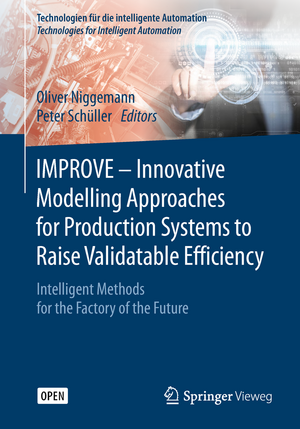
IMPROVE - Innovative Modelling Approaches for Production Systems to Raise Validatable Efficiency: Technologien für die intelligente Automation, cartea 8
Editat de Oliver Niggemann, Peter Schülleren Limba Engleză Paperback – 31 aug 2018
This open access work presents selected results from the European research and innovation project IMPROVE which yielded novel data-based solutions to enhance machine reliability and efficiency in the fields of simulation and optimization, condition monitoring, alarm management, and quality prediction.



Preț: 636.26 lei
Preț vechi: 748.55 lei
-15%
Puncte Express: 954
Carte tipărită la comandă
Livrare economică 05-19 decembrie
Livrare prin curier în România Termenul estimat este afișat lângă disponibilitate.
Transport gratuit pentru acest produs Plată online sau ramburs, în funcție de opțiunile comenzii.
Retur gratuit în 14 zile Comandă securizată și suport în română.
Specificații
ISBN-13: 9783662578049
ISBN-10: 3662578042
Pagini: 140
Ilustrații: VII, 129 p. 52 illus., 29 illus. in color.
Dimensiuni: 168 x 240 x 8 mm
Greutate: 0.24 kg
Ediția:1st ed. 2018
Editura: Springer-Spektrum
Colecția Technologien für die intelligente Automation
Seria Technologien für die intelligente Automation
Locul publicării:Berlin, Heidelberg, Germany
ISBN-10: 3662578042
Pagini: 140
Ilustrații: VII, 129 p. 52 illus., 29 illus. in color.
Dimensiuni: 168 x 240 x 8 mm
Greutate: 0.24 kg
Ediția:1st ed. 2018
Editura: Springer-Spektrum
Colecția Technologien für die intelligente Automation
Seria Technologien für die intelligente Automation
Locul publicării:Berlin, Heidelberg, Germany
V-ar putea interesa
-
 Reliability and Six SIGMAU Dinesh Kumar-18%Preț: 964.12 lei1175.76 lei
 -
 Reliability, Maintenance and Logistic SupportU Dinesh Kumar-18%Preț: 1272.25 lei1551.52 lei
 -
 Scientific Uncertainty and Its Influence on the Public Communication ProcessVirginia H. Sublet-15%Preț: 663.81 lei780.95 lei
 -
 Optimization in Quality ControlM. A. Rahim-18%Preț: 986.35 lei1202.86 lei
 -
 Guidelines for Sensory Analysis in Food Product Development and Quality ControlRoland P. Carpenter-15%Preț: 619.29 lei728.58 lei
 -
 -18%Preț: 1223.39 lei1491.94 lei
 -
 Game Theoretic Risk Analysis of Security ThreatsVicki M. Bier-15%Preț: 670.17 lei788.44 lei
 -
 Quality Management in Reverse LogisticsYiannis Nikolaidis-15%Preț: 662.81 lei779.78 lei
 -
 -20%Preț: 612.81 lei766.01 lei
 -
 -15%Preț: 608.90 lei716.36 lei
 -
 Reliability-Based Structural DesignSeung-Kyum Choi-18%Preț: 1156.02 lei1409.78 lei
 -
 Handbook of Performability EngineeringKrishna B. Misra-24%Preț: 3061.47 lei4028.25 lei
 -
 Handbook of Reliability, Availability, Maintainability and Safety in Engineering DesignRudolph Frederick Stapelberg-18%Preț: 2813.55 lei3431.15 lei
 -
 After-sales Service of Engineering Industrial AssetsVicente González-Prida Díaz-18%Preț: 987.18 lei1203.87 lei
 -
 -15%Preț: 664.57 lei781.85 lei
 -
 Reliability and Optimization of Structural Systems '91Rüdiger Rackwitz-18%Preț: 962.36 lei1173.60 lei
 -
 Neue Wege in der AutomobillogistikWillibald Günthner-18%Preț: 828.97 lei1010.93 lei
 -
 Fringe 2013Wolfgang Osten-18%Preț: 1925.98 lei2348.76 lei
 -
 Preț: 392.17 lei
 -
 Machine Learning for Cyber Physical SystemsOliver Niggemann-20%Preț: 640.60 lei800.75 lei
 -
 -20%Preț: 939.13 lei1173.91 lei
 -
 Practical Acoustic Emission TestingThe Japanese Society for Non-Destructive-18%Preț: 921.54 lei1123.83 lei
 -
 Perspectives on Uncertainty and Risk: The PRIMA Approach to Decision SupportMarjolein B.A. van Asselt-18%Preț: 914.83 lei1115.64 lei
 -
 Bayesian Methods in ReliabilityP. Sander-15%Preț: 612.85 lei721.00 lei
 -
 Electromigration Modeling at Circuit Layout LevelCher Ming TanPreț: 379.78 lei
Cuprins
Concept and Implementation of a Software Architecture for Unifying Data Transfer in Automated Production Systems.- Social Science Contributions to Engineering Projects: Looking Beyond Explicit Knowledge Through the Lenses of Social Theory.- Enable learning of Hybrid Timed Automata in Absence of Discrete Events through Self-Organizing Maps.- Anomaly Detection and Localization for Cyber-Physical Production Systems with Self-Organizing Maps.- A Sampling-Based Method for Robust and Efficient Fault Detection in Industrial Automation Processes.- Validation of similarity measures for industrial alarm flood analysis.- Concept for Alarm Flood Reduction with Bayesian Networks by Identifying the Root Cause.
Textul de pe ultima copertă
This open access work presents selected results from the European research and innovation project IMPROVE which yielded novel data-based solutions to enhance machine reliability and efficiency in the fields of simulation and optimization, condition monitoring, alarm management, and quality prediction.
The Editors
Prof. Dr. Oliver Niggemann is Professor for Artificial Intelligence in Automation. His research interests are in the fields of machine learning and data analysis for Cyber-Physical Systems and in the fields of planning and diagnosis of distributed systems. He is a board member of the research institute inIT and deputy director at the Fraunhofer Application Center Industrial Automation INA located in Lemgo.
Dr. Peter Schüller is postdoctoral researcher at Technische Universität Wien. His research interests are hybrid reasoning systems that combine Knowledge Representation and Machine Learning and applications in the fields of Cyber-Physical systems and Natural Language Processing.
Caracteristici
Provides engineering-lean, unsupervised methods that scale in realistic scenarios Helps to improve reliability and efficiency of complex systems Presents examples and results from real factories and real cyber-physical systems