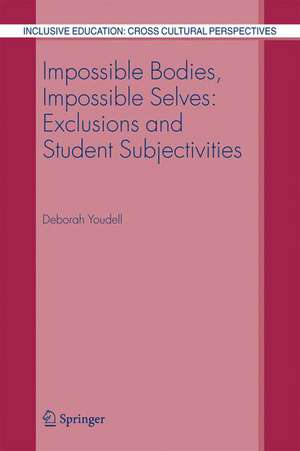
Impossible Bodies, Impossible Selves
Autor Deborah Youdellen Limba Engleză Hardback – 5 apr 2006
The book uses tools offered by post-structural theory to read ethnographic data and show how the discourses that circulate inside schools at once mobilise and elide gender, sexuality, social class, ability, disability, race, ethnicity, religious and cultural belongings at the same time as they open up and close down 'who' students can be as learners.
In demonstrating these processes the book offers new insights into how these 'truths' about students and learners are created and how they come to be bound so tightly to the educational inclusions, privileges and successes that some students enjoy and the exclusions, disadvantages and 'failures' that other students face.
Preț: 645.15 lei
Preț vechi: 759.01 lei
-15%
Puncte Express: 968
Carte tipărită la comandă
Livrare economică 23 noiembrie-07 decembrie
Livrare prin curier în România Termenul estimat este afișat lângă disponibilitate.
Transport gratuit pentru acest produs Plată online sau ramburs, în funcție de opțiunile comenzii.
Retur gratuit în 14 zile Comandă securizată și suport în română.
Specificații
ISBN-13: 9781402045486
ISBN-10: 1402045484
Pagini: 224
Ilustrații: XVII, 207 p.
Dimensiuni: 167 x 249 x 17 mm
Greutate: 0.49 kg
Ediția:2006 edition
Editura: Springer Nature B.V.
Locul publicării:Dordrecht, Netherlands
ISBN-10: 1402045484
Pagini: 224
Ilustrații: XVII, 207 p.
Dimensiuni: 167 x 249 x 17 mm
Greutate: 0.49 kg
Ediția:2006 edition
Editura: Springer Nature B.V.
Locul publicării:Dordrecht, Netherlands
V-ar putea interesa
-
 Indiana UniversityIu Press JournalsPreț: 139.60 lei
 -
 Preț: 323.63 lei
 -
 Ethics in the UniversityJames G Speight-9%Preț: 932.34 lei1024.55 lei
 -
 One LScott Turow-23%Preț: 82.33 lei107.45 lei
 -
 The Researching, Teaching, and Learning TriangleMiguel A. R. B. CastanhoPreț: 364.57 lei
 -
 Admissions Essay Boot CampAshley WellingtonPreț: 79.07 lei
 -
 Perspectives on Educational QualityJaap ScheerensPreț: 335.89 lei
Public țintă
Professional/practitionerCuprins
Subjectivity and Exclusion.- Who's in and who's out? Inclusion and exclusion, globalised education policy, and inequality.- Rendering subjects: Theorising the production of the Self.- Researching Subjects.- Researching subjectivity and educational exclusions.- Names and practices: making subjects in/of school.- Educational Exclusions: Bad Students, and Impossible Learners.- Excluded White-working-class-hetero-adult-masculinity.- Excluded White-working-class-hetero-(un)femininity.- Excluded Black femininity.- Excluded ‘specialness’ (White-working class-hetero-(hyper-masculinity).- Navigating Educational Inclusions and Exclusions.- Included and excluded? Middle class-White-queer-high ability-alternative youth-culture/Working class-White-Black-hetero-low ability-mainstream youth-culture.- Included learners, impossible girls: The incommensurability of Indian-ness and desirable femininity.- Included students, impossible boys: The ‘racing’ and ‘specialing’ of (un-)masculinity.- Intelligible impossibility: The (un-)feminine subject-hood of a ‘geeza-girl’.- Good students, acceptable learners, intelligible girls: Class, race, gender, sexuality and the adornment of feminine bodies.- Between good and bad student, between acceptable and unacceptable learner.- Interrupting Exclusions.- Practicing performative politics for inclusive education.
Textul de pe ultima copertă
This book looks inside the school to examine how every-day, school-level processes act to place particular students 'outside' the educational endeavour and argues for new strategies for thinking critically about and interrupting educational exclusions and inequalities.
Looking across national contexts and drawing on ethnographic studies of schools in the UK and Australia, the book explores the implications of the contemporary education policy context and processes and practices inside schools for students as learners and for educational inequalities.
The book uses tools offered by post-structural theory to read ethnographic data and show how the discourses that circulate inside schools at once mobilize and elide gender, sexuality, social class, ability, disability, race, ethnicity, religious and cultural belongings at the same time as they open up and close down 'who' students can be as learners.
In demonstrating these processes the book offers new insights into how these 'truths' about students and learners are created and how they come to be bound so tightly to the educational inclusions, privileges and successes that some students enjoy and the exclusions, disadvantages and 'failures' that other students face.
Looking across national contexts and drawing on ethnographic studies of schools in the UK and Australia, the book explores the implications of the contemporary education policy context and processes and practices inside schools for students as learners and for educational inequalities.
The book uses tools offered by post-structural theory to read ethnographic data and show how the discourses that circulate inside schools at once mobilize and elide gender, sexuality, social class, ability, disability, race, ethnicity, religious and cultural belongings at the same time as they open up and close down 'who' students can be as learners.
In demonstrating these processes the book offers new insights into how these 'truths' about students and learners are created and how they come to be bound so tightly to the educational inclusions, privileges and successes that some students enjoy and the exclusions, disadvantages and 'failures' that other students face.
Caracteristici
Brings sophisticated but accessible theoretical tools together with ethnographic data from real schools Demonstrates the inseparability of categories such as gender, sexuality, race, ethnicity, class, ability, disability, special needs Develops tools for understanding the relationships between schools, subjectivities, and students as learners Works across national contexts to show the wide applicability of these tools Problematises narrow understandings of inclusion found in contemporary policy Explores a new politics for interrupting educational inequalities