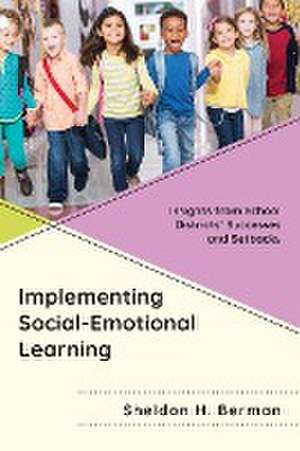
Implementing Social-Emotional Learning: Insights from School Districts’ Successes and Setbacks
Autor Sheldon H. Bermanen Limba Engleză Paperback – 12 iun 2023
Building upon these case studies, Implementing Social-Emotional Learning: Insights from Districts' Successes and Setbacks offers clear guidance so districts can avoid the errors that compromise implementation and can, instead, support district leaders in building successful and sustainable approaches that reach all students, including those at the challenging middle and high school levels.
Preț: 221.28 lei
Preț vechi: 293.38 lei
-25%
Puncte Express: 332
Carte tipărită la comandă
Livrare economică 21 noiembrie-05 decembrie
Livrare prin curier în România Termenul estimat este afișat lângă disponibilitate.
Transport gratuit de la 400.00 lei Plată online sau ramburs, în funcție de opțiunile comenzii.
Retur gratuit în 14 zile Comandă securizată și suport în română.
Specificații
ISBN-13: 9781475869347
ISBN-10: 1475869347
Pagini: 196
Ilustrații: 1 b/w illustration; 1 textbox
Dimensiuni: 148 x 228 x 12 mm
Greutate: 0.3 kg
Editura: Bloomsbury Publishing
Colecția Rowman & Littlefield
Locul publicării:New York, United States
ISBN-10: 1475869347
Pagini: 196
Ilustrații: 1 b/w illustration; 1 textbox
Dimensiuni: 148 x 228 x 12 mm
Greutate: 0.3 kg
Editura: Bloomsbury Publishing
Colecția Rowman & Littlefield
Locul publicării:New York, United States
Cuprins
Foreword
Preface
Chapter 1: Why Does SEL Matter?
Chapter 2: What Is SEL?
Chapter 3: How Should We Implement SEL?-What The Research Tells Us
Chapter 4: Striving for Deep and Transformational Learning-Virginia Beach City Public Schools (Virginia)
Chapter 5: Responding to Demographic Challenges-Marshalltown Community School District (Iowa)
Chapter 6: Taking the First Steps-Moriarty-Edgewood School District (New Mexico)
Chapter 7: Targeting SEL Standards-Naperville Community Unit School District 203 (Illinois)
Chapter 8: Making SEL Foundational-Corvallis School District (Oregon)
Chapter 9: Building for Sustainability-Cleveland Metropolitan School District (Ohio)
Chapter 10: Promising Practices at the Secondary Level
Chapter 11: What Have We Learned?
References
About the Author
Preface
Chapter 1: Why Does SEL Matter?
Chapter 2: What Is SEL?
Chapter 3: How Should We Implement SEL?-What The Research Tells Us
Chapter 4: Striving for Deep and Transformational Learning-Virginia Beach City Public Schools (Virginia)
Chapter 5: Responding to Demographic Challenges-Marshalltown Community School District (Iowa)
Chapter 6: Taking the First Steps-Moriarty-Edgewood School District (New Mexico)
Chapter 7: Targeting SEL Standards-Naperville Community Unit School District 203 (Illinois)
Chapter 8: Making SEL Foundational-Corvallis School District (Oregon)
Chapter 9: Building for Sustainability-Cleveland Metropolitan School District (Ohio)
Chapter 10: Promising Practices at the Secondary Level
Chapter 11: What Have We Learned?
References
About the Author
Recenzii
Thoughtfully planned and executed, social-emotional learning (SEL) opportunities can enhance student belonging, school safety, and academic performance. As Sheldon Berman makes clear in his in-depth analysis of SEL implementation in six districts-large and small, rural and suburban-achieving those outcomes requires that school leaders make SEL an explicit mission. School leaders must enable all staff to become knowledgeable and passionate advocates for learning that honors the whole student and integrates SEL into every aspect of the school's culture and functioning. Everyone who is working to transform schools to support the whole child will benefit from Berman's insights into these six districts' stumbles and triumphs.
As Sheldon Berman shows, there is no single approach to implementing social and emotional learning (SEL). His deep dive into the work of six school districts illuminates how high-quality SEL can be used to meet the unique needs of communities and families across the country and equip adults to serve students in their pursuit of academic excellence and social and emotional wellness. His book is a clarion call for a nationwide focus on social, emotional, and academic learning. Dr. Berman illuminates the critical importance of providing caring learning environments where students receive the instruction and support they need to thrive.
As our society grapples with deep divisions, school district leaders must commit to action plans that ensure all students are in caring communities that help them thrive. Sheldon Berman's latest book brings such plans to life, showing that SEL is not just about a program or evidence-based practices. It's about the kinds of communities we need our schools to be. Offering case studies of six diverse districts, this text reveals how the research, effective programs, and a thoughtful leadership strategy can combine to create the conditions for all children to succeed. Berman reminds us that the achievements of students and educators emerge from an environment that brings out their best. This book shows leaders how implementing SEL can foster just such an ecosystem for learning.
In this important and timely book, Dr. Berman moves from theory to practice with regard to social and emotional learning. Offering compelling evidence and vivid case studies, he guides the reader through practical steps for implementing SEL. Teachers and education leaders, policymakers, and parents will find the practical guidance they need, now more than ever, to support students' development and promote positive interactions with others.
The case studies in this book by Sheldon Berman closely align with our work on teacher-student relationships. The districts' challenges are presented sensitively, and the cases collectively illustrate the different forms, capacities, and pacing that any approach to school change may require. The "why-what-how" chapters feature some of the best integrations of scientific and practical knowledge I've seen relative to social-emotional learning. The "lessons learned" chapter is spot-on, and the book as a whole is a gift to the field as we strive to support positive social-emotional interactions in the classroom and in the broader community.
The pandemic was a vivid reminder of educators' irreplaceable role in promoting students' well-being. Still, such work is easier said than done. That's where Sheldon Berman's Implementing Social-Emotional Learning rises to meet the need. Brimming cover to cover with varied and doable strategies for transforming entire school systems, this book's rich and granular descriptions of six districts in the midst of change show us how talented and committed educators are leading the way. Practical yet inspirational, this book will be devoured, studied, and embraced by those who care about our young people and our schools-and by those who are willing to dig in now to safeguard and enrich their future.
District-level adoption of SEL is a challenging process. This brilliant, easy-to-read book by Dr. Sheldon Berman offers insights on the what, the why, and the how of systemic SEL. One particularly unique aspect is that it shows how SEL plays out differently depending upon the students' ages. This book will become a "go to" text for school leaders and will also lead to rich discussions in universities' school of education courses.
In Implementing Social-Emotional Learning, author Sheldon Berman helps to put the importance of SEL programs in K-12 schools into perspective. The focus of the book is how school districts go about implementing SEL programs that ultimately bear fruit, supporting student development and maximizing a student's ability to learn. Berman, who worked as a superintendent in four districts, establishes a basic premise for why SEL programs are needed, reviewing the CASEL standards and EASEL frameworks necessary to develop a sense of community and create a sense of equity within the classroom and school. He illustrates how classroom learning experiences can be related to the concepts of self-awareness, relationship skills, social awareness, self-management and responsible decision making. This integration enables students "to see and experience the utility of these skills as they work together to achieve their academic skills." In Implementing Social-Emotional Learning, Berman shares good information about the need to create a safe, warm and equitable learning environment - rather than focusing on "fixing" students. While there is no single best place to start, layering successful elements to deepen the fidelity of the vision will improve the environment and student experience.
As Sheldon Berman shows, there is no single approach to implementing social and emotional learning (SEL). His deep dive into the work of six school districts illuminates how high-quality SEL can be used to meet the unique needs of communities and families across the country and equip adults to serve students in their pursuit of academic excellence and social and emotional wellness. His book is a clarion call for a nationwide focus on social, emotional, and academic learning. Dr. Berman illuminates the critical importance of providing caring learning environments where students receive the instruction and support they need to thrive.
As our society grapples with deep divisions, school district leaders must commit to action plans that ensure all students are in caring communities that help them thrive. Sheldon Berman's latest book brings such plans to life, showing that SEL is not just about a program or evidence-based practices. It's about the kinds of communities we need our schools to be. Offering case studies of six diverse districts, this text reveals how the research, effective programs, and a thoughtful leadership strategy can combine to create the conditions for all children to succeed. Berman reminds us that the achievements of students and educators emerge from an environment that brings out their best. This book shows leaders how implementing SEL can foster just such an ecosystem for learning.
In this important and timely book, Dr. Berman moves from theory to practice with regard to social and emotional learning. Offering compelling evidence and vivid case studies, he guides the reader through practical steps for implementing SEL. Teachers and education leaders, policymakers, and parents will find the practical guidance they need, now more than ever, to support students' development and promote positive interactions with others.
The case studies in this book by Sheldon Berman closely align with our work on teacher-student relationships. The districts' challenges are presented sensitively, and the cases collectively illustrate the different forms, capacities, and pacing that any approach to school change may require. The "why-what-how" chapters feature some of the best integrations of scientific and practical knowledge I've seen relative to social-emotional learning. The "lessons learned" chapter is spot-on, and the book as a whole is a gift to the field as we strive to support positive social-emotional interactions in the classroom and in the broader community.
The pandemic was a vivid reminder of educators' irreplaceable role in promoting students' well-being. Still, such work is easier said than done. That's where Sheldon Berman's Implementing Social-Emotional Learning rises to meet the need. Brimming cover to cover with varied and doable strategies for transforming entire school systems, this book's rich and granular descriptions of six districts in the midst of change show us how talented and committed educators are leading the way. Practical yet inspirational, this book will be devoured, studied, and embraced by those who care about our young people and our schools-and by those who are willing to dig in now to safeguard and enrich their future.
District-level adoption of SEL is a challenging process. This brilliant, easy-to-read book by Dr. Sheldon Berman offers insights on the what, the why, and the how of systemic SEL. One particularly unique aspect is that it shows how SEL plays out differently depending upon the students' ages. This book will become a "go to" text for school leaders and will also lead to rich discussions in universities' school of education courses.
In Implementing Social-Emotional Learning, author Sheldon Berman helps to put the importance of SEL programs in K-12 schools into perspective. The focus of the book is how school districts go about implementing SEL programs that ultimately bear fruit, supporting student development and maximizing a student's ability to learn. Berman, who worked as a superintendent in four districts, establishes a basic premise for why SEL programs are needed, reviewing the CASEL standards and EASEL frameworks necessary to develop a sense of community and create a sense of equity within the classroom and school. He illustrates how classroom learning experiences can be related to the concepts of self-awareness, relationship skills, social awareness, self-management and responsible decision making. This integration enables students "to see and experience the utility of these skills as they work together to achieve their academic skills." In Implementing Social-Emotional Learning, Berman shares good information about the need to create a safe, warm and equitable learning environment - rather than focusing on "fixing" students. While there is no single best place to start, layering successful elements to deepen the fidelity of the vision will improve the environment and student experience.