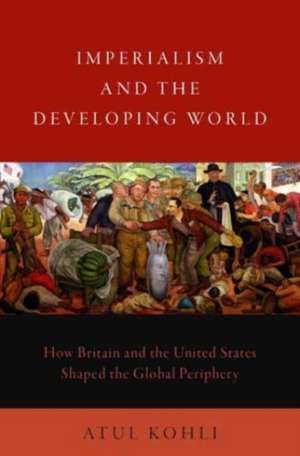
Imperialism and the Developing World: How Britain and the United States Shaped the Global Periphery
Autor Atul Kohlien Limba Engleză Paperback – 30 dec 2021
Preț: 195.73 lei
Preț vechi: 241.84 lei
-19%
Puncte Express: 294
Carte tipărită la comandă
Livrare economică 27 noiembrie-08 decembrie
Livrare prin curier în România Termenul estimat este afișat lângă disponibilitate.
Transport gratuit de la 400.00 lei Plată online sau ramburs, în funcție de opțiunile comenzii.
Retur gratuit în 14 zile Comandă securizată și suport în română.
Specificații
ISBN-13: 9780197582497
ISBN-10: 0197582494
Pagini: 560
Dimensiuni: 157 x 236 x 32 mm
Greutate: 0.79 kg
Editura: Oxford University Press
Colecția OUP USA
Locul publicării:New York, United States
ISBN-10: 0197582494
Pagini: 560
Dimensiuni: 157 x 236 x 32 mm
Greutate: 0.79 kg
Editura: Oxford University Press
Colecția OUP USA
Locul publicării:New York, United States
Recenzii
There is much to love about Imperialism and the Developing World. It is extensive, it is provocative, and it provides a great template for historically informed scholarship that is also relevant to contemporary political issues . . . a remarkably ambitious book that will be relevant to a multidisciplinary constituency of readers for years to come.
Imperialism and the Developing World is a creative and readable approach to the history of British and American imperialism .... [It] powerfully advances the concept of informal empire and demonstrates the significance of sovereignty in economic histories of imperialism.
[T]his is a good book, well written and reflects the labours of first class research and handling of sources.
An immersive account of the history of imperialism for those seeking a refined and concise introduction to the empirical literature ... students of history and international relations will derive useful insights from the book, which can be used to initiate fruitful class discussions for graduate courses on this topic.
Kohli's new book marks an invaluable contribution to the studies of development in the non-Western world. The study sharpens our understanding of the political association between imperialism and underdevelopment by identifying the deterrence of the rise of a sovereign state as a key causal process.
an ambitious analysis of the imperialistic adventures of Great Britain and the United States across some 400 years ...Kohli's analysis is based on an enormous trove of historical sources, and frequently illustrated with striking quotes from contemporary actors and observers. ... [His] This Weberian framing ... may be the book's most important and enduring contribution. It is powerful enough to account for themes echoing across four centuries and two different imperial powers .... It is an articulate opening salvo in what is bound to be a productive scholarly conversation.
Kohli's new work is as important, equally engaging, and as much thoroughly researched as the first 'volume'. It answers three key questions: first, why do imperialists imperialise? Second, how do they do that? And, third, with what consequences on both the metropole and the imperialised country?
The silos of regional expertise that divides the discipline of political science make Kohli's ambition and ability to construct such a thorough empirical and analytical exercise at this scale both rare and impressive. Some of the most rewarding moments of the book for me were the various insights these attentive explorations yielded.
Kohli makes an admirable foray into the common ground between history, political economy, and international relations. His volume should find a comfortable place on the shelves of all three.
Imperialism and the Developing World is a terrific book that engages with crucial enduring questions. It is refreshing to read work in political science that makes such important and challenging arguments. Atul Kohli's newest work will be much-read and debated. "-Robert O. Keohane, Professor of International Affairs, Princeton University
This fascinating book retraces the long arc of economic imperialism, from the East India Company to the Washington Consensus of the late 20th century. Kohli argues national economic interest led Britain and the U.S. to undermine national sovereignty in the periphery, and the prospects of economic development that goes with it. This is a work of considerable scholarship, serious yet readable."-Dani Rodrik, Ford Foundation Professor of International Economy, Harvard Kennedy School
This is a grand study of the relationship between imperialism and its impact on developing countries. The author demonstrates an enormous depth of research and analysis, with an admirable style of writing and clarity in unpacking some of the very complex issues. The manuscript is indeed a very impressive piece of academic work. It is highly readable and a scholarly treasure for students of history, politics and international relations, as well as policy makers."-Amin Saikal, Professor of International Relations, Australian National University
This monumental new book on imperialism is a very important contribution to our comprehension of the role of Britain and the United States in the developing world. Whether or not one agrees with Kohli's basic arguments-that imperialism is driven by the pursuit of national economic interest and that it undermines the development prospects of poor countries by limiting their sovereignty-his careful accumulation of historical information provides the basis for understanding key international processes in the 19th and 20th centuries."-Barbara Stallings, William R. Rhodes Research Professor, Watson Institute for International Studies, Brown University
Imperialism and the Developing World is a creative and readable approach to the history of British and American imperialism .... [It] powerfully advances the concept of informal empire and demonstrates the significance of sovereignty in economic histories of imperialism.
[T]his is a good book, well written and reflects the labours of first class research and handling of sources.
An immersive account of the history of imperialism for those seeking a refined and concise introduction to the empirical literature ... students of history and international relations will derive useful insights from the book, which can be used to initiate fruitful class discussions for graduate courses on this topic.
Kohli's new book marks an invaluable contribution to the studies of development in the non-Western world. The study sharpens our understanding of the political association between imperialism and underdevelopment by identifying the deterrence of the rise of a sovereign state as a key causal process.
an ambitious analysis of the imperialistic adventures of Great Britain and the United States across some 400 years ...Kohli's analysis is based on an enormous trove of historical sources, and frequently illustrated with striking quotes from contemporary actors and observers. ... [His] This Weberian framing ... may be the book's most important and enduring contribution. It is powerful enough to account for themes echoing across four centuries and two different imperial powers .... It is an articulate opening salvo in what is bound to be a productive scholarly conversation.
Kohli's new work is as important, equally engaging, and as much thoroughly researched as the first 'volume'. It answers three key questions: first, why do imperialists imperialise? Second, how do they do that? And, third, with what consequences on both the metropole and the imperialised country?
The silos of regional expertise that divides the discipline of political science make Kohli's ambition and ability to construct such a thorough empirical and analytical exercise at this scale both rare and impressive. Some of the most rewarding moments of the book for me were the various insights these attentive explorations yielded.
Kohli makes an admirable foray into the common ground between history, political economy, and international relations. His volume should find a comfortable place on the shelves of all three.
Imperialism and the Developing World is a terrific book that engages with crucial enduring questions. It is refreshing to read work in political science that makes such important and challenging arguments. Atul Kohli's newest work will be much-read and debated. "-Robert O. Keohane, Professor of International Affairs, Princeton University
This fascinating book retraces the long arc of economic imperialism, from the East India Company to the Washington Consensus of the late 20th century. Kohli argues national economic interest led Britain and the U.S. to undermine national sovereignty in the periphery, and the prospects of economic development that goes with it. This is a work of considerable scholarship, serious yet readable."-Dani Rodrik, Ford Foundation Professor of International Economy, Harvard Kennedy School
This is a grand study of the relationship between imperialism and its impact on developing countries. The author demonstrates an enormous depth of research and analysis, with an admirable style of writing and clarity in unpacking some of the very complex issues. The manuscript is indeed a very impressive piece of academic work. It is highly readable and a scholarly treasure for students of history, politics and international relations, as well as policy makers."-Amin Saikal, Professor of International Relations, Australian National University
This monumental new book on imperialism is a very important contribution to our comprehension of the role of Britain and the United States in the developing world. Whether or not one agrees with Kohli's basic arguments-that imperialism is driven by the pursuit of national economic interest and that it undermines the development prospects of poor countries by limiting their sovereignty-his careful accumulation of historical information provides the basis for understanding key international processes in the 19th and 20th centuries."-Barbara Stallings, William R. Rhodes Research Professor, Watson Institute for International Studies, Brown University
Notă biografică
Atul Kohli is the David K.E. Bruce Professor of International Affairs at Princeton University. He is the author of several books, including Poverty amid Plenty in the New India, which was a Foreign Affairs Best Book of 2012 on Asia and the Pacific, and State-Directed Development, winner of the 2005 Charles Levine Award of the International Political Science Association. He served as the chief editor of the journal World Politics from 2006-13 and was Vice President of the American Political Science Association during 2009-10.
Cuprins
- Introduction
- Part I. How It Began: Great Britain and the Developing World
- Chapter 1: The East India Company
- Chapter 2: Informal Empire: Argentina; Egypt; China
- Chapter 3: Varieties of Colonialism: India; Nigeria
- Part II. How It Continues: The United States and the Developing World
- Chapter 4: Seeking Influence Abroad: Caribbean; Pacific Asia
- Chapter 5: Fighting "Third World" Nationalism: Iran; Vietnam; Chile
- Chapter 6: Global Assertion, Soft and Hard: the Washington Consensus (Latin America); the Middle East (Iraq)
- Conclusion