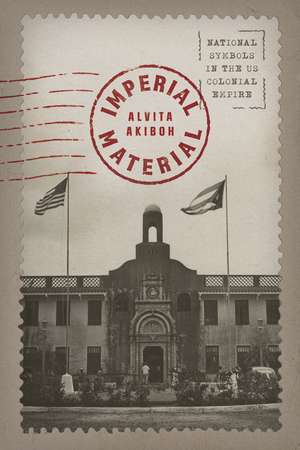
Imperial Material: National Symbols in the US Colonial Empire
Autor Alvita Akibohen Limba Engleză Paperback – 10 noi 2023
In Imperial Material, Alvita Akiboh reveals how US national identity has been created, challenged, and transformed through embodiments of empire found in US territories, from the US dollar bill to the fifty-star flag. These symbolic objects encode the relationships between territories—including the Philippines, the Hawaiian Islands, Puerto Rico, and Guam—and the empire with which they have been entangled. Akiboh shows how such items became objects of local power, their original intent transmogrified. For even if imperial territories were not always front and center for federal lawmakers and administrators, their inhabitants remained continuously aware of the imperial United States, whose presence announced itself on every bit of currency, every stamp, and the local flag.
| Toate formatele și edițiile | Preț | Express |
|---|---|---|
| Paperback (1) | 200.19 lei 3-5 săpt. | +16.57 lei 7-11 zile |
| University of Chicago Press – 10 noi 2023 | 200.19 lei 3-5 săpt. | +16.57 lei 7-11 zile |
| Hardback (1) | 561.49 lei 6-8 săpt. | |
| University of Chicago Press – 10 noi 2023 | 561.49 lei 6-8 săpt. |
Preț: 200.19 lei
Puncte Express: 300
Preț estimativ în valută:
35.44€ • 41.27$ • 30.79£
35.44€ • 41.27$ • 30.79£
Carte disponibilă
Livrare economică 03-17 februarie
Livrare express 20-24 ianuarie pentru 26.56 lei
Preluare comenzi: 021 569.72.76
Specificații
ISBN-13: 9780226828480
ISBN-10: 0226828484
Pagini: 320
Ilustrații: 54 halftones
Dimensiuni: 152 x 229 x 23 mm
Greutate: 0.4 kg
Ediția:1
Editura: University of Chicago Press
Colecția University of Chicago Press
ISBN-10: 0226828484
Pagini: 320
Ilustrații: 54 halftones
Dimensiuni: 152 x 229 x 23 mm
Greutate: 0.4 kg
Ediția:1
Editura: University of Chicago Press
Colecția University of Chicago Press
Notă biografică
Alvita Akiboh is assistant professor of history at Yale University.
Cuprins
List of Figures
A Note on Terminology: On Mainlands and Americans
Introduction: National Symbols in the US Colonial Empire
1 What Followed the Flag
2 Pocket-Sized Imperialism
3 Symbolic Supremacy
4 The Object(s) of Occupation
5 Symbolic Decolonization
Conclusion
Acknowledgments
Notes
Bibliography
Index
A Note on Terminology: On Mainlands and Americans
Introduction: National Symbols in the US Colonial Empire
1 What Followed the Flag
2 Pocket-Sized Imperialism
3 Symbolic Supremacy
4 The Object(s) of Occupation
5 Symbolic Decolonization
Conclusion
Acknowledgments
Notes
Bibliography
Index
Recenzii
“One of the closest readings we have of how the US imperial community evolved in first half of the twentieth century, an extended moment of expansion, transformation, and (obscured) continuity. . . . Drawing from an impressive array of archives in multiple countries, Imperial Material uses a chorus of historical voices—Euro-American, Filipino, Chamoru, Puerto Rican, Kānaka Maoli—to advance its arguments. The result is a lively, attentive, and revealing new way to understand the American empire and its discontents during a time of global ascent.”
“[Akiboh] has written an empirically saturated and fine-grained history of symbolic integration through material culture in the US colonial empire. Her compelling analysis of the role of flags, stamps, and currency in so-called Americanization programs explores the uses of a national iconographic inventory as an analytical lens into the ubiquitous nature of colonialism, its embedded tensions between conflicting political formats of nation and empire, and its creative appropriations and contestations by the colonized.”
“Imperial Material is a welcome contribution to studies of the (US) American empire as it stretched globally across the tropics but remained, paradoxically, local at all points, shedding light on the contested relations through which empires communicate materially and symbolically with their subjects while also calling attention to the persistence of US colonial relations in contemporary Pacific and Caribbean settings.”
“With crisp prose and a sweeping narrative arc, Akiboh offers an original, ambitious, and deeply researched work of scholarship. By focusing on the uses and meanings of US national symbols that were exported to the colonies—flags, stamps, and currency—Akiboh uncovers the quotidian practices that made real the experience of colonialism. These symbols were everyday reminders to colonial subjects that they were living under US rule. And they were never just symbols. As Akiboh compellingly demonstrates, they have been at ‘the center of debates about national identity, inclusion, and exclusion in the US colonial empire.’”
“This is terrific scholarship. Akiboh presents a highly original, impressively researched, clearly written, and helpfully illustrated study of the official accoutrements of US imperialism.”
“Akiboh’s original and compelling story shows us that empire was as much a matter of stamps, money, and flags as it was about raw colonial domination—and that indeed the latter did not happen without the former. At once seminal and revelatory, this book covers uncharted territory in the historiography of American empire and of empire more broadly.”
“In this vividly written history, Akiboh traces ideas and artifacts in motion. Whether saluting the Stars and Stripes, raising a seditious flag, or marking political heroes on the stamps of the independent Philippines, colonized people throughout the Pacific made and remade the meanings of national symbols. Imperial Material boldly demonstrates that at stake in these contests was nothing less than life or death.”
“Imperial Material is an important, innovative history that examines the crucial role of quotidian objects in effort to foster allegiance or loyalty. Akiboh shows how the imperial fetishization of flags, stamps, and currency reveals imperial insecurity about its reliance on the colonized for the imperial arrangement to work. In turn, the objects serve to foster pride in a newly decolonized nation. A major contribution to our understanding of the affective dimension of US empire.”