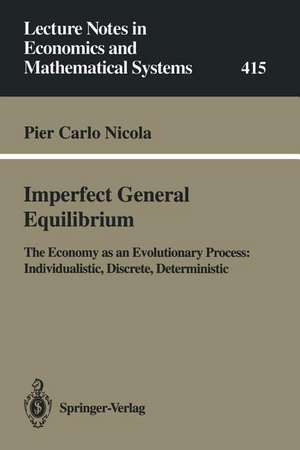
Imperfect General Equilibrium: The Economy as an Evolutionary Process: Individualistic, Discrete, Deterministic: Lecture Notes in Economics and Mathematical Systems, cartea 415
Autor Pier C. Nicolaen Limba Engleză Paperback – 29 aug 1994
Din seria Lecture Notes in Economics and Mathematical Systems
-
 Preț: 368.38 lei
 -
 Preț: 365.65 lei
 -
 Preț: 428.35 lei
 -
 Preț: 478.67 lei
 -
 Preț: 365.90 lei
 -
 Preț: 398.93 lei
 -
 Preț: 384.48 lei
 - 15%
 Preț: 646.64 lei
 -
 Preț: 364.71 lei
 -
 Preț: 437.64 lei
 -
 Preț: 370.76 lei
 - 15%
 Preț: 618.65 lei
 -
 Preț: 363.99 lei
 -
 Preț: 331.98 lei
 -
 Preț: 409.58 lei
 -
 Preț: 363.18 lei
 - 18%
 Preț: 778.82 lei
 -
 Preț: 377.68 lei
 -
 Preț: 405.53 lei
 - 15%
 Preț: 620.72 lei
 -
 Preț: 367.23 lei
 -
 Preț: 363.18 lei
 - 15%
 Preț: 611.54 lei
 - 15%
 Preț: 621.61 lei
 -
 Preț: 363.41 lei
 -
 Preț: 430.76 lei
 - 15%
 Preț: 618.65 lei
 -
 Preț: 371.37 lei
 - 15%
 Preț: 629.18 lei
 -
 Preț: 399.23 lei
 -
 Preț: 395.12 lei
 -
 Preț: 383.75 lei
 -
 Preț: 383.75 lei
 -
 Preț: 377.40 lei
 - 15%
 Preț: 610.96 lei
 - 20%
 Preț: 628.32 lei
 -
 Preț: 365.45 lei
 -
 Preț: 476.60 lei
 -
 Preț: 363.14 lei
 - 15%
 Preț: 611.04 lei
 -
 Preț: 371.20 lei
 -
 Preț: 364.19 lei
 - 15%
 Preț: 640.81 lei
 -
 Preț: 364.48 lei
 - 15%
 Preț: 611.19 lei
 -
 Preț: 365.09 lei
 - 15%
 Preț: 613.62 lei
 - 15%
 Preț: 612.55 lei
 -
 Preț: 432.70 lei
Preț: 367.49 lei
Puncte Express: 551
Carte tipărită la comandă
Livrare economică 08-22 decembrie
Livrare prin curier în România Termenul estimat este afișat lângă disponibilitate.
Transport gratuit de la 400.00 lei Plată online sau ramburs, în funcție de opțiunile comenzii.
Retur gratuit în 14 zile Comandă securizată și suport în română.
Specificații
ISBN-13: 9783540581024
ISBN-10: 3540581022
Pagini: 188
Ilustrații: XI, 167 p.
Dimensiuni: 155 x 235 x 10 mm
Greutate: 0.27 kg
Ediția:Softcover reprint of the original 1st ed. 1994
Editura: Springer Berlin, Heidelberg
Colecția Springer
Seria Lecture Notes in Economics and Mathematical Systems
Locul publicării:Berlin, Heidelberg, Germany
ISBN-10: 3540581022
Pagini: 188
Ilustrații: XI, 167 p.
Dimensiuni: 155 x 235 x 10 mm
Greutate: 0.27 kg
Ediția:Softcover reprint of the original 1st ed. 1994
Editura: Springer Berlin, Heidelberg
Colecția Springer
Seria Lecture Notes in Economics and Mathematical Systems
Locul publicării:Berlin, Heidelberg, Germany
V-ar putea interesa
-
 Capital and Time: A Neo-Austrian TheoryJ. R. Hicks-27%Preț: 355.72 lei489.75 lei
 -
 Welfare EconomicsRobin BoadwayPreț: 497.46 lei
 -
 -23%Preț: 504.99 lei655.83 lei
 -
 Preț: 205.32 lei
 -
 Fair EconomicsIrene Schoene-28%Preț: 190.32 lei264.82 lei
 -
 Agent-Based Modelling in EconomicsLynne Hamill-8%Preț: 428.72 lei466.00 lei
 -
 Environmental Economics and SustainabilityBrian Chi-Ang LinPreț: 246.81 lei
 -
 Seventeen Contradictions and the End of CapitalismDavid Harvey-19%Preț: 75.86 lei93.37 lei
 -
 The Essential KeynesJohn Maynard Keynes-16%Preț: 80.11 lei95.93 lei
 -
 Systems Dependability AssessmentJean-Francois Aubry-9%Preț: 1015.29 lei1115.71 lei
 -
 The Reformation in EconomicsPhilip PilkingtonPreț: 371.71 lei
 -
 Handbook of New Institutional EconomicsClaude Ménard-18%Preț: 728.59 lei888.52 lei
 -
 Economic DynamicsGiancarlo Gandolfo-18%Preț: 977.31 lei1191.84 lei
Public țintă
ResearchCuprins
1 Meaningful Elements of Economic Thought.- 1.1 Some Predecessors.- 1.2 Walras and Associates.- 1.3 Modern Competitive Theories.- 1.4 Temporary General Equilibrium.- 1.5 General non Competitive Equilibrium 14.- 1.6 Fixed Prices and Rationing.- 1.7 Game Theory and Market Forms.- 1.8 Sequential Equilibria and Rational Expectations.- 2 Introductory Examples.- 2.1 Summary of a One Period Walrasian Model.- 2.2 A “Vital Utility” Index.- 2.3 Numerical Experiments.- 2.4 Conclusion.- 3 Goods, Money, Public Administration.- 3.1 Goods.- 3.2 Money.- 3.3 Prices and Values.- 3.4 Labour.- 3.5 Public Goods and Public Administration.- 4 Firms.- 4.1 Preliminaries.- 4.2 The Firm.- 4.3 Present Choices.- 4.4 Intertemporal Decisions.- 4.5 Existence of an Optimal Program.- 4.6 Revising Decisions.- 4.7 Market Choices by Firms.- 5 Consumers.- 5.1 Preliminaries.- 5.2 Consumers.- 5.3 Conclusion.- 6 Imperfect General Equilibrium.- 6.1 General Environment.- 6.2 The Network of Exchanges.- 6.3 Imperfect Temporary General Equilibrium.- 6.4 Updating Prices.- 7 Dynamics and Growth, Stationary Equilibria.- 7.1 Some Elements on Evolutionary Processes.- 7.2 Stationary Equilibria.- 7.3 Endogenous Cycles. Chaos.- 8 Numeric Simulations. Cycles and Quasi-Chaos.- 8.1 Society and the Computer.- 8.2 Main Features.- 8.3 Firms’ Decisions.- 8.4 Labour Rationing.- 8.5 Consumers’ Decisions.- 8.6 Effective Transactions.- 8.7 Updating Parameters in Calendar Time.- 9 Micro-Analysis versus Macro-Synthesis.- 9.1 Microeconomics and Macroeconomics.- 9.2 Aggregation.- 9.3 Aggregations in the Imperfect Model.- 10 Epilogue.- A.1 Linear Spaces.- A.2 Topological Spaces and Metric Spaces.- A.3 Linear Topological Spaces.- A.4 Normed Spaces and Banach Spaces.- References.- Name Index.