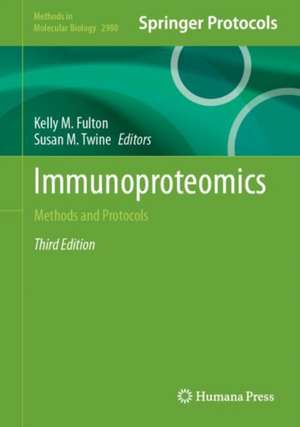
Immunoproteomics
Editat de Kelly M. Fulton, Susan M. Twineen Limba Engleză Hardback – 15 oct 2025
Practical and thorough, Immunoproteomics: Methods and Protocols aids researchers in transferring these techniques to their own laboratories in addition to providing a reference to guide researchers toward appropriate techniques.
Preț: 1085.72 lei
Preț vechi: 1324.05 lei
-18%
Puncte Express: 1629
Carte tipărită la comandă
Livrare economică 23 noiembrie-07 decembrie
Livrare prin curier în România Termenul estimat este afișat lângă disponibilitate.
Transport gratuit pentru acest produs Plată online sau ramburs, în funcție de opțiunile comenzii.
Retur gratuit în 14 zile Comandă securizată și suport în română.
Specificații
ISBN-13: 9781071648315
ISBN-10: 1071648314
Pagini: 480
Ilustrații: XIII, 469 p. 96 illus., 82 illus. in color.
Dimensiuni: 183 x 260 x 32 mm
Greutate: 1.04 kg
Ediția:Third Edition 2026
Editura: Springer
ISBN-10: 1071648314
Pagini: 480
Ilustrații: XIII, 469 p. 96 illus., 82 illus. in color.
Dimensiuni: 183 x 260 x 32 mm
Greutate: 1.04 kg
Ediția:Third Edition 2026
Editura: Springer
V-ar putea interesa
-
 Nanoparticles and the Immune System: Safety and EffectsDiana Boraschi-29%Preț: 229.49 lei323.79 lei
 -
 AutoantibodiesYehuda Shoenfeld-27%Preț: 1022.95 lei1400.84 lei
 -
 Mast CellsGuha Krishnaswamy-5%Preț: 1148.66 lei1209.11 lei
 -
 DNA VaccinesMark W Saltzman-5%Preț: 1113.47 lei1172.08 lei
 -
 Transplantation ImmunologyPhilip Hornick-5%Preț: 1114.57 lei1173.24 lei
 -
 Immunological TolerancePaul J. Fairchild-5%Preț: 1151.49 lei1212.10 lei
 -
 Innate ImmunityJonathan Ewbank-5%Preț: 1100.07 lei1157.96 lei
 -
 Neutrophil Methods and ProtocolsMark T. Quinn-5%Preț: 1484.17 lei1562.28 lei
 -
 Guide to Signal Pathways in Immune CellsE Nigel Wardle-5%Preț: 735.49 lei774.19 lei
 -
 RNA InterferenceWei-Ping Min-5%Preț: 764.00 lei804.22 lei
 -
 Antimicrobial PeptidesAndrea Giuliani-5%Preț: 765.23 lei805.50 lei
 -
 Suppression and Regulation of Immune ResponsesMaria Cristina Cuturi-5%Preț: 730.68 lei769.14 lei
 -
 The Complement SystemMihaela Gadjeva-5%Preț: 1154.50 lei1215.26 lei
 -
 Lupus Renal Involvement: A Case-Based AtlasGyl Eanes Barros Silva-24%Preț: 755.13 lei987.50 lei
 -
 Bacterial Glycomics: Current Research, Technology and ApplicationsChristopher W. Reid-9%Preț: 1321.53 lei1452.24 lei
 -
 Proteases and Their Receptors in InflammationNathalie Vergnolle-5%Preț: 1100.61 lei1158.54 lei
 -
 The InflammasomesIsabelle Couillin-5%Preț: 1095.69 lei1153.36 lei
 -
 Intradermal ImmunizationMarcel B. M. Teunissen-5%Preț: 1097.10 lei1154.84 lei
 -
 Vaccines against AllergiesRudolf Valenta-5%Preț: 1058.20 lei1113.90 lei
 -
 Thymic Development and Selection of T LymphocytesThomas Boehm-5%Preț: 738.82 lei777.70 lei
 -
 Clostridial NeurotoxinsCesare Montecucco-5%Preț: 721.98 lei759.97 lei
 -
 Transgenic Models of Human Viral and Immunological DiseaseFrancis V. Chisari-5%Preț: 375.47 lei395.23 lei
 -
 -5%Preț: 1075.50 lei1132.11 lei
 -
 IgE Receptor (Fc¿RI) Function in Mast Cells and BasophilsMajed M. Hamawy-5%Preț: 731.61 lei770.12 lei
 -
 Local Immunosuppression of Organ TransplantsScott A. Gruber-5%Preț: 354.73 lei373.40 lei
 -
 Monoclonal Antibodies in TransplantationLucienne Chatenoud-5%Preț: 352.80 lei371.37 lei
 -
 The Human T-Cell Receptor Repertoire and TransplantationPeter van den Elsen-5%Preț: 684.95 lei721.00 lei
 -
 Developmental Aspects of the Lymphatic Vascular SystemFriedemann Kiefer-5%Preț: 1126.69 lei1185.99 lei
 -
 Cytokine FrontiersTakayuki Yoshimoto-5%Preț: 1147.85 lei1208.27 lei
Cuprins
Introduction to the Immune System.- Immunoproteomics Methods and Techniques.- Classical Immunoproteomics: Serological Proteome Analysis (SERPA) for Antigen Identification.- Profiling of Cytokine and Chemokine Responses using Multiplex Bead Array Technology.- Preparation of the Low Molecular Weight Serum Proteome for Mass Spectrometry Analysis.- Enriching for Low Abundance Serum Proteins using ProteoMiner™ and Protein Level HPLC.- Identification of the Antigen Content of Electroimmunoprecipitates.- Detection of Human Norovirus-Specific Antibodies using the Luciferase Immunoprecipitation System (LIPS) Assay.- Intact Mass Spectrometry Analysis of Immuno-Isolated Human Therapeutic Antibodies from Serum.- Antigen Identification for Cell-Binding Antibodies using Ligand Directed Crosslinking and Biotin Transfer.- Whole Genome-Phage Display Libraries: A Powerful Tool for Antigen Discovery.- Multiplexed Detection of Autoantibodies to Glycopeptides using Microarray.- Construction and Screening of an Antigen-Derived Peptide Library Displayed on Yeast Cell Surface for CD4+ T Cell Epitope Identification.- Isolation of Major Histocompatibility Complex (MHC)-Associated Peptides by Immunoaffinity Purification.- Enhanced Mass Spectrometry Detection of MHC Peptides.- Enrichment of Phosphorylated MHC Peptides with Immobilized Metal Affinity Chromatography and Titanium Dioxide Particles.- Mass Spectrometric Identification and Molecular Modeling of Glycopeptides Presented by MHC Class I and II Processing Pathways.- Genome Based Bioinformatic Prediction of Major Histocompatibility (MHC).- Enhancing Mass Spectrometry-Based MHC-I Peptide Identification through a Targeted Database Search Approach.- Prioritization of Therapeutic Targets of Inflammation Using Proteomics, Bioinformatics, and In Silico Cell-Cell Interactomics.- Genomics Driven Immunoproteomics: An Integrative Platform to Uncover Important Biomarkers for Human Diseases.- Identification of Antigens in Immune Complexes.- Analysis and Characterization of Immune Cells and their Activation Status by Whole-Cell MALDI TOF Mass Spectrometry.- A Molecular Immunoproteomics Approach to Assess the Viral Antigenicity of Influenza.- Immunoproteomic Biomarkers: From Publication to Personalized Medicine.
Textul de pe ultima copertă
Providing current diverse approaches and techniques used to study the immunoproteome, Immunoproteomics: Methods and Protocols collects chapters from key researchers that deliver information to be used in diagnostics, disease progression, and vaccine correlates of protection analysis, to name but a few. This detailed volume includes techniques used for the study of the antibody targets of bacterial pathogens, viruses, and cancer, mass spectrometry-based approaches to characterize T-cell epitopes, chapters on detection and relative quantification of cytokines in serum, as well as in silico prediction of epitopes using sequence-based or modeling approaches. Written in the highly successful Methods in Molecular Biology series format, chapters include introductions to their respective topics, lists of the necessary materials and reagents, step-by-step, readily reproducible laboratory protocols, and tips on troubleshooting and avoiding known pitfalls.
Practical and thorough, Immunoproteomics: Methods and Protocols aids researchers in transferring these techniques to their own laboratories in addition to providing a reference to guide researchers toward appropriate techniques.
Practical and thorough, Immunoproteomics: Methods and Protocols aids researchers in transferring these techniques to their own laboratories in addition to providing a reference to guide researchers toward appropriate techniques.
Caracteristici
Provides current diverse approaches and techniques to study the immunoproteome Offers lab-ready protocols proven and used by experts around the world Features key tips and implementation advice to ensure successful results Includes supplementary material: sn.pub/extras