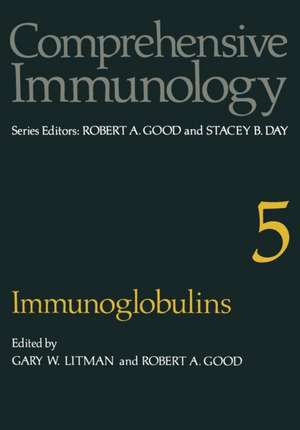
Immunoglobulins: Comprehensive Immunology, cartea 5
Editat de Gary Litmanen Limba Engleză Paperback – 8 mar 2012
Preț: 365.66 lei
Preț vechi: 384.90 lei
-5%
Puncte Express: 548
Carte tipărită la comandă
Livrare economică 30 noiembrie-14 decembrie
Livrare prin curier în România Termenul estimat este afișat lângă disponibilitate.
Transport gratuit de la 400.00 lei Plată online sau ramburs, în funcție de opțiunile comenzii.
Retur gratuit în 14 zile Comandă securizată și suport în română.
Specificații
ISBN-13: 9781468408072
ISBN-10: 1468408070
Pagini: 404
Ilustrații: XVIII, 382 p.
Dimensiuni: 178 x 254 x 21 mm
Greutate: 0.7 kg
Ediția:Softcover reprint of the original 1st ed. 1978
Editura: Springer Us
Colecția Springer
Seria Comprehensive Immunology
Locul publicării:New York, NY, United States
ISBN-10: 1468408070
Pagini: 404
Ilustrații: XVIII, 382 p.
Dimensiuni: 178 x 254 x 21 mm
Greutate: 0.7 kg
Ediția:Softcover reprint of the original 1st ed. 1978
Editura: Springer Us
Colecția Springer
Seria Comprehensive Immunology
Locul publicării:New York, NY, United States
V-ar putea interesa
-
 Immunology for Medical Students: Helbert ImunologieMatthew Helbert-5%Preț: 390.04 lei410.57 lei
 -
 -9%Preț: 817.74 lei898.61 lei
 -
 ImmunologyGavin P. Spickett-5%Preț: 285.07 lei300.08 lei
 -
 Allergy and Clinical ImmunologyHugh A. Sampson-5%Preț: 531.47 lei559.44 lei
 -
 Vaccines and AutoimmunityShoenfeld-9%Preț: 1026.62 lei1128.15 lei
 -
 An Epidemic of AbsenceMoises Velasquez-Manoff-5%Preț: 114.26 lei120.28 lei
 -
 Atlas of Lymph Node PathologyRoberto N. Miranda-5%Preț: 2022.59 lei2129.04 lei
 -
 Antiphospholipid SyndromeDoruk Erkan-5%Preț: 784.79 lei826.10 lei
 -
 -23%Preț: 1650.13 lei2153.16 lei
Public țintă
ResearchCuprins
1 Studies on the Three-Dimensional Structure of Immunoglobulins.- 1. Introduction.- 2. X-Ray Crystallographic Techniques.- 3. Immunoglobulins and Fc Fragments.- 4. Three-Dimensional Structure of Light Chains.- 5. Fab Fragments.- 6. Antibody Combining Sites.- 7. Structure of Fab-Hapten Complexes.- 8. Structure and Genetic Control of VL and VH Regions.- 9. Conclusions.- 10. Note Added in Proof.- References.- 2 Solution Conformation and Segmental Flexibility of Immunoglobulins.- 1. Introduction.- 2. Immunoglobulin G.- 3. Immunoglobulin M.- 4. Immunoglobulin A.- 5. Immunoglobulin D.- 6. Immunoglobulin E.- 7. Concluding Remarks.- References.- 3 The Affinity of Antibody: Range, Variability, and the Role of Multivalence.- 1. Introduction.- 2. Affinity for Monovalent Ligands.- 3. Role of Multivalence.- 4. Structural Analysis of Combining Sites.- 5. Closing Statement.- References.- 4 Antibody Combining Regions.- 1. Background.- 2. Structural Properties of Antibody Combining Regions.- 3. Structural and Functional Correlates of Antigen-Binding.- 4. Biological Significance of Antigen-Binding.- 5. Summary.- References.- 5 The Secretory Component and the J Chain.- 1. Introduction.- 2. The Secretory Component.- 3. The J Chain.- References.- 6 The Structural Basis for the Biological Properties of Immunoglobulins.- 1. Introduction.- 2. Nature of Immunoglobulin Biological Properties.- 3. Submolecular Localization of Immunoglobulin Biological Properties.- 4. Summary and Conclusions.- References.- 7 The Significance of Gene Duplication in Immunoglobulin Evolution (Epimethean Natural Selection and Promethean Evolution).- 1. Introduction.- 2. Epimethean Nature of Evolution by Natural Selection.- 3. Why the Promethean Evolution of the Immune System?.- 4. Strategy of Promethean Evolution.- 5.Conclusions.- References.- 8 The Phylogenetic Origins of Immunoglobulin Structure.- 1. Introduction.- 2. Invertebrate Humoral Immunity—Agglutinins.- 3. Immunoglobulins of Ostracoderm-Derived Vertebrates.- 4. Immunoglobulins of Placoderm-Derived Vertebrates.- 5. Conformation and Active Sites.- 6. Proteolytic Cleavage Products of Immunoglobulins from Lower Species.- 7. Primary Structure.- 8. Cell-Surface Immunoglobulin and Immunoglobulin-Related Structure(s).- 9. Summary and Conclusions.- References.- 9 Evidence for and the Significance of ‘Two Genes, One Polypeptide Chain’.- 1. Basic Immunoglobulin Units.- 2. History.- 3. Allotypes of Rabbit Heavy-Chain Variable Regions.- 4. Sharing of a Single Constant Region by Variable Regions.- 5. Sharing of a Single Variable Region by Constant Regions.- 6. Reciprocal Sharing of Variable and Constant Regions in Heavy Chains.- 7. DNA-RNA Hybridization.- 8. Fusion of the Variable and Constant Regions.- 9. Three Linkage Groups.- 10. More Than Two Genes for One Polypeptide Chain?.- 11. Specific Gene Activation and Differential Gene Expression.- 12. Genetic Switch.- 13. Summary.- References.- 10 Structure of Atypical Immunoglobulins—Relationship to Genetic Control Mechanisms.- 1. Introduction.- 2. Heavy-Chain Variants: Heavy-Chain-Disease Proteins.- 3. Myelomas with Altered Heavy Chains.- 4. Myelomas with Altered Light Chains.- 5. Hybrid Molecules.- 6. Nonsecretors.- 7. Discussion.- References.- 11 Patterns of Sequence Variability in Immunoglobulin Variable Regions: Functional, Evolutionary, and Genetic Implications.- 1. Introduction.- 2. Variable Regions Defined: Molecular Limits and Phylogenetic Occurrence.- 3. Variable Region-Constant Region Transition.- 4. Subgroups Defined and Their Distribution in Phylogeny.- 5.Phylogenetically Associated Residues.- 6. Nature of Idiotypy and Its Relationship to Hypervariable Regions and the Antibody Combining Site.- 7. Genetic Origin of Variable-Region Sequence Diversity.- 8. Conclusions.- References.- 12 Genetic Control of Immunoglobulin Synthesis in Man.- 1. Introduction.- 2. Evidence for Genetic Control of Antibody Synthesis in Experimental Animals.- 3. Evidence for Genetic Control of Immunoglobulin Synthesis in Man.- References.- 13 Heavy-Chain Variable (VH) Subgroups among Myeloma Proteins, Antibodies, and Membrane Immunoglobulins of Lymphocytes.- 1. Introduction.- 2. Anti-VH-Subgroup Antisera.- 3. Comparison of VH Subgroups of the Same Proteins Determined Serologically and by Amino Acid Sequence Analysis.- 4. Serologically Determined VH Subgroups in Myeloma Proteins with Previously Unknown VH Subgroups.- 5. Relative Amounts of the VH Subgroups in Different Human Sera.- 6. Restriction of Immune and Natural Human Antibodies for VH Subgroups.- 7. VH Subgroups of Membrane Immunoglobulin of Normal Human Lymphocytes.- 8. VH Subgroups of Membrane Immunoglobulin of Chronic Lymphocytic Leukemia Cells.- 9. Comments.- References.- 14 Cryoglobulins and Pyroglobulins.- 1. Cryoglobulins.- 2. Pyroglobulins.- References.- 15 Biosynthesis and Secretion of Immunoglobulins.- 1. Introduction.- 2. Methods.- 3. Synthesis of Light and Heavy Polypeptide Chains.- 4. Assembly of Immunoglobulin Molecules.- 5. Secretion of Immunoglobulins.- 6. Differentiation of B Lymphocytes.- References.- 16 Lymphocyte Membrane Immunoglobulins: An Overview.- 1. Introduction.- 2. Basic Data on Membrane Immunoglobulins.- 3. Cells That Carry Actively Synthesized Membrane Immunoglobulins.- 4. Membrane Immunoglobulin Idiotypes, Allotypes, and Isotypes.- 5. Effects of the Interactionbetween Membrane Immunoglobulins and Antiimmunoglobulin Antibodies.- References.