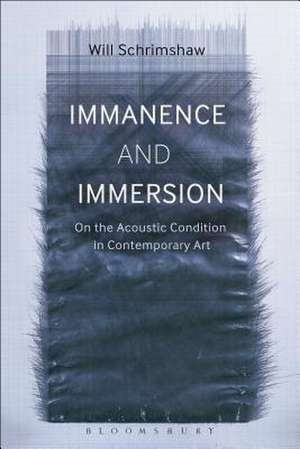
Immanence and Immersion: On the Acoustic Condition in Contemporary Art
Autor Will Schrimshawen Limba Engleză Paperback – 18 apr 2019
Immanence and Immersion takes a critical approach to the figures of immersion and interiority describing an acoustic condition in contemporary art. It is argued that a price paid for this predisposition towards immersion is often the conceptual potency and efficacy of the work undertaken, resulting in arguments that compound the marginalisation and disempowerment of practices and discourses concerned with the sonic. The variously phenomenological, correlational and mystical positions that support the predominance of the immersive are subject to critique before suggesting that a stronger distinction between the often confused concepts of immersion and the immanence might serve as a means of breaking with the figure of immersion and the circle of interiority towards attaining greater conceptual potency and epistemological efficacy within the sonic arts.
Preț: 248.44 lei
Preț vechi: 331.06 lei
-25%
Puncte Express: 373
Carte tipărită la comandă
Livrare economică 24 noiembrie-08 decembrie
Livrare prin curier în România Termenul estimat este afișat lângă disponibilitate.
Transport gratuit de la 400.00 lei Plată online sau ramburs, în funcție de opțiunile comenzii.
Retur gratuit în 14 zile Comandă securizată și suport în română.
Specificații
ISBN-13: 9781501352034
ISBN-10: 1501352032
Pagini: 224
Dimensiuni: 152 x 229 x 15 mm
Greutate: 0.3 kg
Editura: Bloomsbury Publishing
Colecția Bloomsbury Academic
Locul publicării:New York, United States
ISBN-10: 1501352032
Pagini: 224
Dimensiuni: 152 x 229 x 15 mm
Greutate: 0.3 kg
Editura: Bloomsbury Publishing
Colecția Bloomsbury Academic
Locul publicării:New York, United States
V-ar putea interesa
-
 -27%Preț: 436.72 lei600.64 lei
 -
 Signifying RappersDavid Foster WallacePreț: 92.57 lei
 -
 Music and SentimentCharles RosenPreț: 104.92 lei
 -
 Music, Sound and Filmmakers: Sonic Style in CinemaJames WierzbickiPreț: 380.12 lei
 -
 How Music WorksDavid ByrnePreț: 149.83 lei
 -
 Pure DropJeff ApterPreț: 231.63 lei
 -
 Brian Eno: Oblique MusicSean Albiez-16%Preț: 200.44 lei238.10 lei
 -
 -25%Preț: 181.35 lei240.79 lei
 -
 How Music WorksJohn Powell-19%Preț: 74.86 lei92.24 lei
 -
 Torn Music: Rejected Film Scores. A Selected HistoryGergely Hubai Hubai-20%Preț: 187.27 lei233.73 lei
 -
 Musik Fantasie - Schülerheft 1Karin SchuhPreț: 113.22 lei
 -
 Das Musik-1x1Martin LeuchtnerPreț: 90.94 lei
Cuprins
List of Figures
List of Tables
Preface
Acknowledgements
0. Introduction
0.1. Immersion is the New Orthodoxy
0.2. The Ideology of Immersion
0.3. Immersion and Correlationism
0.4. Immanence and Immersion
0.5. Exteriority and the Outside
0.6. Exiting Immersion
1. Decentralisation
1.1. Get Out of the Defensive Position
1.2. Transcendental Empiricism: Approaching the Edge of the Circle
1.3. Negative Duration
1.4. Prodigious Simplification
2. Infraesthetics
2.1. Extreme Audition
2.2. Rolf Julius
2.3. Stephen Vitiello
2.4. Nina Canell
3. Writing Out Sound
3.1. Writing and Exteriority
3.2. Exteriority and the Real
3.3. Sound Recording and Writing Sound
3.4. Sound is Always-Already Written Out
4. Immersive Phenomenology
4.1. Husserl
4.1.1 Intentionality and Direct Realism
4.1.2 Realism and Reduction
4.2. Merleau-Ponty
4.2.1 Immersive Phenomenology
4.2.2 Return to the Depth of the Pre-Objective
5. Sonic Materialism
5.1. Affective Matter
5.2. Material Phenomenology
5.3. Sonic-Material Phenomenology
5.4. Sonic Realism
6. The Scientific Image
6.1. Ryoichi Kurokawa: Abstraction and the Lifeworld
6.2. Towards a Corruption of Aesthetic Sufficiency
7. Repurposing Conceptualism
7.1. Immanence and Representation
7.2. Extinction Abounds: Katie Paterson
8. The Stratification of Immanence
8.1. Immanence Contra Immersion
8.2. Beyond the Circle
8.3. Immanence and an Ethics of Exteriority
References
List of Tables
Preface
Acknowledgements
0. Introduction
0.1. Immersion is the New Orthodoxy
0.2. The Ideology of Immersion
0.3. Immersion and Correlationism
0.4. Immanence and Immersion
0.5. Exteriority and the Outside
0.6. Exiting Immersion
1. Decentralisation
1.1. Get Out of the Defensive Position
1.2. Transcendental Empiricism: Approaching the Edge of the Circle
1.3. Negative Duration
1.4. Prodigious Simplification
2. Infraesthetics
2.1. Extreme Audition
2.2. Rolf Julius
2.3. Stephen Vitiello
2.4. Nina Canell
3. Writing Out Sound
3.1. Writing and Exteriority
3.2. Exteriority and the Real
3.3. Sound Recording and Writing Sound
3.4. Sound is Always-Already Written Out
4. Immersive Phenomenology
4.1. Husserl
4.1.1 Intentionality and Direct Realism
4.1.2 Realism and Reduction
4.2. Merleau-Ponty
4.2.1 Immersive Phenomenology
4.2.2 Return to the Depth of the Pre-Objective
5. Sonic Materialism
5.1. Affective Matter
5.2. Material Phenomenology
5.3. Sonic-Material Phenomenology
5.4. Sonic Realism
6. The Scientific Image
6.1. Ryoichi Kurokawa: Abstraction and the Lifeworld
6.2. Towards a Corruption of Aesthetic Sufficiency
7. Repurposing Conceptualism
7.1. Immanence and Representation
7.2. Extinction Abounds: Katie Paterson
8. The Stratification of Immanence
8.1. Immanence Contra Immersion
8.2. Beyond the Circle
8.3. Immanence and an Ethics of Exteriority
References
Recenzii
Schrimshaw has written a very insightful and well-crafted book . his book has pushed me to think more carefully about my own work and ideas. I would encourage any philosophically-inclined practitioner (as Schrimshaw puts it) to dive in.
This intriguing and timely synthesis of sound studies, sound art, new music and recent trends in continental philosophy supports a sonic practitioner's shrewd and necessary critique of the assumptions constraining his burgeoning field.
Immanence and Immersion is an important addition to ongoing debates in sound studies and sound art. Through a series of astute philosophical analyses and critical readings of artworks, Schrimshaw effectively distinguishes two terms that are often confused-immersion and immanence-and thereby opens a new path for sound artists and critics alike.
This intriguing and timely synthesis of sound studies, sound art, new music and recent trends in continental philosophy supports a sonic practitioner's shrewd and necessary critique of the assumptions constraining his burgeoning field.
Immanence and Immersion is an important addition to ongoing debates in sound studies and sound art. Through a series of astute philosophical analyses and critical readings of artworks, Schrimshaw effectively distinguishes two terms that are often confused-immersion and immanence-and thereby opens a new path for sound artists and critics alike.