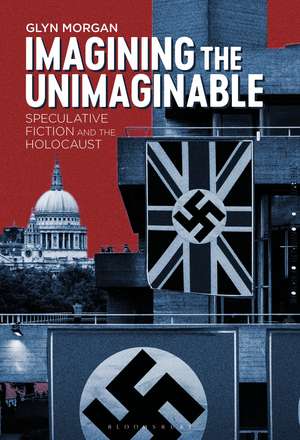
Imagining the Unimaginable: Speculative Fiction and the Holocaust
Autor Dr. Glyn Morganen Limba Engleză Paperback – 29 iul 2021
The conventional discourse around the Holocaust is one of the unapproachable, unknowable, and the unimaginable. The Holocaust has been compared to an earthquake, another planet, another universe, a void. It has been said to be beyond language, or else have its own incomprehensible language, beyond art, and beyond thought.
The 'othering' of the event has spurred the phenomenon of non-realist Holocaust literature, engaging with speculative fiction and its history of the uncanny, the grotesque, and the inhuman. This book examines the most common forms of nonmimetic Holocaust fiction, the dystopia and the alternate history, while firmly positioning these forms within a broader pattern of non-realist engagements with the Holocaust.
Preț: 234.30 lei
Preț vechi: 321.63 lei
-27%
Puncte Express: 351
Carte tipărită la comandă
Livrare economică 24 noiembrie-08 decembrie
Livrare prin curier în România Termenul estimat este afișat lângă disponibilitate.
Transport gratuit de la 400.00 lei Plată online sau ramburs, în funcție de opțiunile comenzii.
Retur gratuit în 14 zile Comandă securizată și suport în română.
Specificații
ISBN-13: 9781501373152
ISBN-10: 1501373153
Pagini: 222
Dimensiuni: 152 x 229 x 17 mm
Greutate: 0.31 kg
Editura: Bloomsbury Publishing
Colecția Bloomsbury Academic
Locul publicării:New York, United States
ISBN-10: 1501373153
Pagini: 222
Dimensiuni: 152 x 229 x 17 mm
Greutate: 0.31 kg
Editura: Bloomsbury Publishing
Colecția Bloomsbury Academic
Locul publicării:New York, United States
Cuprins
Acknowledgments
Introduction: Fictionalising the Holocaust
1. Precursors and Early Texts: Swastika Night (1937) and the Myth of Silence
2. Problematizing History: The Man in the High Castle (1962), Fatherland (1992), and Making History (1996)
3. The Damned and the Saved: The Boys from Brazil (1976), The Portage to San Cristobal of A.H. (1981), Hope: A Tragedy (2012), and The Yiddish Policeman's Union (2007)
4. Reimagining Horror: The Plot Against America (2004), Farthing (2006), A Man Lies Dreaming (2014), and J (2014)
Epilogue: Further Fabulation
Notes
Bibliography
Index
Introduction: Fictionalising the Holocaust
1. Precursors and Early Texts: Swastika Night (1937) and the Myth of Silence
2. Problematizing History: The Man in the High Castle (1962), Fatherland (1992), and Making History (1996)
3. The Damned and the Saved: The Boys from Brazil (1976), The Portage to San Cristobal of A.H. (1981), Hope: A Tragedy (2012), and The Yiddish Policeman's Union (2007)
4. Reimagining Horror: The Plot Against America (2004), Farthing (2006), A Man Lies Dreaming (2014), and J (2014)
Epilogue: Further Fabulation
Notes
Bibliography
Index
Recenzii
Morgan's remarkable achievement with Imagining the Unimaginable has been to show that SF Holocaust fiction is not only a real possibility, but a rich subgenre of speculative literature ... a valuable project indeed: the Holocaust is an event that demands repeated evaluation and attempts to make sense of it.
A thorough and well-written work of scholarship that turns the myth of silence into a resounding yell and should be a core text for courses that teach SF ... If the Holocaust is impossible to understand except through direct experience, Morgan's book is a timely intervention to remind us that, not only should it be understood in this post-survivor age, but we have a readily available library of texts to set us on the proper path.
Readers will find this a thoughtful work, full of valuable insights about the texts discussed and a stimulus for thinking about how valuable the tools of science fiction are for imagining the unimaginable.
This is a compact and useful volume that will be of interest to anyone interested in the complexities of Holocaust fiction.
At once theoretically sophisticated and readable, Glyn Morgan's study makes a notable contribution to the field of Holocaust literature by showing how Anglo-American speculative fiction - a genre encompassing science fiction, fantasy, and alternate history - has reflected, as well as shaped, the evolving memory of the Holocaust.
Expanding the canon and extending the debate about representation, this thoughtful, wide-ranging and critically-aware book charts new territory in our understanding both of the Holocaust and of speculative fiction.
A thorough and well-written work of scholarship that turns the myth of silence into a resounding yell and should be a core text for courses that teach SF ... If the Holocaust is impossible to understand except through direct experience, Morgan's book is a timely intervention to remind us that, not only should it be understood in this post-survivor age, but we have a readily available library of texts to set us on the proper path.
Readers will find this a thoughtful work, full of valuable insights about the texts discussed and a stimulus for thinking about how valuable the tools of science fiction are for imagining the unimaginable.
This is a compact and useful volume that will be of interest to anyone interested in the complexities of Holocaust fiction.
At once theoretically sophisticated and readable, Glyn Morgan's study makes a notable contribution to the field of Holocaust literature by showing how Anglo-American speculative fiction - a genre encompassing science fiction, fantasy, and alternate history - has reflected, as well as shaped, the evolving memory of the Holocaust.
Expanding the canon and extending the debate about representation, this thoughtful, wide-ranging and critically-aware book charts new territory in our understanding both of the Holocaust and of speculative fiction.